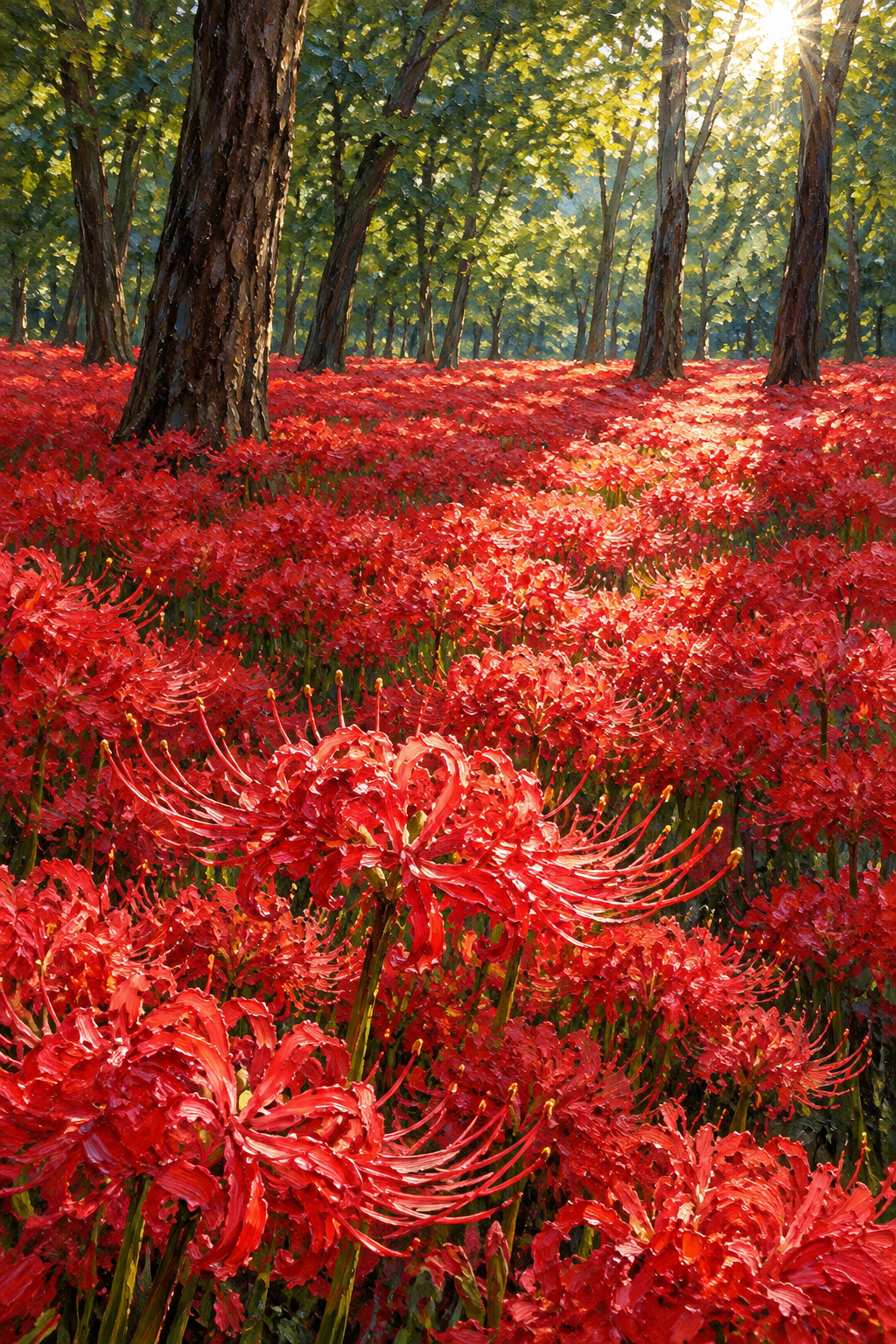
Light Goes Where There Is No Path
Critique
Introduction Red spider lilies fill a gently undulating woodland floor beneath tall dark trunks. Sunlight enters at the upper right and spreads across a central band of flowers. The painting balances the near blossoms' forms with a more open arrangement of trees, making light a route inward. Description A thick trunk rises left of center, with smaller slanting trunks behind it. Several large red flower heads occupy the lower foreground, their long stamens ending in pale yellow points. Beyond them, flowers form low continuous mounds. Green foliage overhead is flecked with yellow light, and bright rays fall through a clear opening near the top right. Analysis The strong near trunk divides the upper area without closing the central view. The sunlit flower band curves from right toward the middle, giving depth to the otherwise continuous red field. Dark stems and ground shadows separate neighboring clusters. Larger curved petal strokes below gradually resolve into smaller marks, while the trees retain distinct intervals throughout the recession. Interpretation and Evaluation The light behaves like an invitation across terrain that has no visible footpath. The viewer follows illumination instead of a constructed route. The work is effective in using intensity selectively: some red flowers glow almost orange, while shaded areas remain deep crimson, so abundance becomes a sequence of different conditions rather than a single unmodulated color. Conclusion The foreground stamens first encourage close looking, but the brighter middle ground gradually draws attention beyond them. The trees' varied angles preserve rhythm around that movement. The painting gives a dense floral floor a readable topography, showing how small changes in brightness and mark size can make an apparently continuous surface feel spatially differentiated.
Same Subcategory
 Harvest Cart at Sundown
Similar Artworks
 Even the Sunbeams Turn Crimson
 Crimson at the Heart of Stillness
 Waiting Just Beyond This Trunk
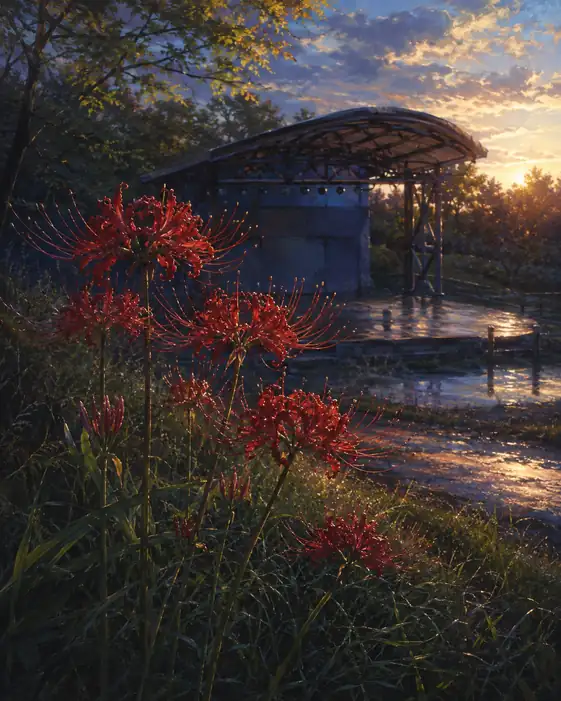 Madder Outdoor Stage and Twilight Lycoris
 The Crimson Tapestry of the Deep Woods
 Abyss of Memory: A Crimson Flickering Dream
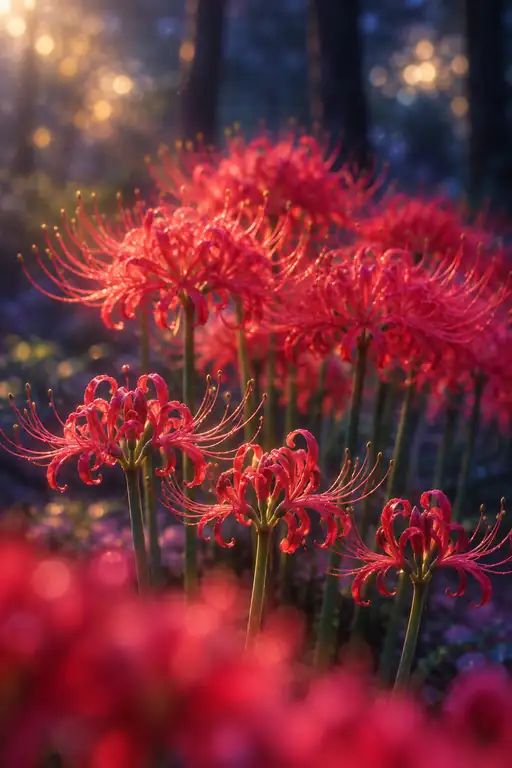 Our Secret Place in the Woods
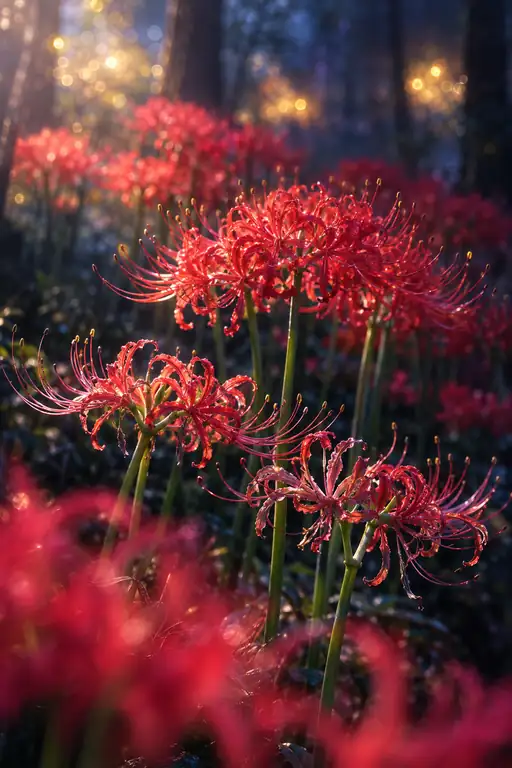 The Forest Opens a Window
 White, and a Little Closer to the Sky
 Even the Long Way Is in Bloom