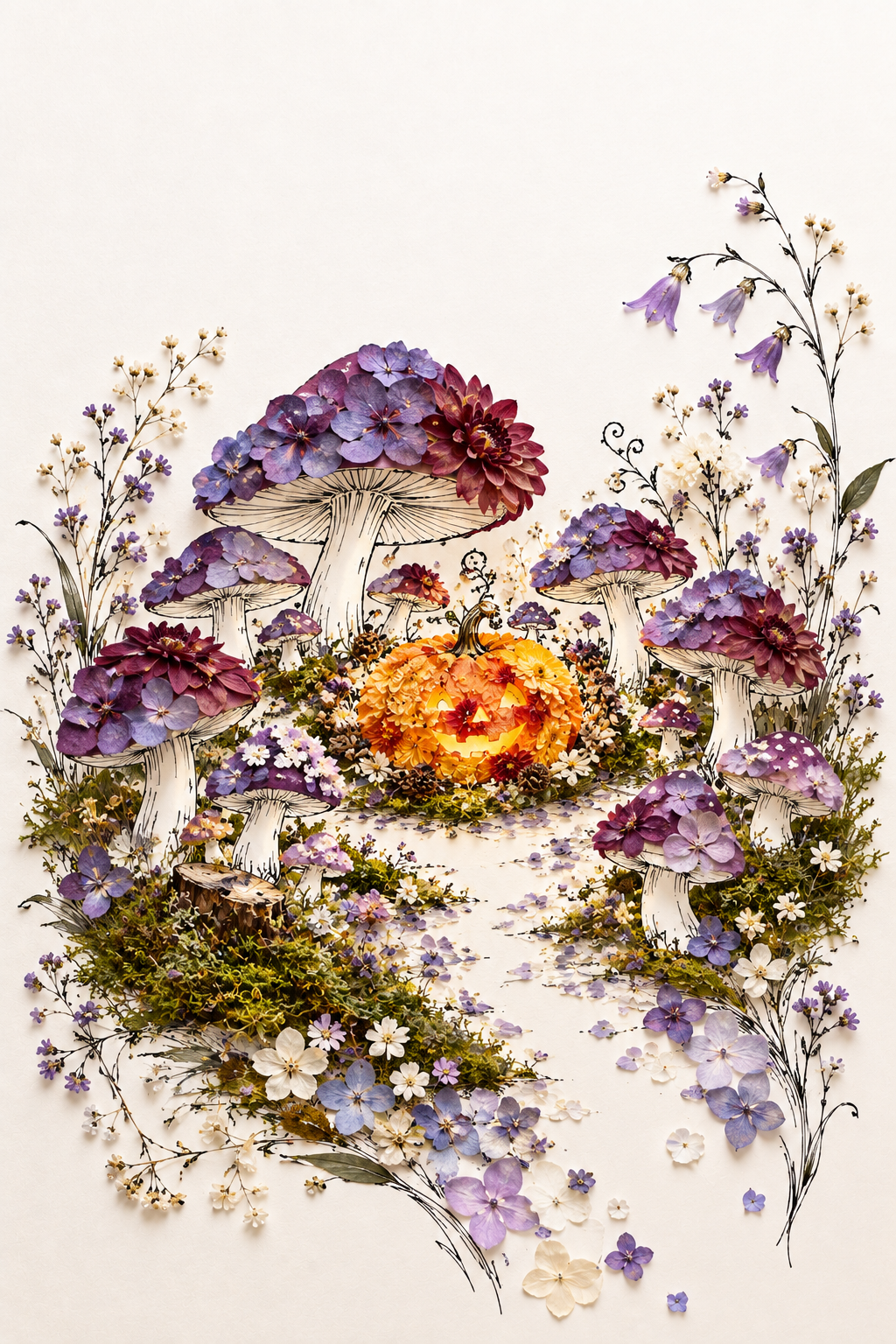
The Lantern at the End of the Little Path
Critique
1. Introduction A glowing pumpkin rests among mushrooms capped with violet flowers. Moss and small blossoms make a miniature woodland. Central light gives the open setting a sheltered heart. 2. Description Mushrooms rise beside a narrow path. Pale stems and gills are drawn in black lines; caps carry purple and burgundy petals. Smaller mushrooms stand farther back. A carved pumpkin glows at the center. Moss, white daisies, purple florets, and scattered petals cover the ground. Bell shaped flowers rise at the edges. Beyond this low world, the background remains white. 3. Analysis The largest mushrooms frame the pumpkin without closing it in. Caps at different heights establish depth, and the small path opens from the lower edge toward the light. Purple dominates the upper forms, while orange concentrates at the center. Fine ink gills separate the mushroom structure from the applied flower texture. The moss makes a dark base for the pale path and flowers. Tall outer stems give the compact cluster a loose, airy boundary. 4. Interpretation and Evaluation The pumpkin can be read as a little hearth or lantern inside an imagined forest. Its face adds friendliness to the unusual scale of the mushrooms. The image is most persuasive where the path, light, and surrounding caps work together: they invite entry into a small place rather than presenting a flat collection of pretty objects. The open background keeps that invitation gentle, without forcing an elaborate landscape. 5. Conclusion Floral mushroom caps and a central glow transform an autumn still life into a tiny destination. The path makes the viewer's imagined movement part of the scene.
Same Subcategory
Similar Artworks
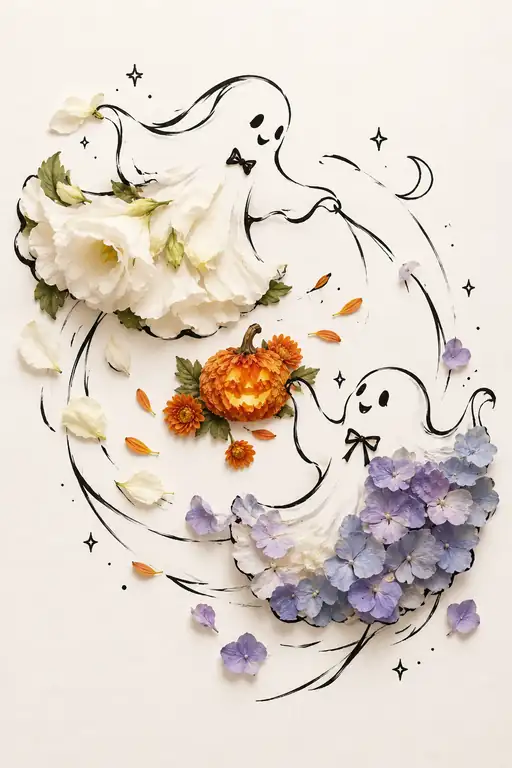 Around Our Little Light
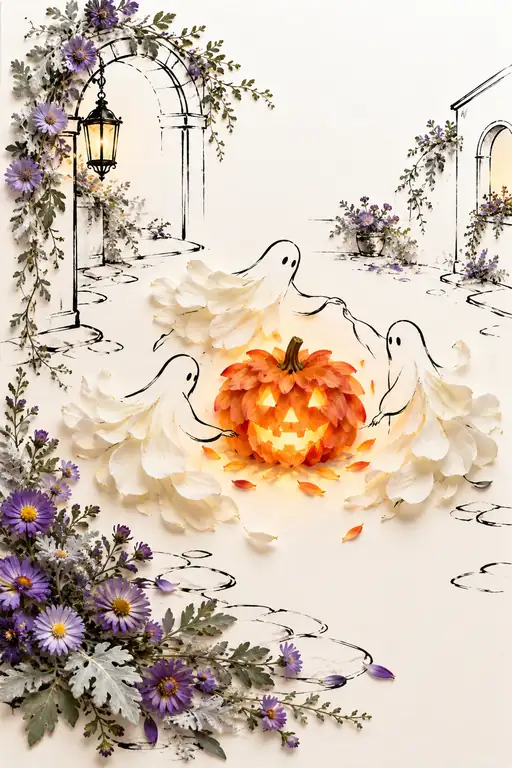 Room for One More in the Circle of Light
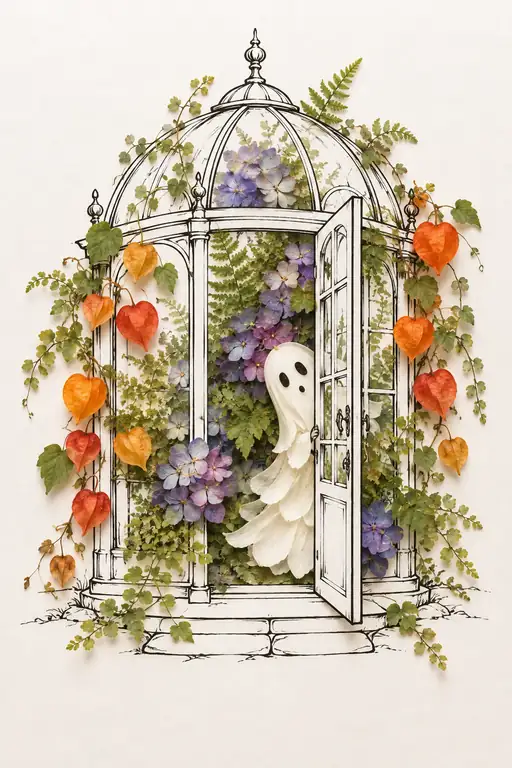 The Door Was Always Open
 Even Ghosts Need Someone to Hold
 How Much Does a Smile Weigh?
 Quiet Touch of Gentle Curiosity
 The Castle Where Autumn Keeps Its Dreams
 Following the Lantern Through Clouds
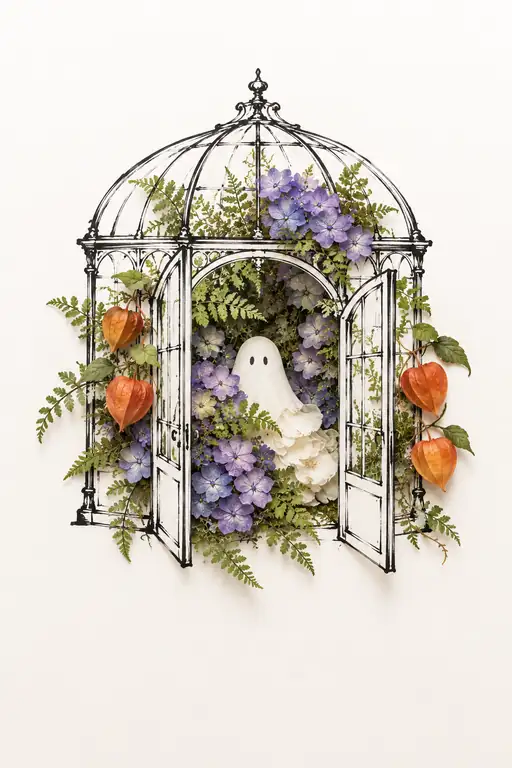 The Door Was Open All Along
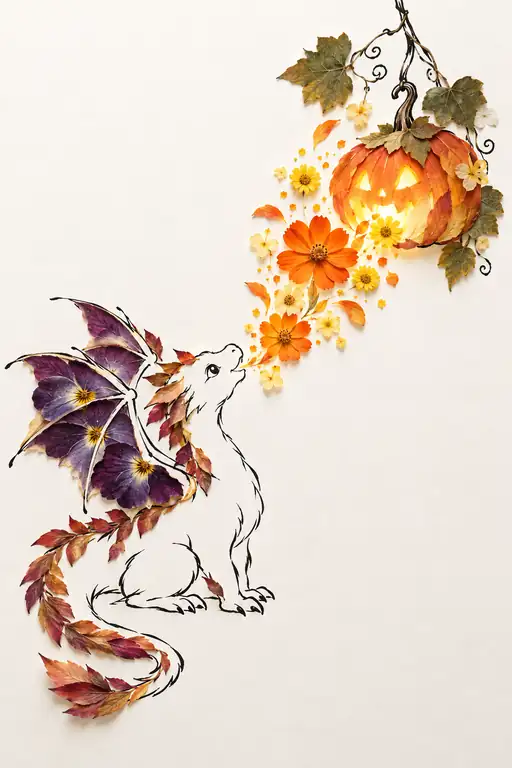 Tender Breath That Kindles Light