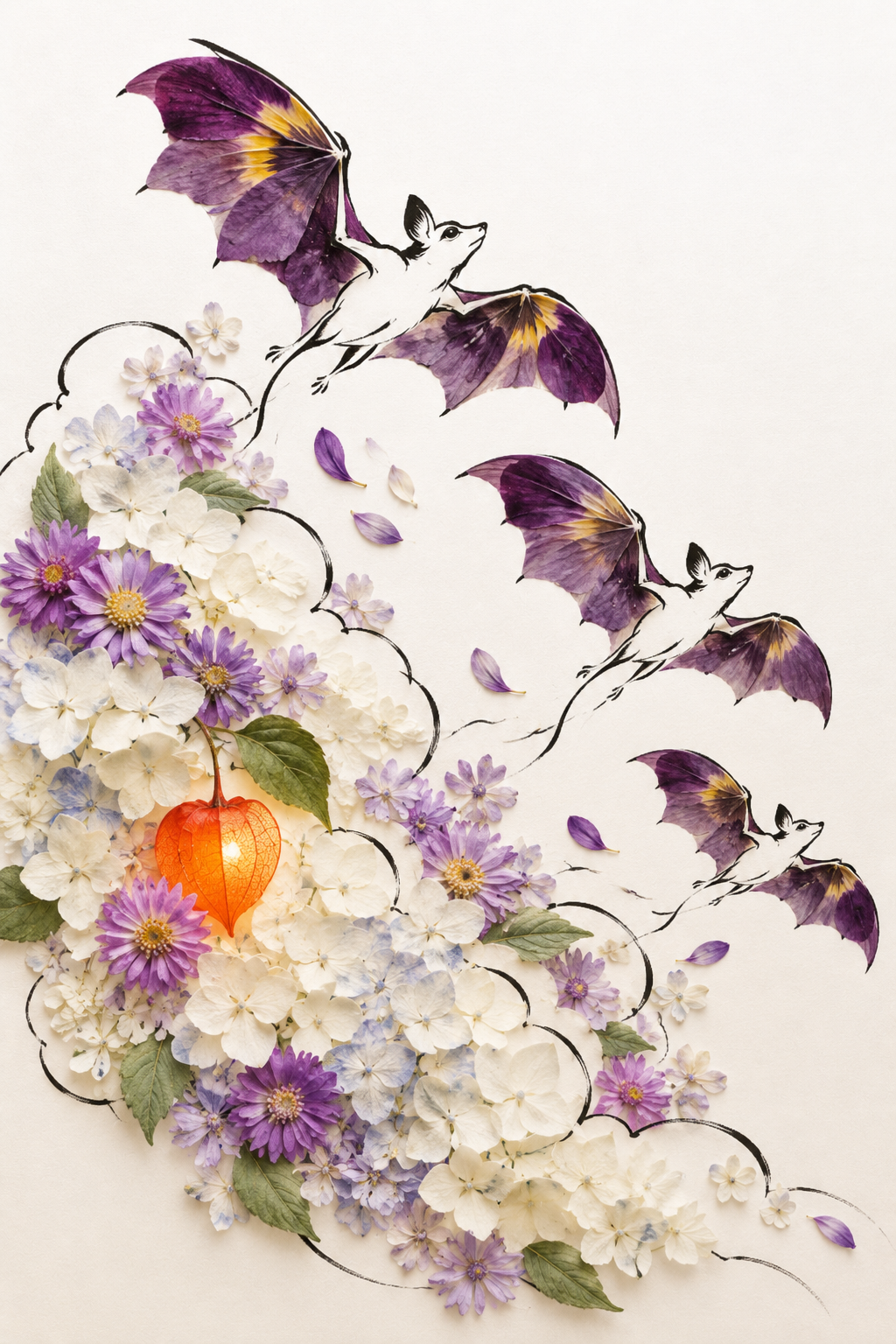
The Night Takes Wing
Critique
1. Introduction Three winged animals rise from white and violet flowers. Their bodies are spare drawings, while broad wings use deep purple petals marked with yellow. An orange lantern hangs below, giving the scene a warm point of light. 2. Description The largest creature flies upper left, another follows at mid right, and the smallest is farther down. Each has pointed ears, a narrow tail, and spread wings. The flower bank curves across the lower half, mixing pale blooms, violet daisies, and green leaves. Loose petals appear between the flowers and flying figures. 3. Analysis The animals form a rising diagonal that begins at the flower bank and extends toward the open upper field. Their changing scale gives depth and a rhythm of successive flight. The wings' purple masses contrast with the almost uncolored bodies, making motion legible at a glance. The lantern's orange glow interrupts the cool floral palette without overwhelming it. Curved black lines around the blossoms connect the flying forms to their point of departure. 4. Interpretation and Evaluation The scene suggests a departure from a richly furnished garden into open air. The repeated animals are similar, yet their positions and proportions create progression rather than a static pattern. Its composition makes purposeful use of empty space, and the color design controls the relation between cool flowers and warm light. The blend of drawn creatures with textured petals offers an inventive visual language. 5. Conclusion The flower mound first appears to be the subject, but the ascending figures turn it into a starting place. Their upward course and the lantern below give the image a clear sense of transition.
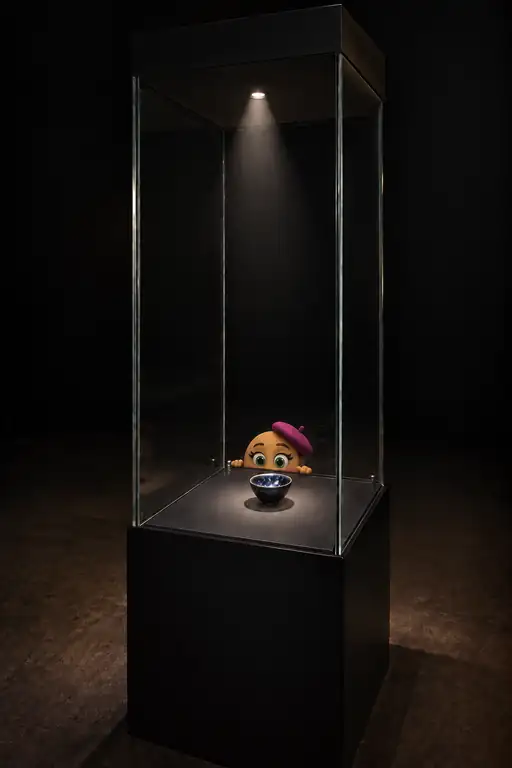 Let Me See Those Stars Too
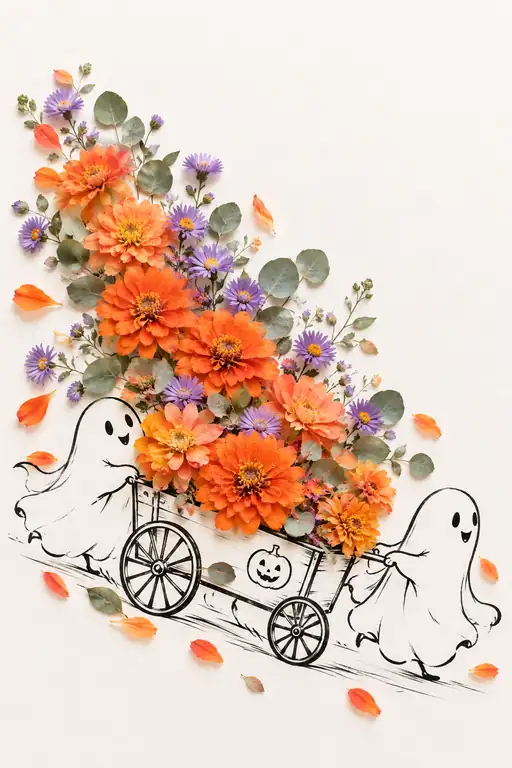 We Bring the Celebration
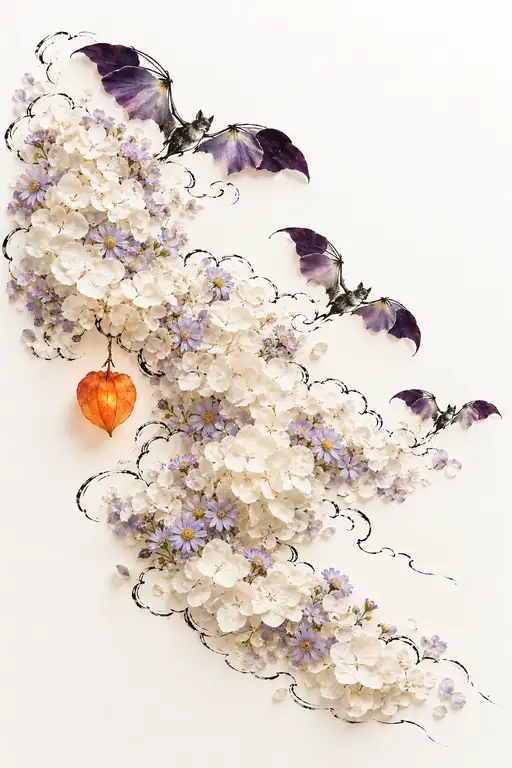 Following the Lantern Through Clouds
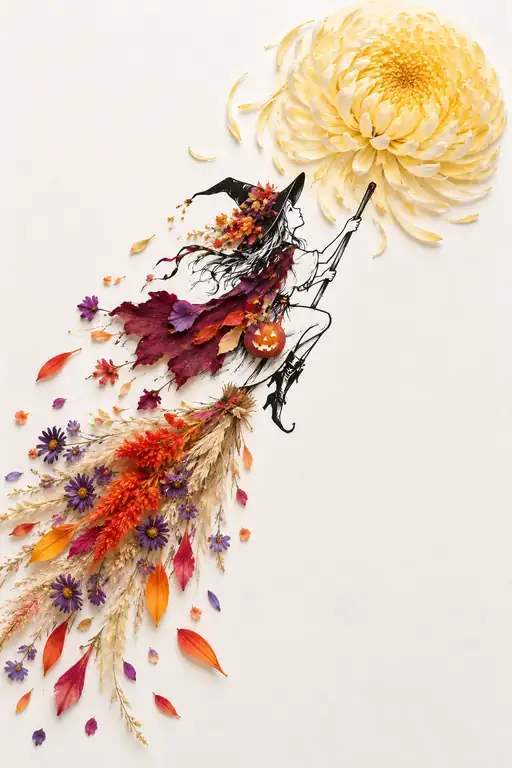 One Flight to That Distant Glow
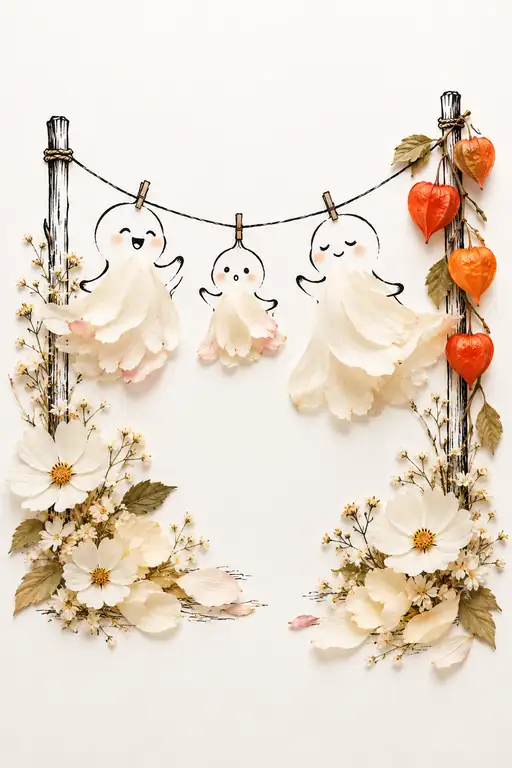 The Day We Hung Out Together
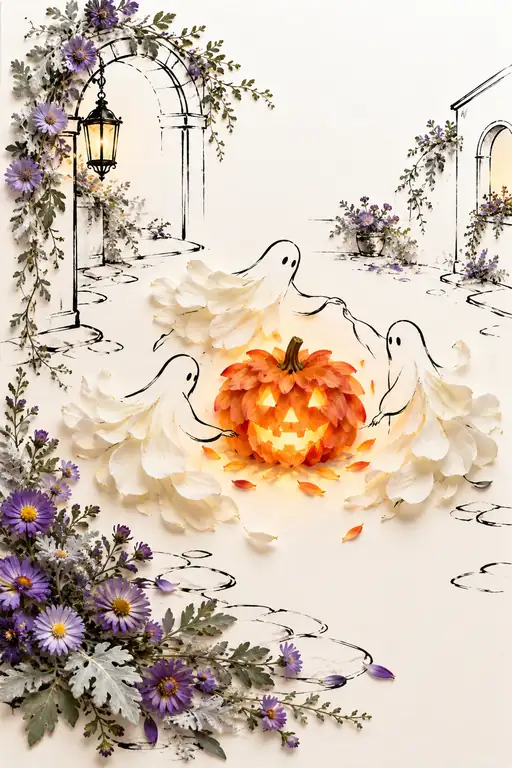 Room for One More in the Circle of Light
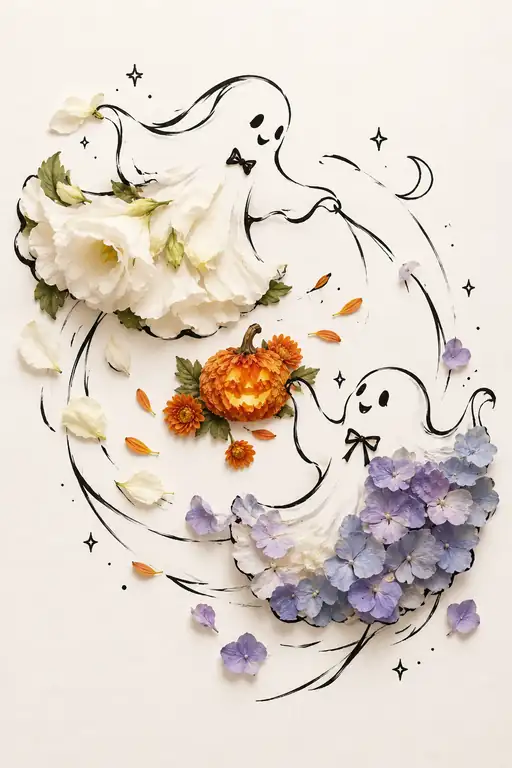 Around Our Little Light
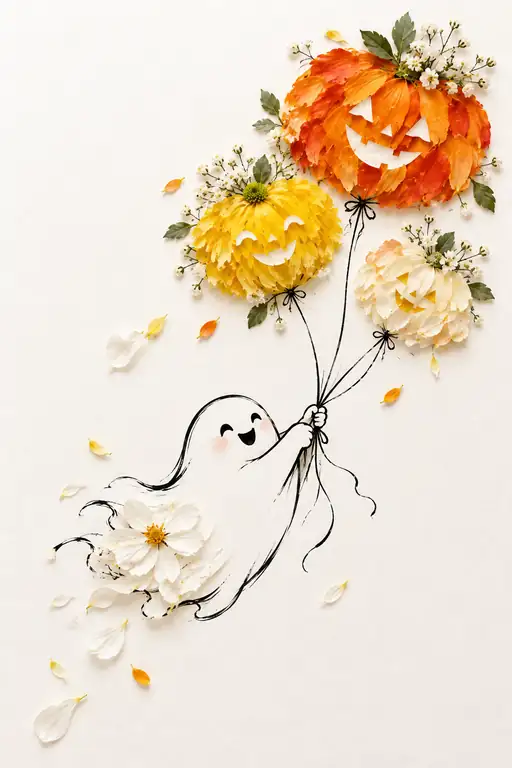 Floating with Gentle Lanterns
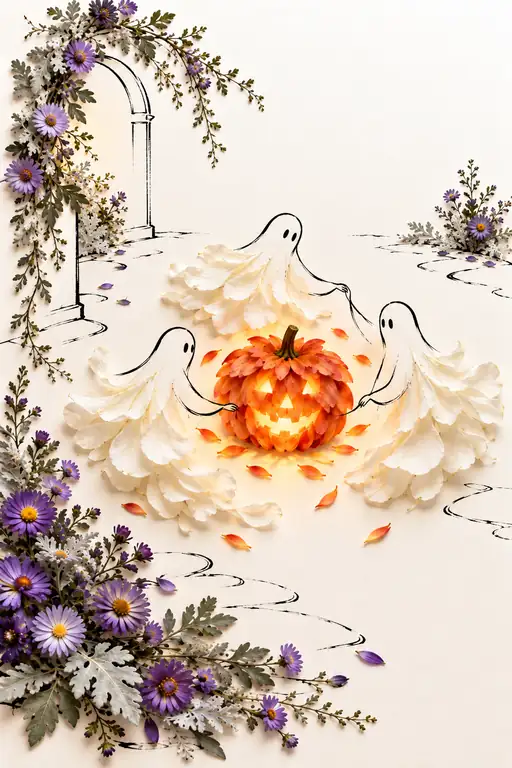 Gathering Around the Little Glow
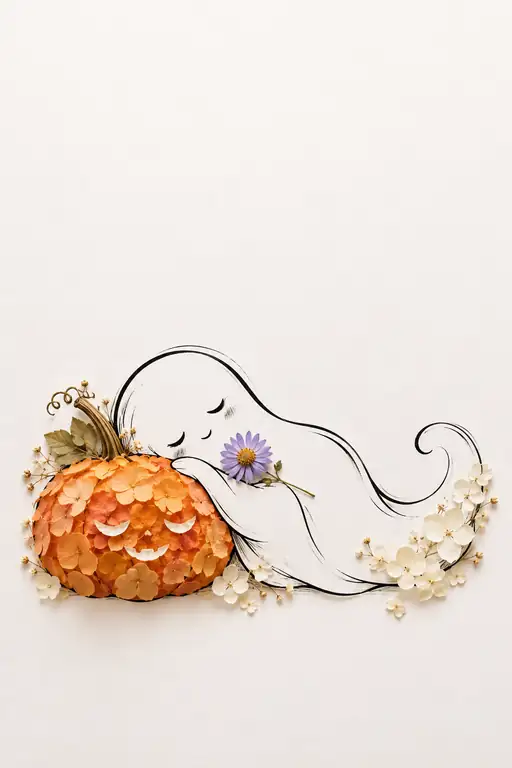 Even Ghosts Need Someone to Hold
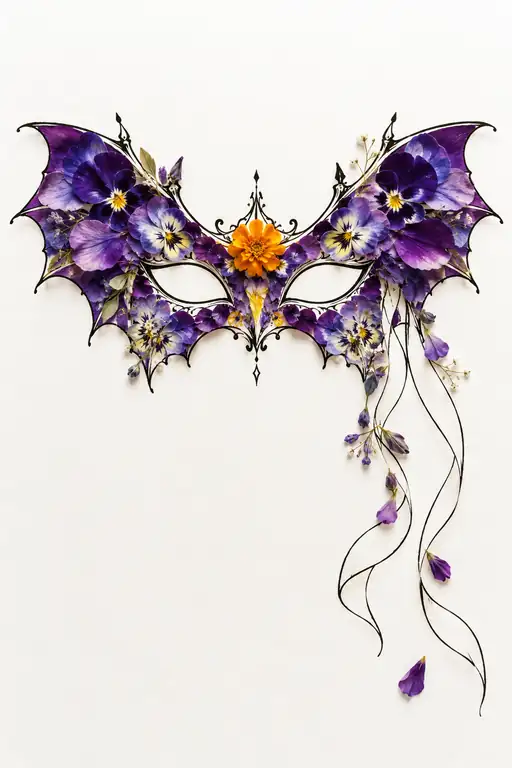 The Eyes I Leave Open
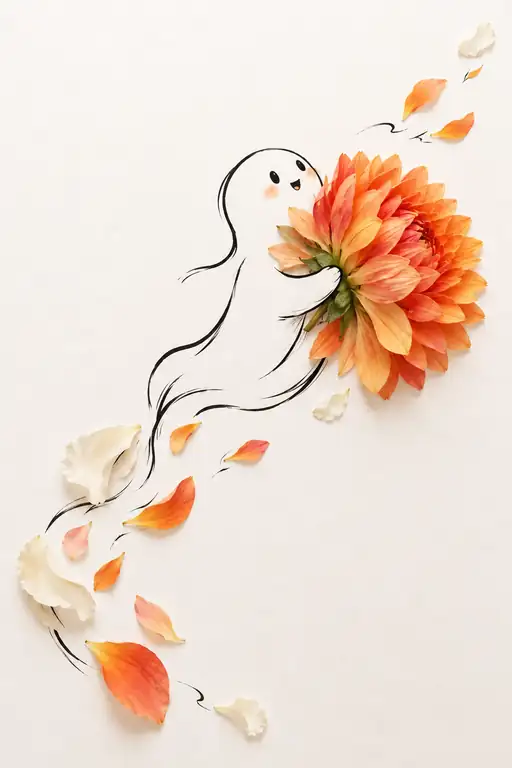 The Joy I Carry