The Story Learned to Float
Critique
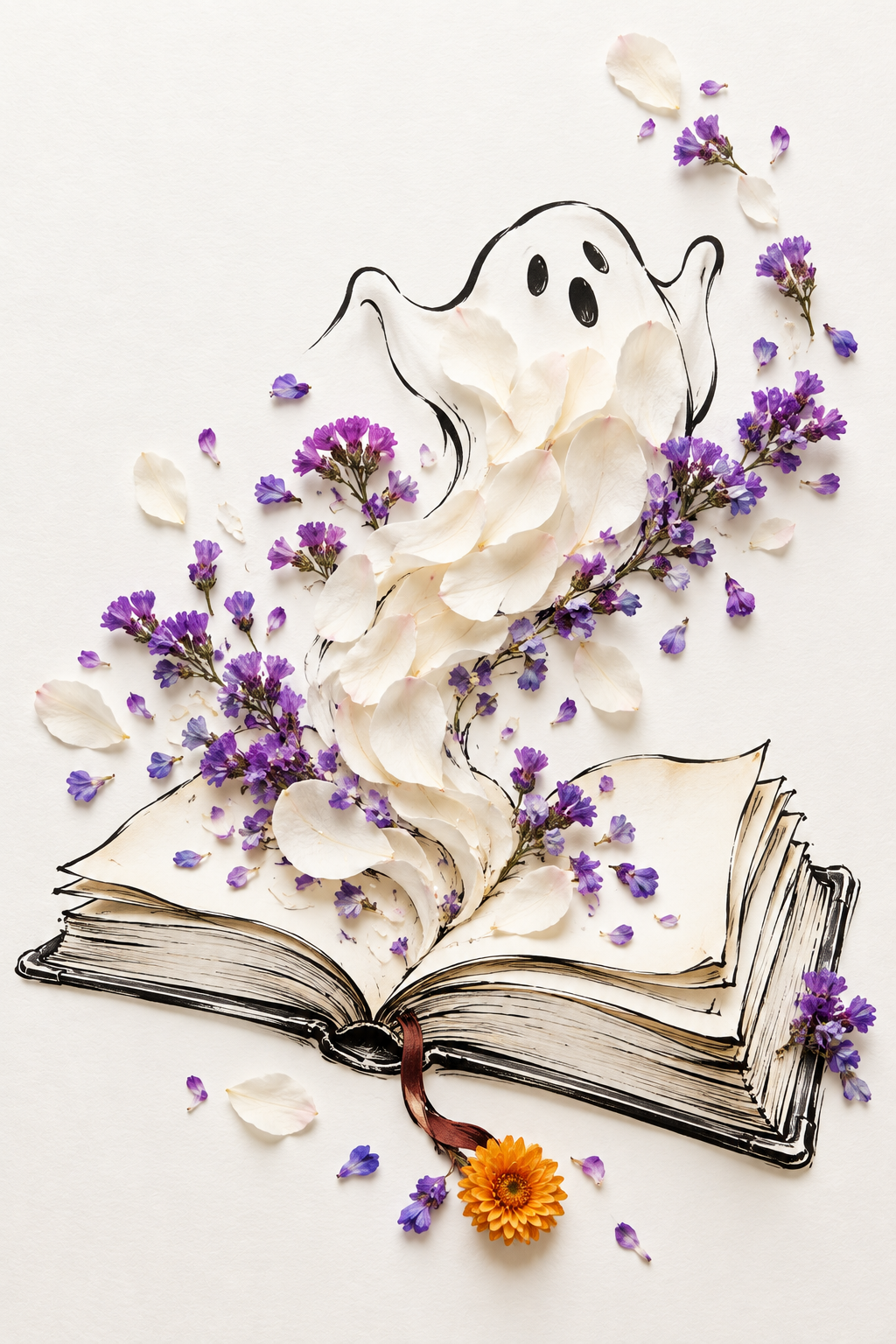
1. Introduction An open book releases a white ghost through a rising stream of pale petals and purple flowers. The book occupies the lower field, providing a base for a loosely constructed apparition above. The image gives imaginative emergence a material form while keeping the boundary between printed object and living growth visibly unstable. 2. Description Thick outlined pages curve upward on both sides of the binding. A brown ribbon falls from the central fold toward an orange flower below. White petals rise from the gutter in a twisting column, accompanied by branching violet blossoms; at the top, a black-outlined ghost raises its arms around three dark facial marks. 3. Analysis The book's horizontal spread anchors the vertical ascent. Repeated page edges correspond to layered petals, linking the stable lower object with the dispersing upper body. Purple branches flank the white column and separate it from pale paper, while the single orange accent below the binding gives a warm counterpoint without interrupting the upward route. 4. Interpretation and Evaluation The scene can be read as a story becoming present outside its pages. That reading is supported by the figure's emergence from the central fold, not by visible text. The transformation works because petals both resemble loose sheets and retain their botanical texture, allowing the image to connect reading, growth, and apparition without illustrating a specific tale. 5. Conclusion The ghost first offers a recognizable fantasy, but the book's layered edges become increasingly important on inspection. They establish the visual logic that makes emergence plausible. The composition successfully turns a conceptual act of imagination into an observable progression of surfaces, with scattered fragments keeping the process open beyond the central column.
Same Subcategory
 The Joy I Carry
 The Day We Hung Out Together
Similar Artworks
 Floating with Gentle Lanterns
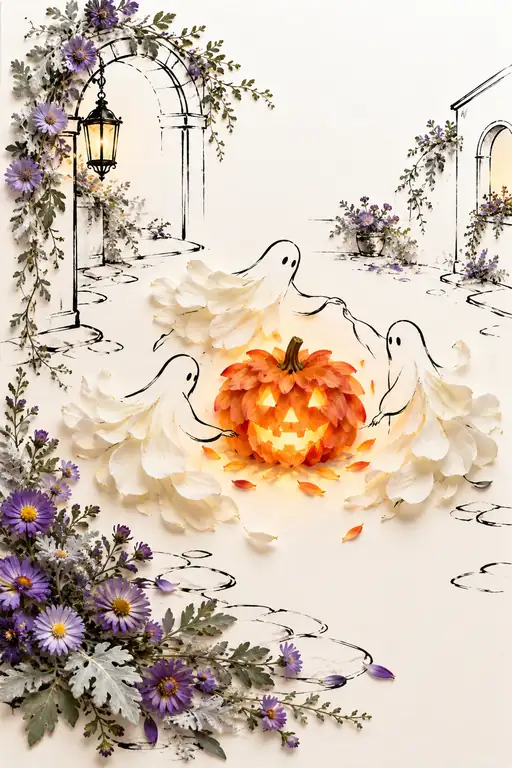 Room for One More in the Circle of Light
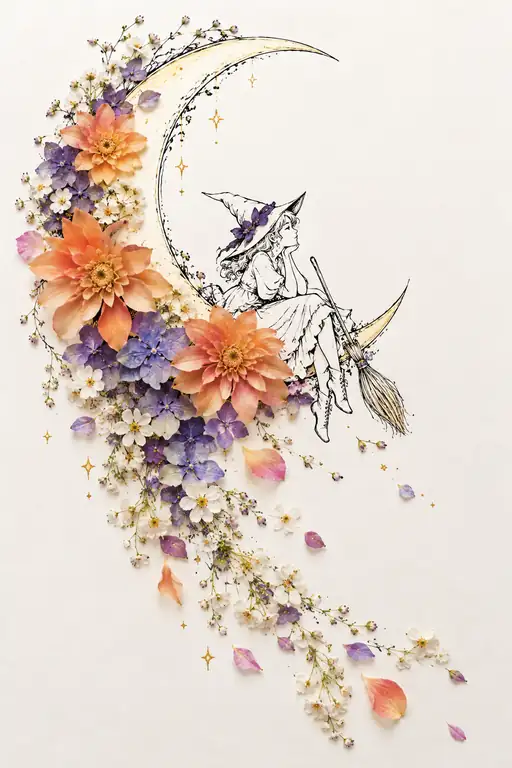 A Place to Rest Among Stars
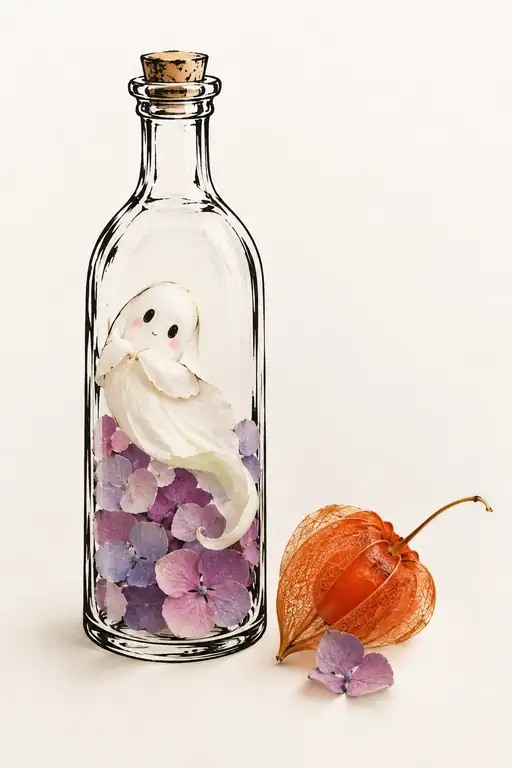 A Little World Under Cork
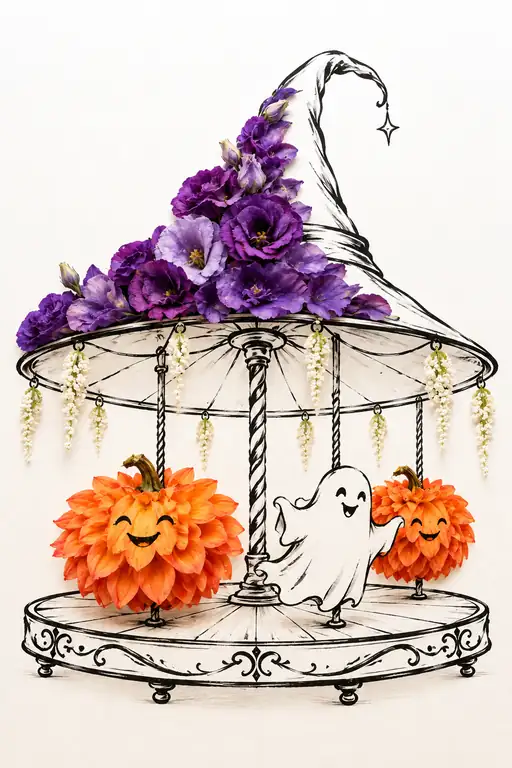 Merry Carousel of the Twilight Spell
 Next, It Is Your Turn to Smile
 Quiet Touch of Gentle Curiosity
 Gathering Around the Little Glow
 We Bring the Celebration
 High Spirits Take the Air