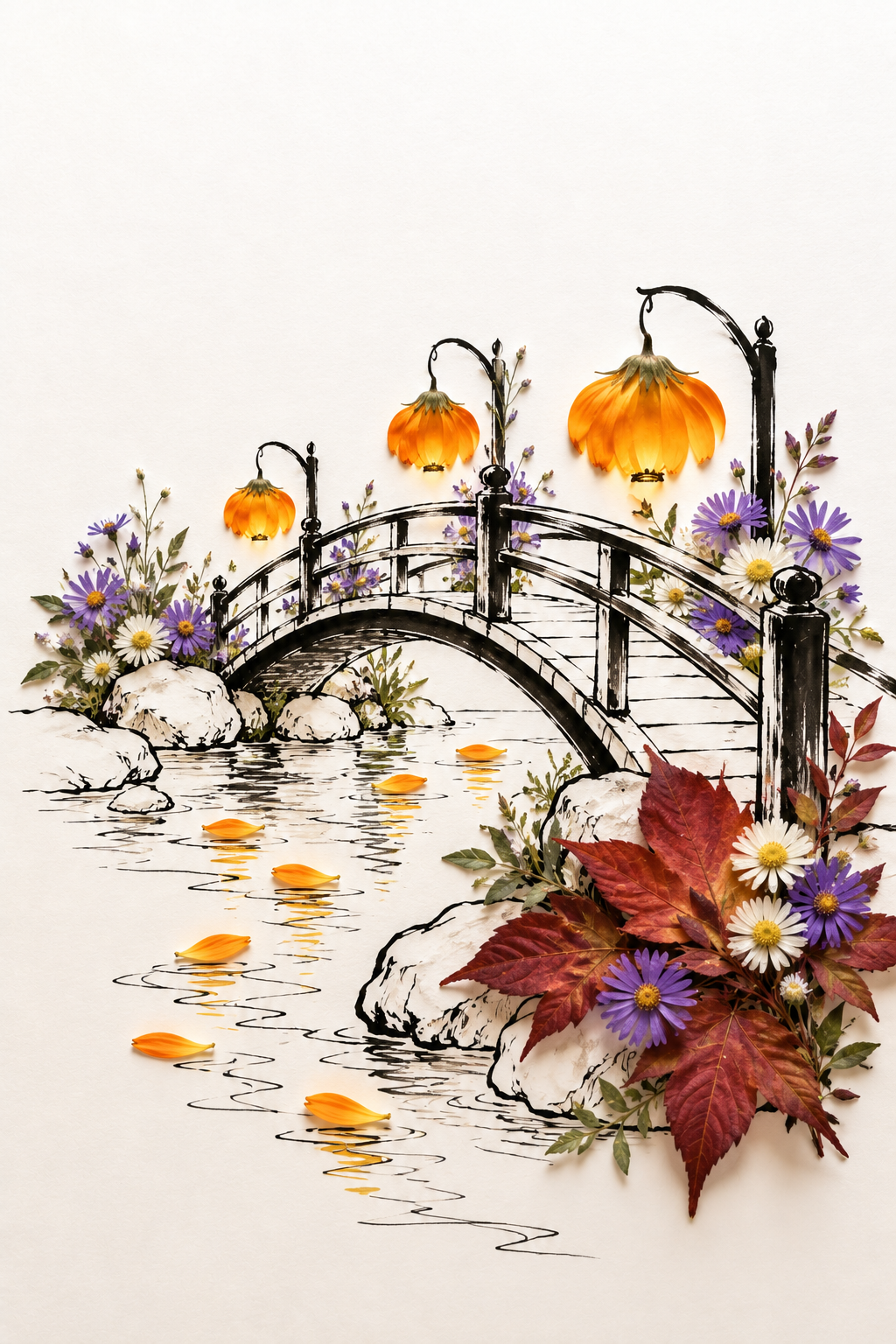
Where the Lanterns Meet the Water
Critique
1. Introduction An arched footbridge crosses a narrow stream beneath three orange flower-shaped lanterns. Purple and white blossoms line the banks, with large red leaves gathered at the near right. The work combines black linear architecture with botanical relief, creating a landscape whose illumination appears to grow from its own plant forms. 2. Description The bridge rises from the lower right toward the left bank, supported by dark posts and curved rails. Three lamps diminish in size as they recede, their shades formed from downward-facing orange petals. Loose orange fragments float on the pale stream among drawn ripples, and small rocks define both banks. 3. Analysis The bridge's arc establishes the main spatial crossing, while repeated lamp sizes measure depth above it. The largest foreground leaves create a near screen that contrasts with finer plants beyond. Orange reflections repeat beneath the floating petals, connecting material objects to the drawn water and giving the otherwise white stream a readable surface. 4. Interpretation and Evaluation The flower lamps turn illumination into an organic property of the setting. This invention is sustained by consistent placement, scale, and reflections rather than by decorative novelty alone. The numerous flowers could compete with the crossing, but the strong black rails maintain the bridge's structural role and keep the stream open as a distinct visual route. 5. Conclusion The viewer first notices the unusual lamps, then follows their sequence across the bridge and down to the water. Floating petals provide a slower second movement beneath the architectural arc. The image succeeds in coordinating growth, light, and passage through repeated forms while preserving clear differences between solid structure and flowing surface.
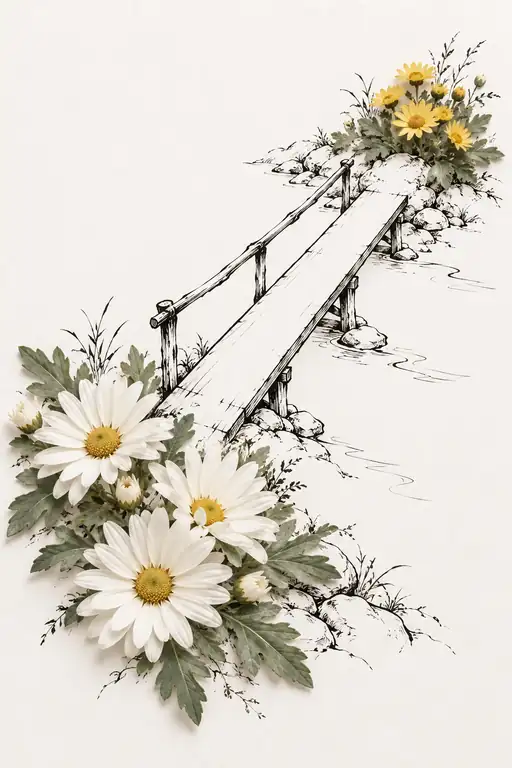 Across the Quiet Between Us
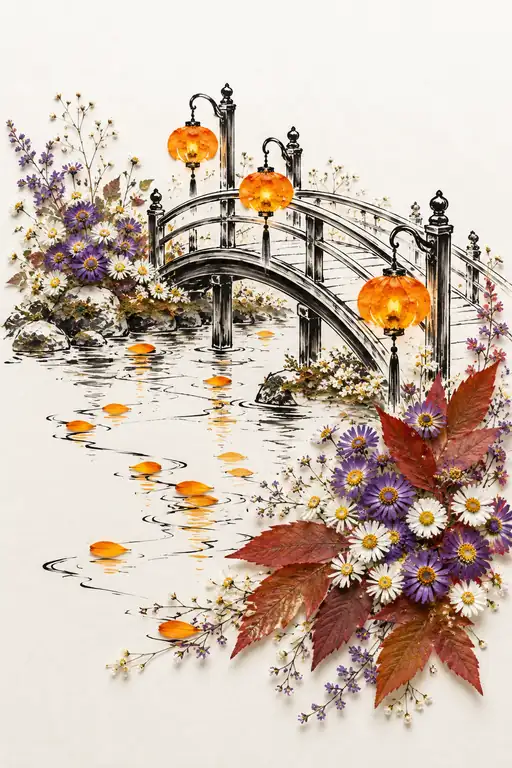 Following the Light Across
 I Saved You a Seat
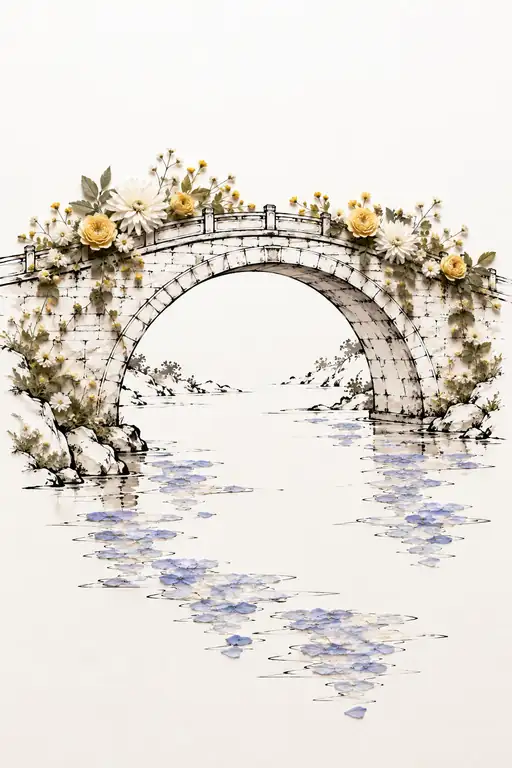 A Crossing Worth the Pause
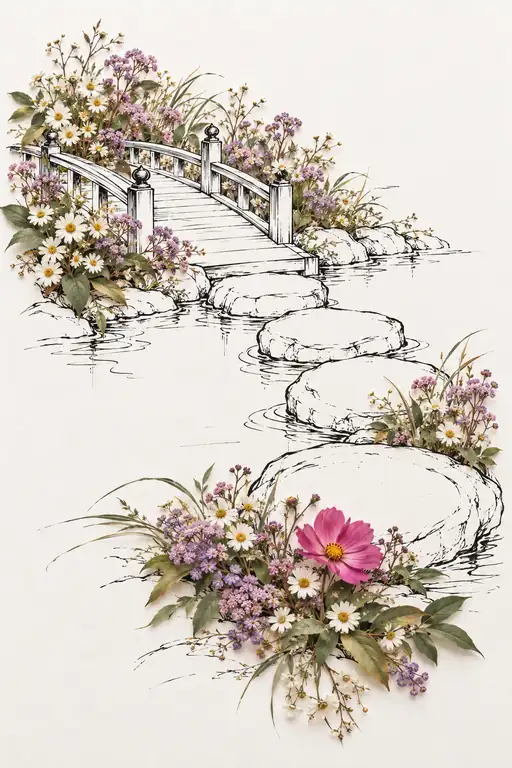 Let Each Step Take Its Time
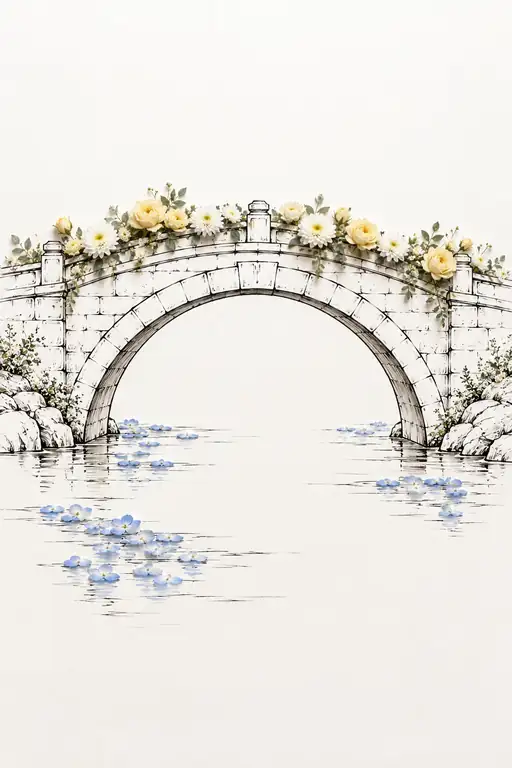 There Is Ease in Crossing Over
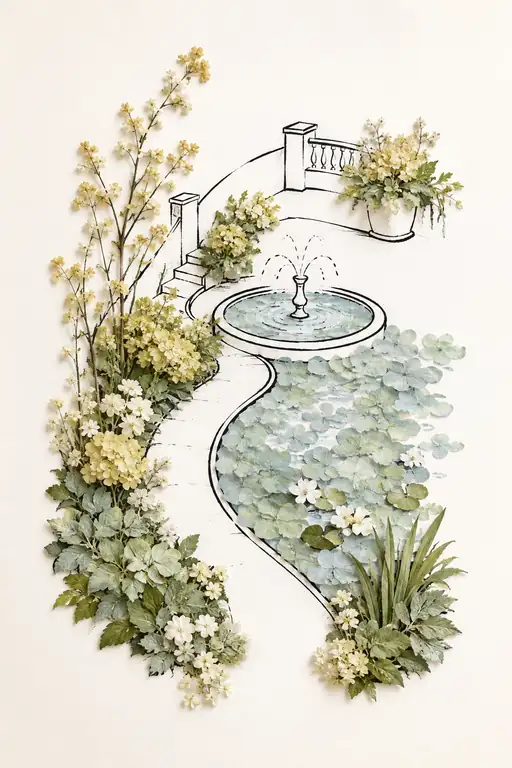 Serenade of the Garden Fountain
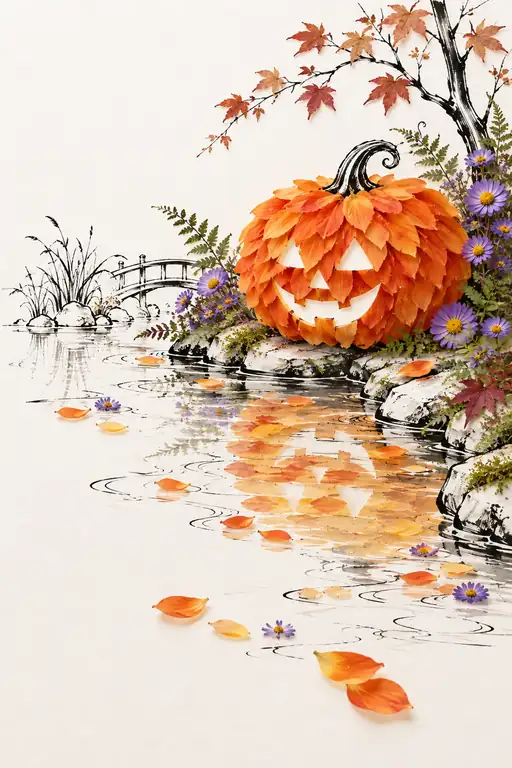 Autumn Smile Rippling upon the Water
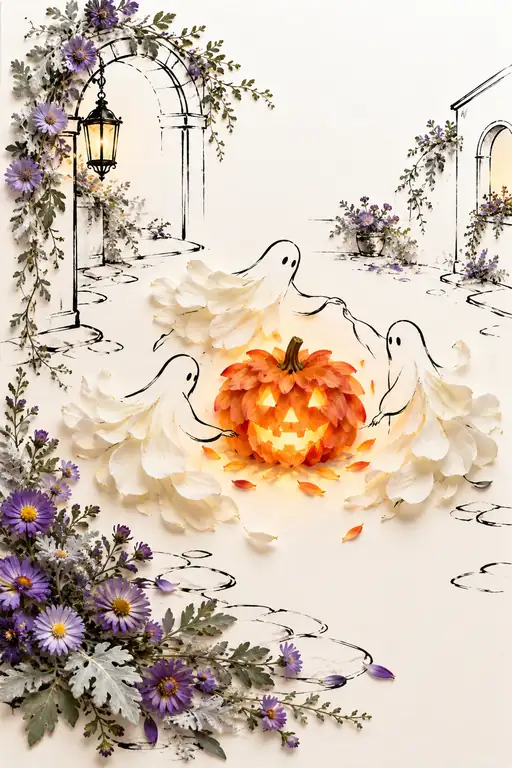 Room for One More in the Circle of Light
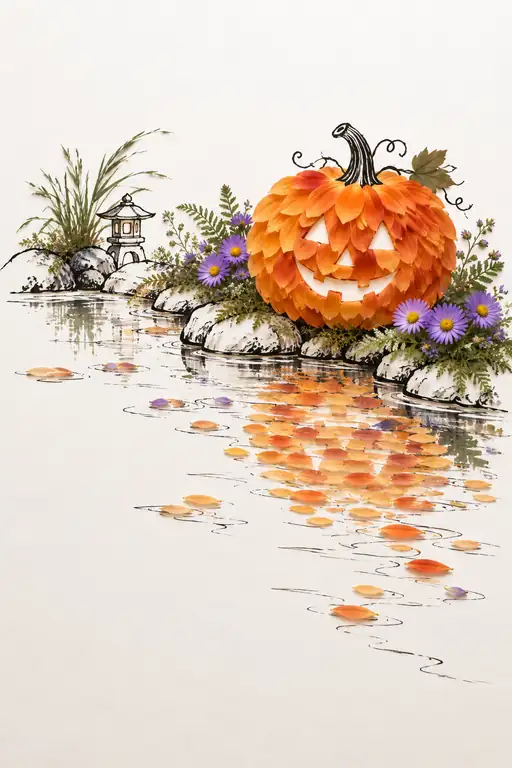 The Pond Holds a Second Smile
 Home Before the Spell Fades