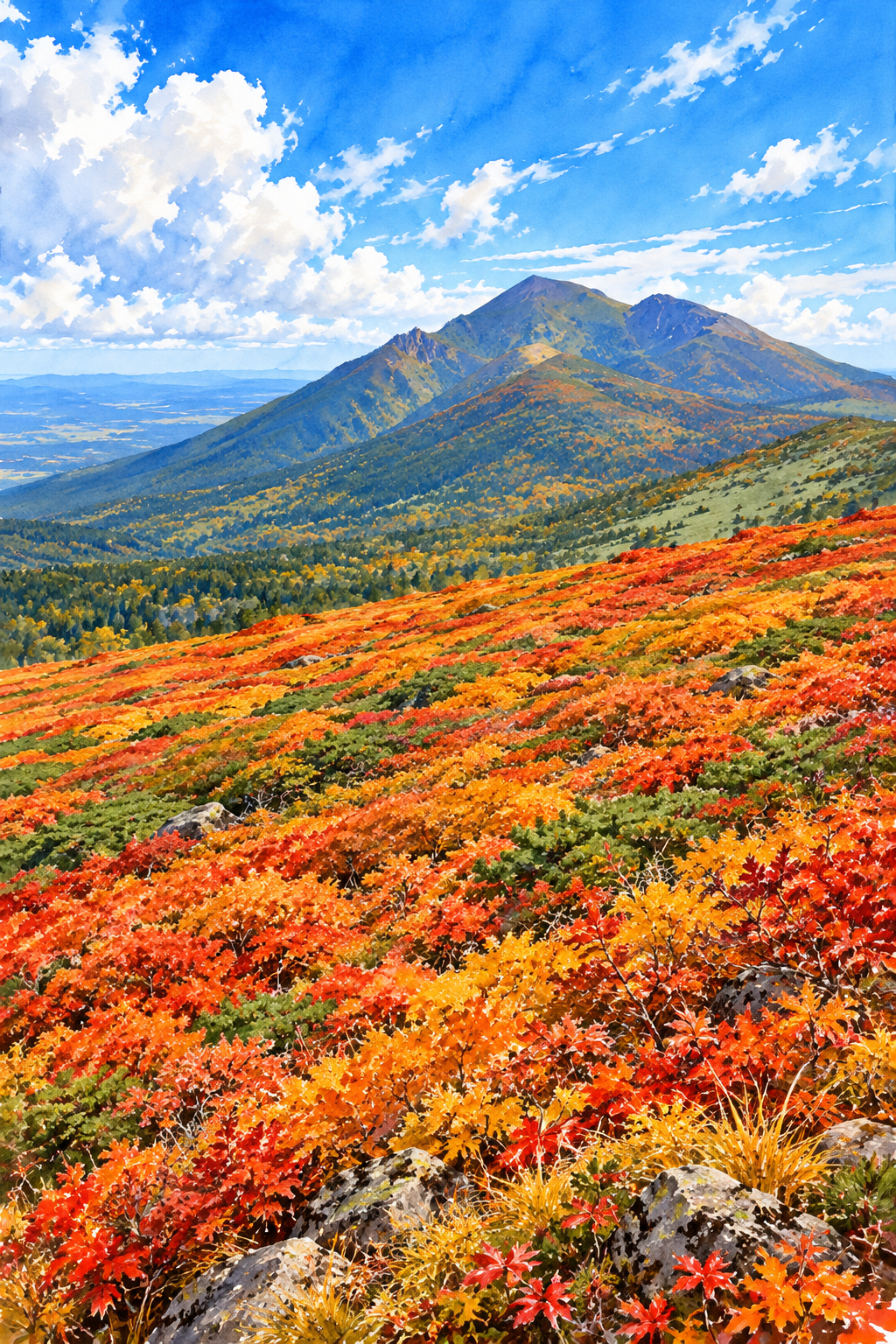
Autumn Opens to the Sky
Critique
Introduction A wide mountain rises beneath a bright blue sky, above a slope striped with orange, red, and green vegetation. The image gives substantial space to both sky and foreground, making the distant summit a connecting element rather than an isolated focal object. Crisp clouds and finely broken foliage create a luminous watercolor-like surface. Description Large gray rocks and golden grass tufts occupy the lower edge. Beyond them, low red shrubs alternate with green patches in bands that rise toward the right. A wooded valley separates this foreground from the mountain's broad blue-green flanks. A large cumulus formation fills the upper left, while thin white cloud streaks cross the open right sky. Analysis The slope's diagonal bands contrast with the mountain's more stable triangular profile. Fine foreground marks gradually compress into the distant forest, establishing scale through texture. The blue sky repeats cooler tones within the mountain, while the orange hillside supplies a contrasting lower field. Differently shaped clouds keep the broad sky active without overwhelming the terrain. Interpretation and Evaluation The scene emphasizes open visibility and the distribution of autumn color across a large landform. Its strength is the coordination of several spatial scales, from individual grass blades to distant ridges. The absence of a dominant foreground branch allows the eye to travel laterally across the slope, supporting a more panoramic experience within the vertical format. Conclusion The first impression of saturated color develops into appreciation of broad, connected surfaces. Foreground rocks establish proximity, the wooded valley supplies depth, and the summit organizes the transition to sky. Controlled texture changes and complementary color fields allow the composition to remain spacious despite its densely described autumn vegetation.
Same Subcategory
Similar Artworks
 From This Red to the Far Peaks
 The Distance Filled with Light
 Autumn Beneath a Troubled Light
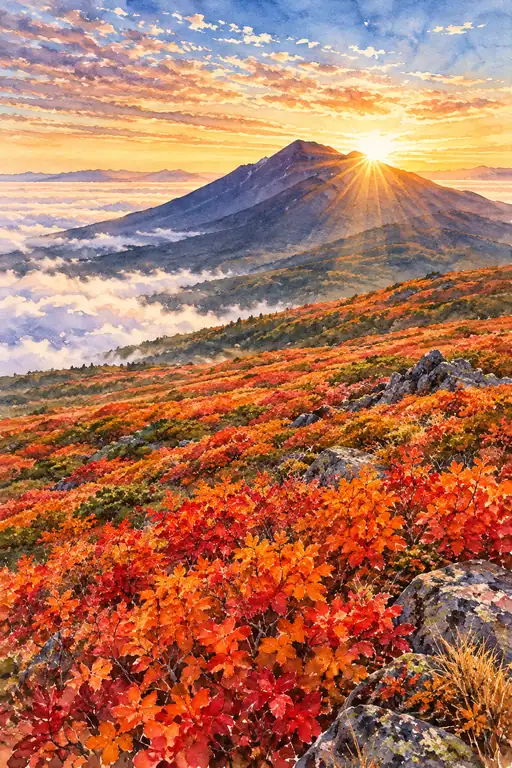 Golden Threads Across the Mountain
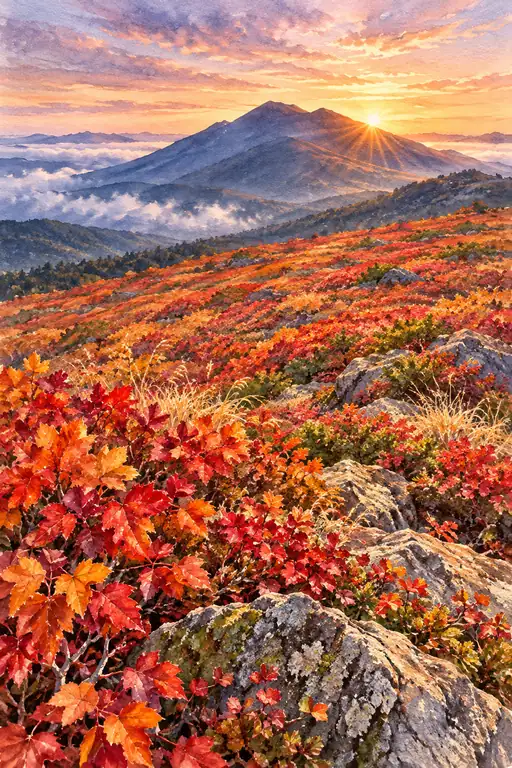 Where Light Touches Stone
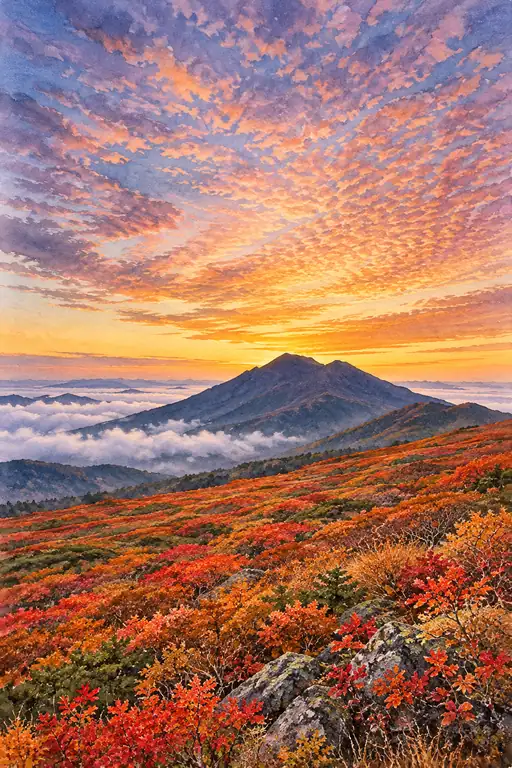 A Thousand Quiet Afterglows
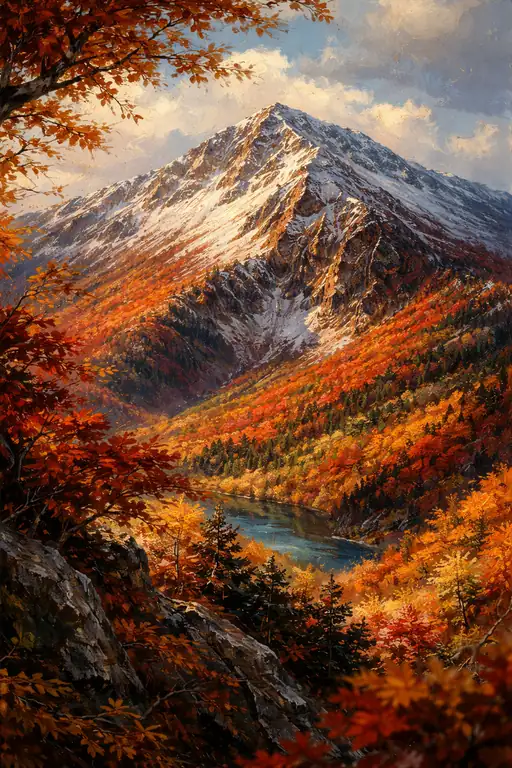 Autumn's Embrace Beneath the Frozen Peak
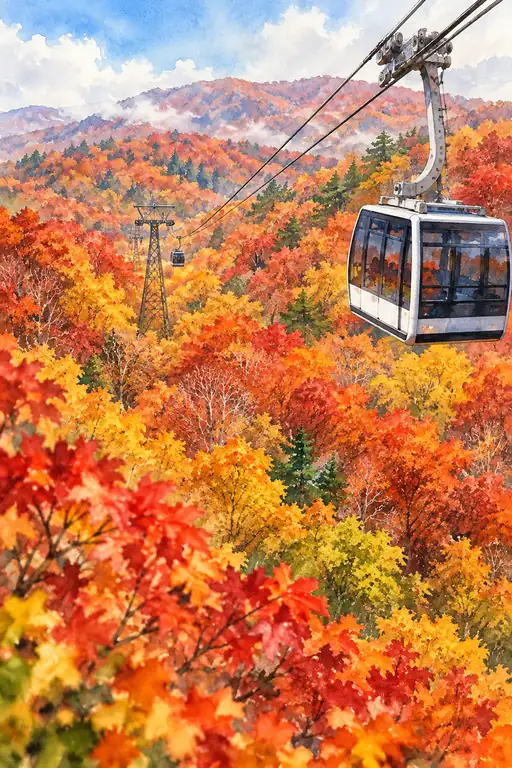 The Mountain Enters Our Window
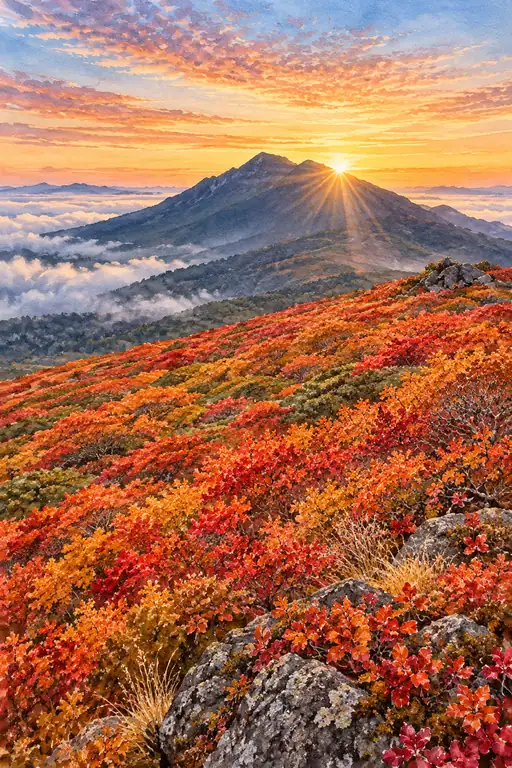 The Ridge Receives the Light
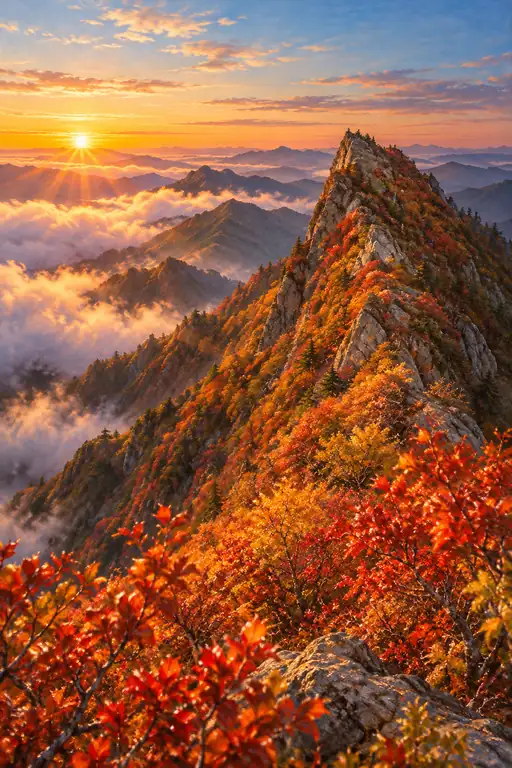 Golden Ridge Above the Sea of Clouds