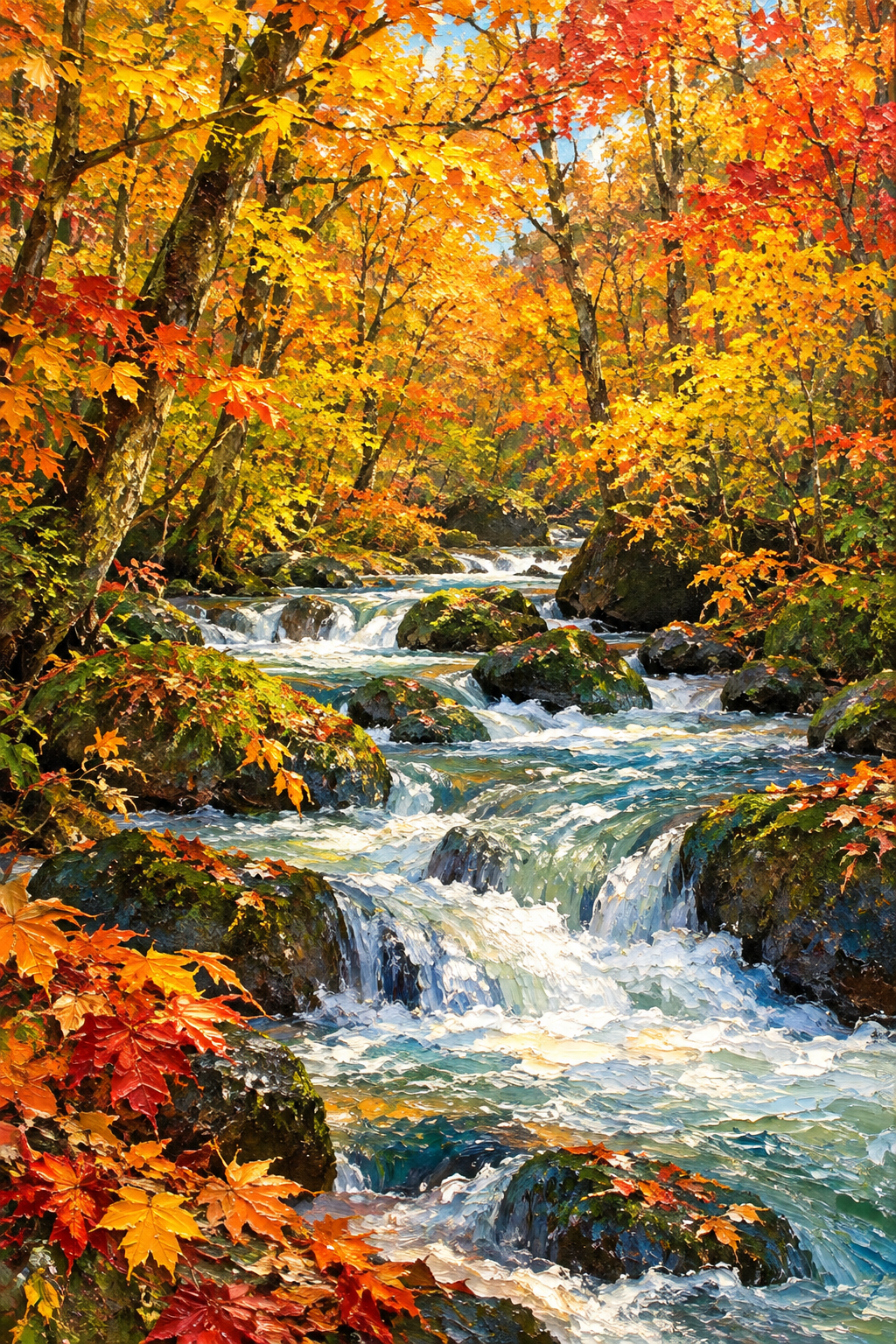
The River Learns Every Stone
Critique
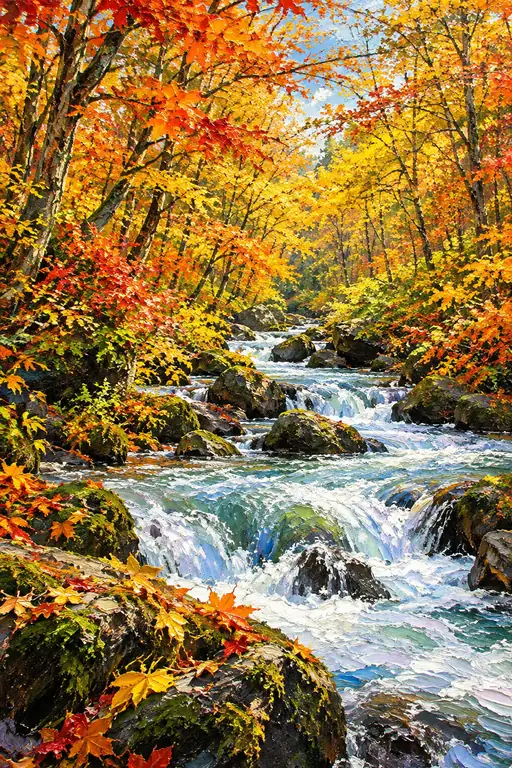
Introduction A forest stream flows through numerous shallow falls beneath yellow and red autumn foliage. A leaning trunk dominates the left side, while dark boulders alternate along the watercourse. The painting-like surface is built from substantial, directional strokes that give the moving current and stationary banks markedly different textures. Description The near cascade drops between two large rocks before spreading across a pale blue-green pool. Another small mossy stone appears at the lower right, partly surrounded by foam. Red-orange leaves cluster over the left foreground, while fine branches and tall trunks fill the upper field. Small patches of blue sky remain visible between the leaves. Analysis The leaning left trunk introduces a strong diagonal above the stepped stream. Successive dark stones create interruptions that make the water's route readable from foreground to distance. White strokes widen around each obstruction, then gather into narrower passages. Warm leaf reflections enter the near water, linking the canopy's saturated colors with the cooler lower half. Interpretation and Evaluation The image emphasizes the accumulation of small changes rather than the spectacle of one large waterfall. Repeated falls and differently sized stones produce a sustained visual rhythm. Its strength lies in keeping this rhythm clear despite abundant foliage and thick surface marks; the left bank's dense red leaves also give the viewer a stable point of proximity. Conclusion The initial impression of autumn abundance develops into awareness of carefully repeated flow and resistance. The foreground pool briefly broadens the movement before another small stone divides it. Tracing these changes reveals a landscape organized through alternating scale, direction, and texture, where color intensity remains supported by a legible arrangement of trunks, banks, and water.
Same Subcategory
Similar Artworks
 Water Finds a Way Past What Has Fallen
 The Forest Opens a Window to the Sky
 The River Carries the Forest's Fire
 Close Enough to Hear Autumn
 Where Autumn Rests Beside the Rush
 Autumn Whispers in the Sunlit Gorge
 The Roaring Heart of the Mountain
 A Symphony of Falling Leaves
 Morning Spills Through the Arch
 The Sun Enters Through Stone