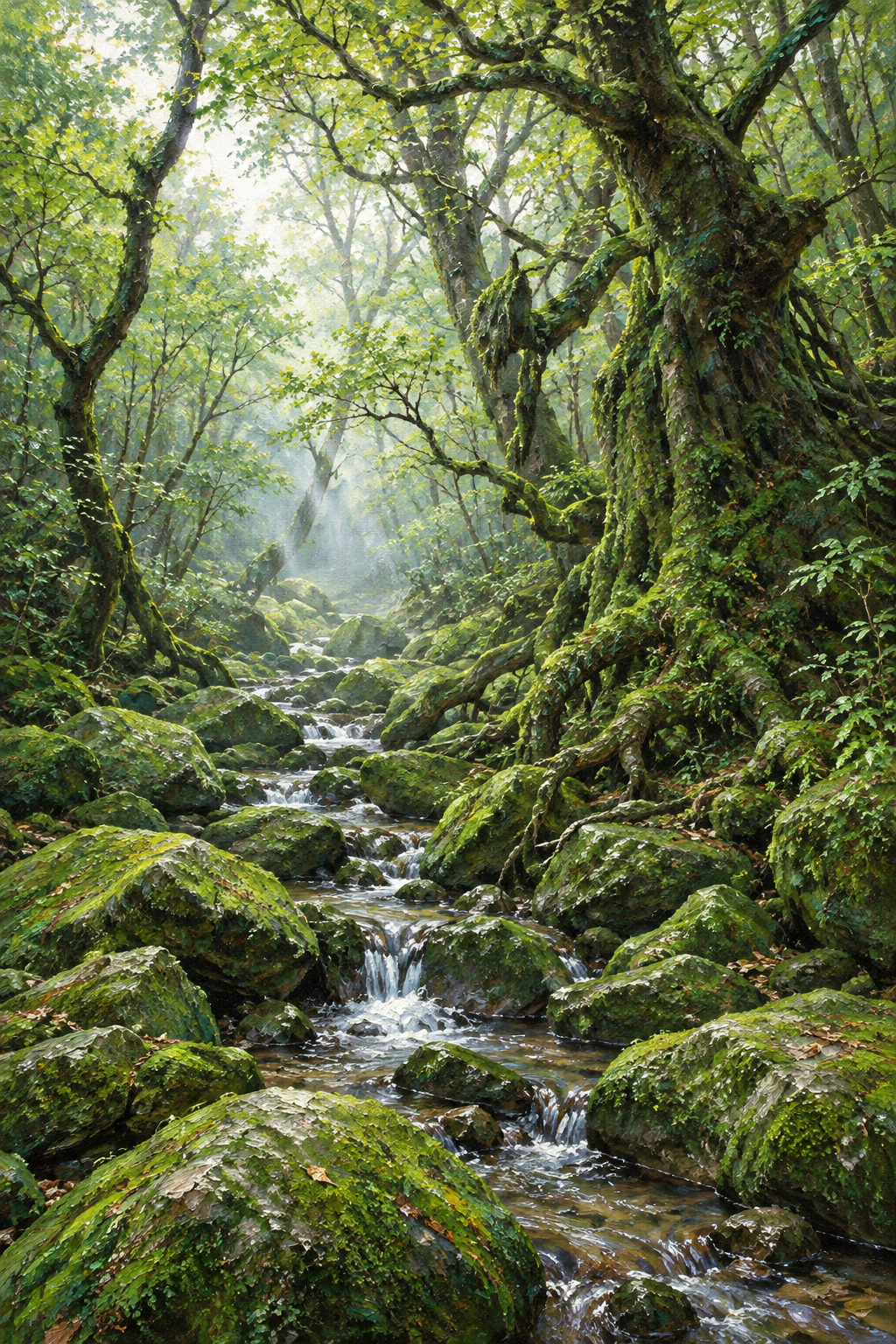
The Forest Lets the Light In
Critique
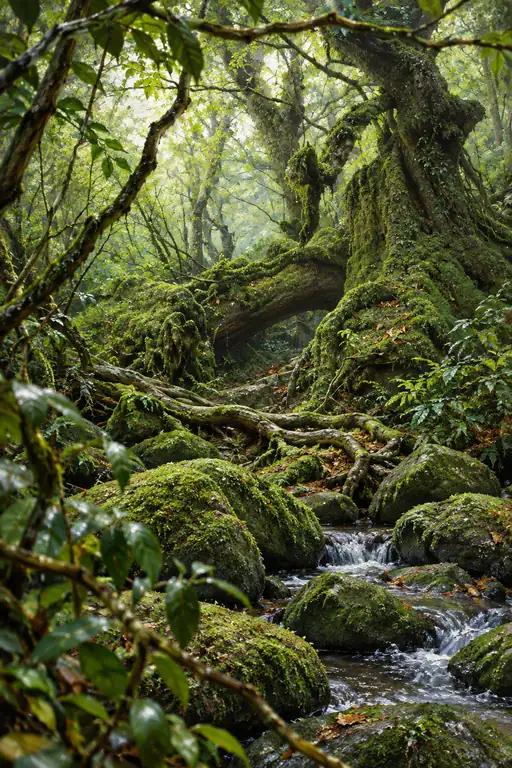
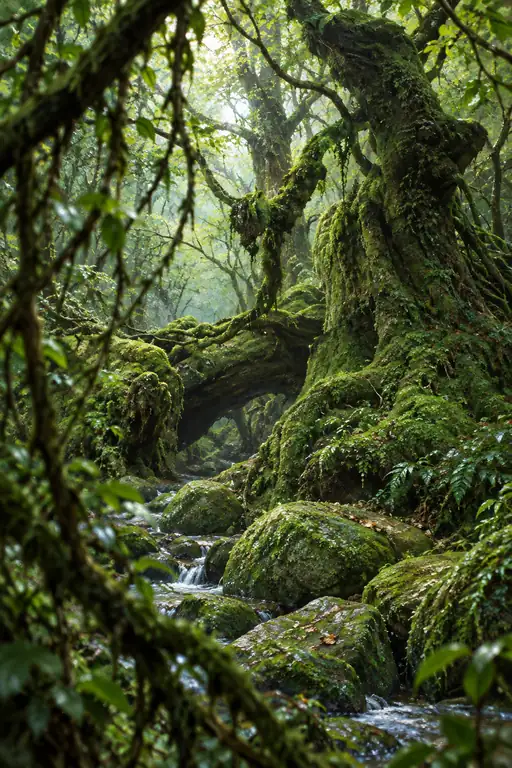
Introduction A rocky stream extends through a green forest toward shafts of pale light. A large tree stands on the right, its roots spreading toward the water, while finer trunks rise on the left. The composition gives the stream a clear guiding role, opening a visible route through an otherwise densely layered environment. Description Rounded foreground boulders carry moss, small plants, and scattered dry leaves. Water falls in short white steps between them. The right trunk has folded bark, hanging growth, and a lateral branch reaching toward the center. Above, overlapping leaves filter daylight, with a particularly bright opening at the upper left and hazy illumination farther down the channel. Analysis Repeated cascades establish depth through changes in size and spacing. The large lower-left rock anchors the foreground, while the right tree balances it at a higher level. Diagonal roots guide attention back toward the stream. Light shafts separate the distant trunks without sharply outlining them, contrasting with the crisp wet edges and granular surfaces of nearby stones. Interpretation and Evaluation The image makes water seem continuous even where rocks conceal sections of its course. This continuity offers a calm counterpoint to the tangled roots and branches. Detailed moss and bark establish a mature, inhabited natural environment without human figures. The strongest achievement is the coordination of dense textures with a luminous center that prevents the composition from feeling closed. Conclusion The initial impression of abundant forest detail develops into attention to a route defined by water and light. Foreground weight and distant softness are carefully balanced. The varied edges and repeating white falls make the scene both materially convincing and easy to explore visually.
Same Subcategory
Similar Artworks
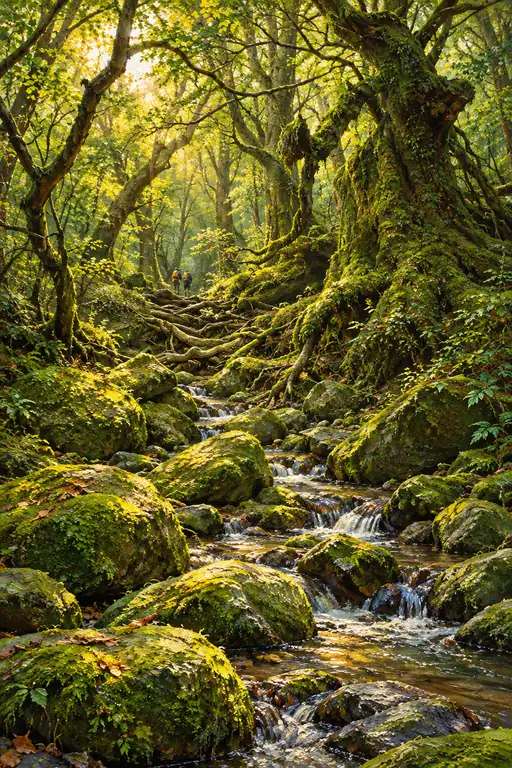 Our Footsteps Borrow the Forest
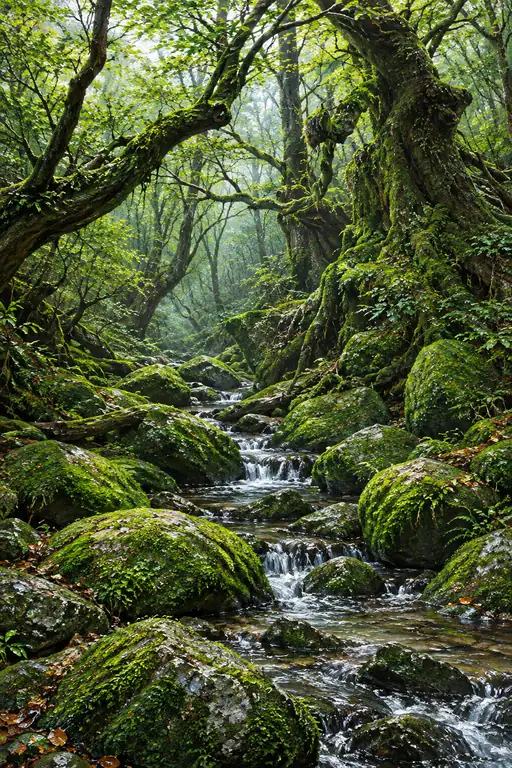 Water Knows the Way Beneath the Branches
 Breath of the Verdant Stream
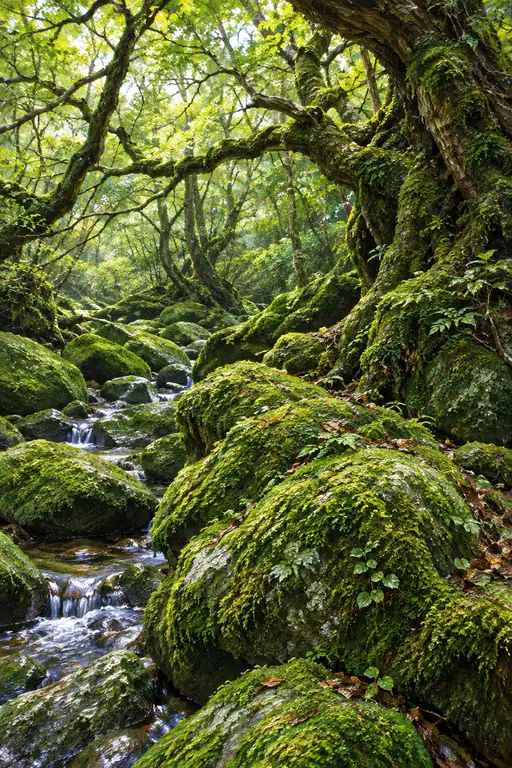 The Weight of Green, the Voice of Water
 Inside the Old Tree's Embrace
 Dance of the Restless Rapids
 What the Leaves Let Me See
 Veil of the Emerald Stream
 Symphony of the Crystal Rapids
 Sunlit Serenade of the Secret Brook