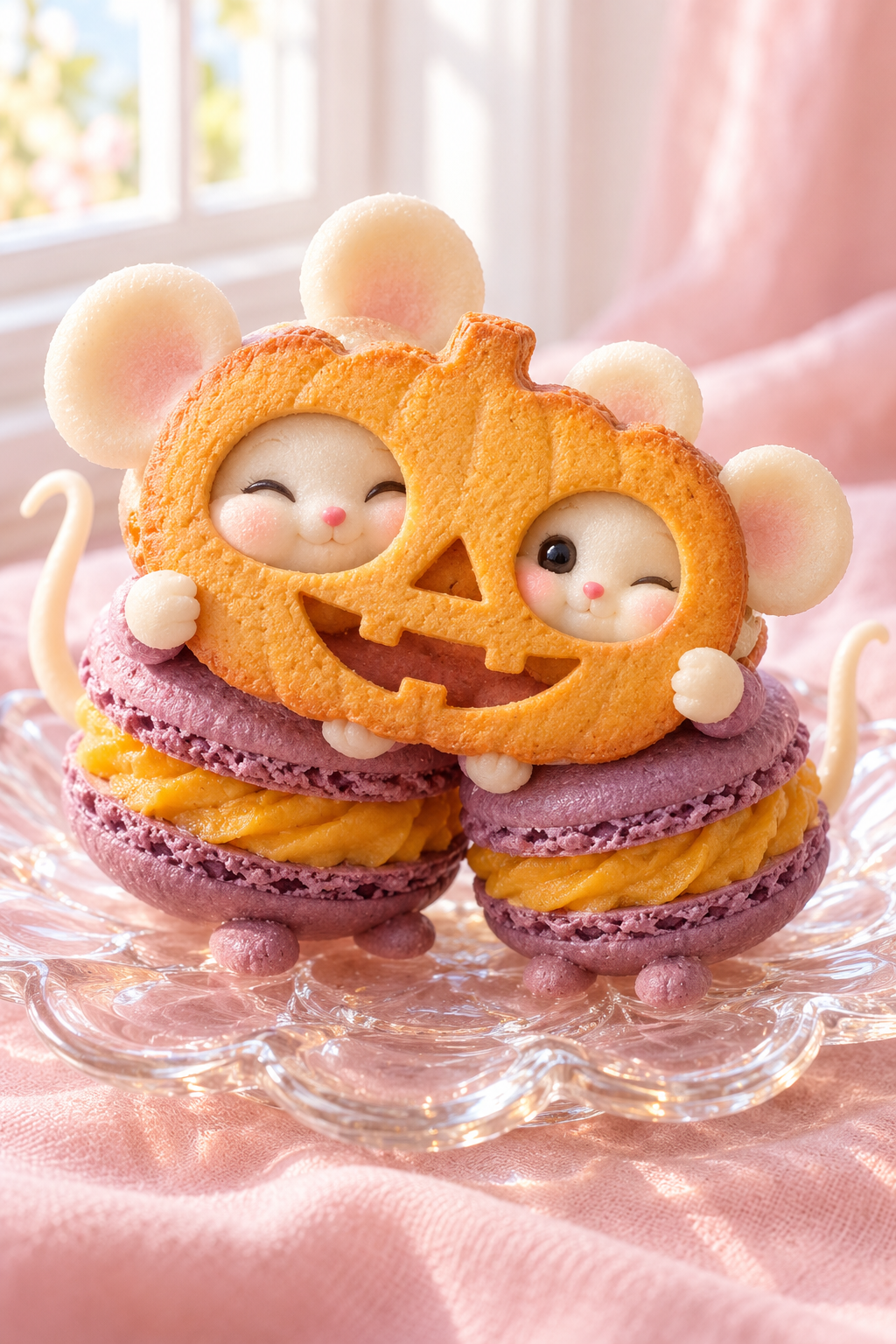
One Disguise, Twice the Mischief
Critique
Introduction Two mouse-like macaron figures hold a single orange pumpkin mask between them. Their pale faces appear through its round openings, one smiling with closed eyes and the other winking. The bright pink setting and transparent plate present the pair as a coordinated, playful group rather than separate decorative sweets. Description Purple macaron shells enclose thick orange filling and rest on small rounded feet. Large pale ears rise behind the shared mask, and narrow tails curl outward at either side. Tiny hands grip the mask's edges. Its triangular nose and broad cutout smile sit between the faces, creating another expression that belongs to the object they carry together. Analysis The mask joins the two bodies across a broad horizontal span. Differences in their expressions and heights prevent the pairing from becoming mechanically symmetrical. Orange repeats in the filling, linking the upper ornament with the lower structure. The porous macaron edges contrast with smooth faces and the plate's bright reflections, while soft window light unifies the pale surrounding surfaces. Interpretation and Evaluation The shared prop makes cooperation visible without requiring a complex gesture. Individuality remains readable through the wink and closed-eye smile. The additional pumpkin expression adds a second layer of play, since one object frames two faces while also carrying its own. The texture distinctions and clear silhouette support the invention, although the uniformly sweet colors leave little tonal tension. Conclusion The first impression of paired character sweets develops into attention to shared action and multiple expressions. The strongest compositional choice is the single mask spanning both figures. Repeated orange and purple areas hold the arrangement together, giving an elaborate design a clear relational center.
Same Subcategory
 Oh, It Was You All Along
 I Saved a Little Boo for You
Similar Artworks
 Whose Little Magic Have We Found
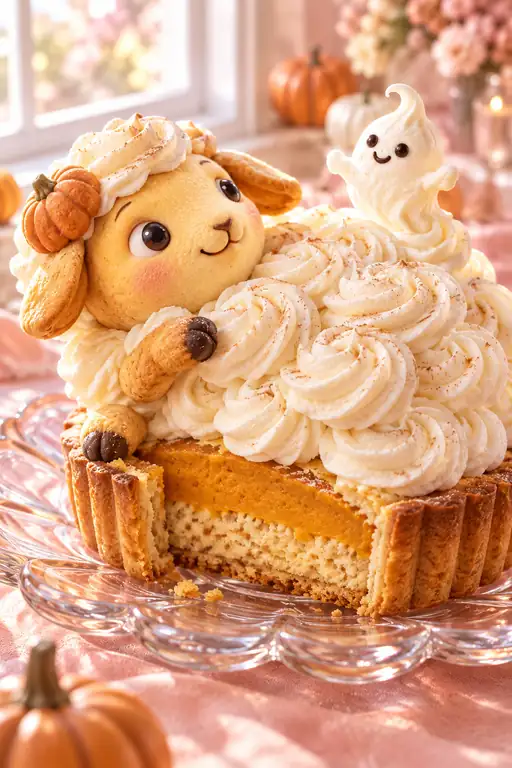 A Friendly Haunting Among the Curls
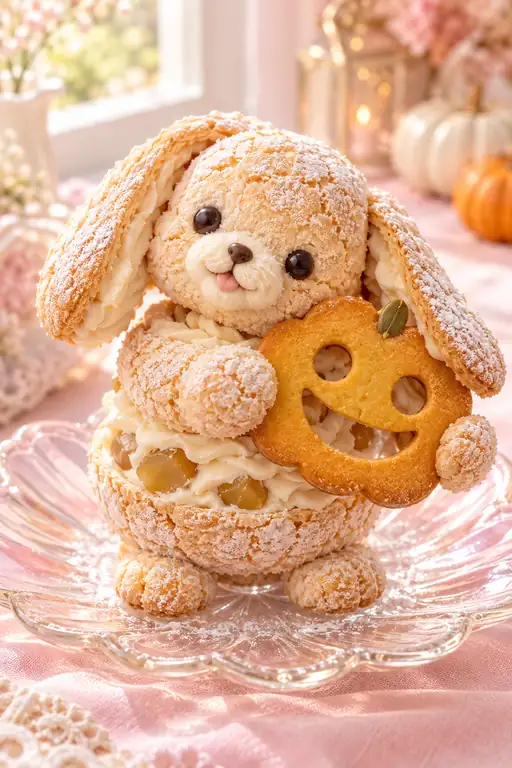 I Saved a Smile for You
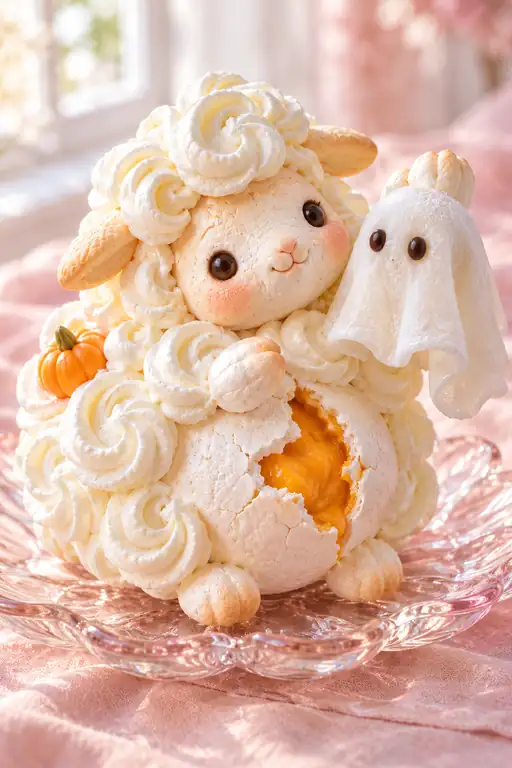 You Can Haunt My Afternoon
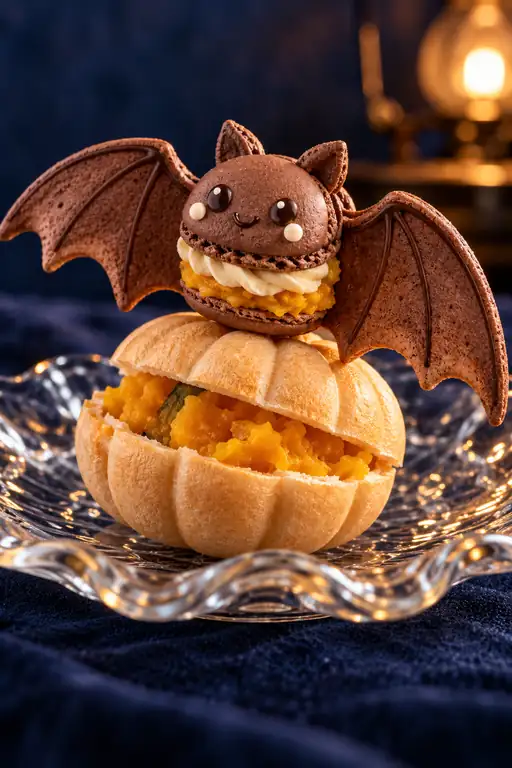 Little Wings upon the Pumpkin Shell
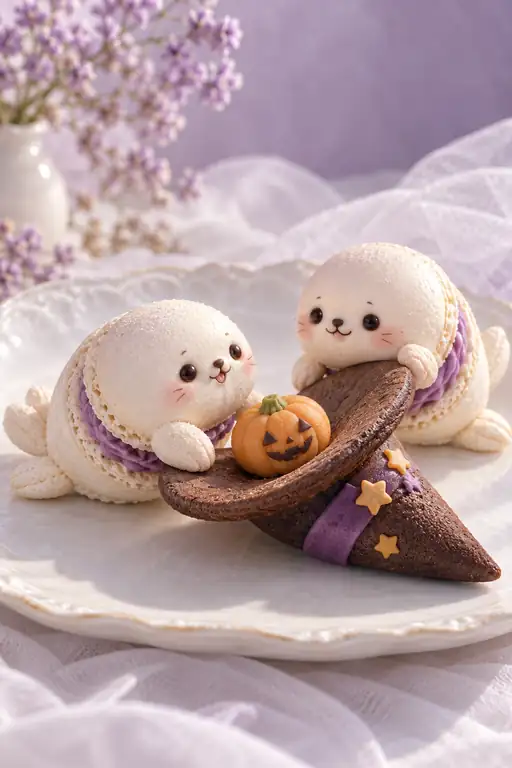 What Shall We Conjure Together?
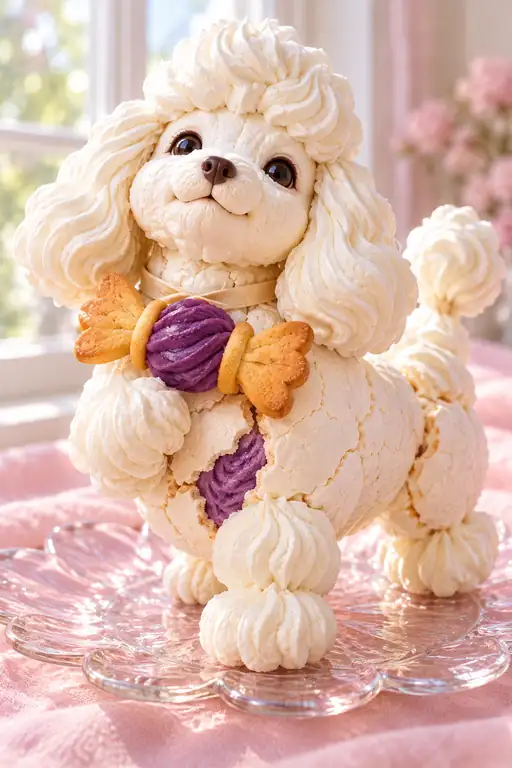 The Violet I Hold Within
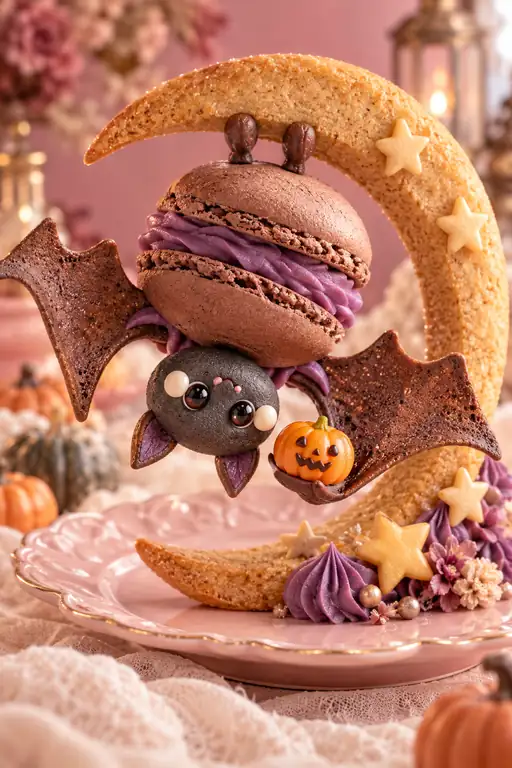 My Moon Hangs the Other Way
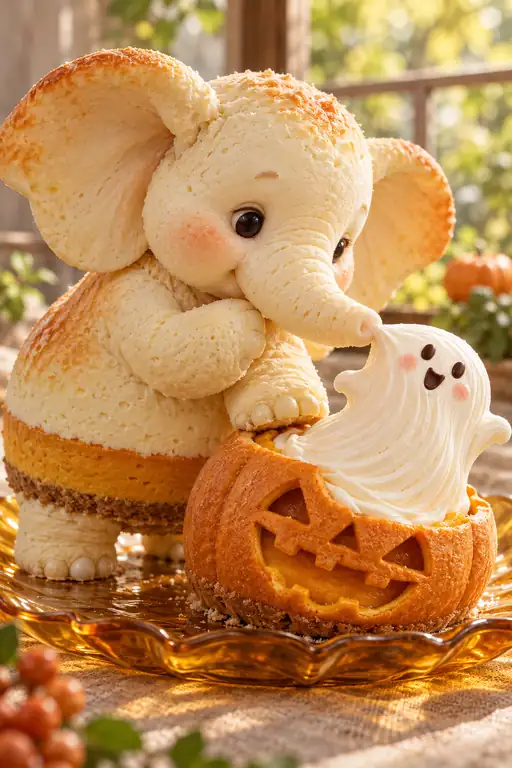 Up You Come, Little Ghost
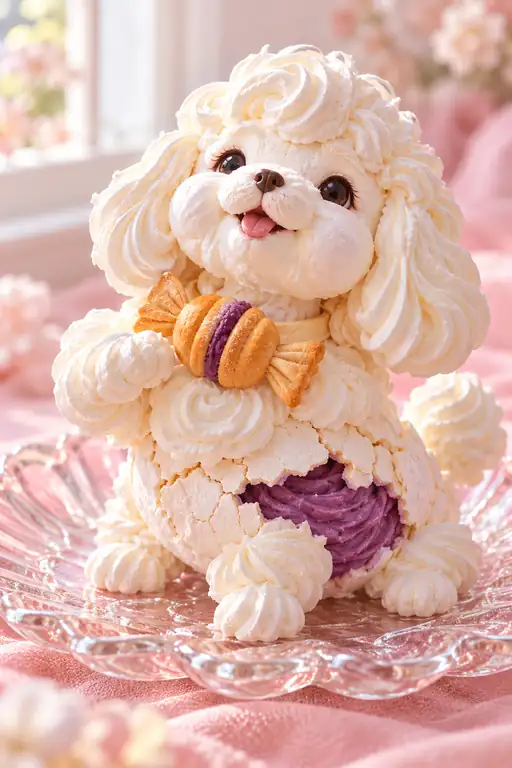 A Violet Secret Beneath the Curls