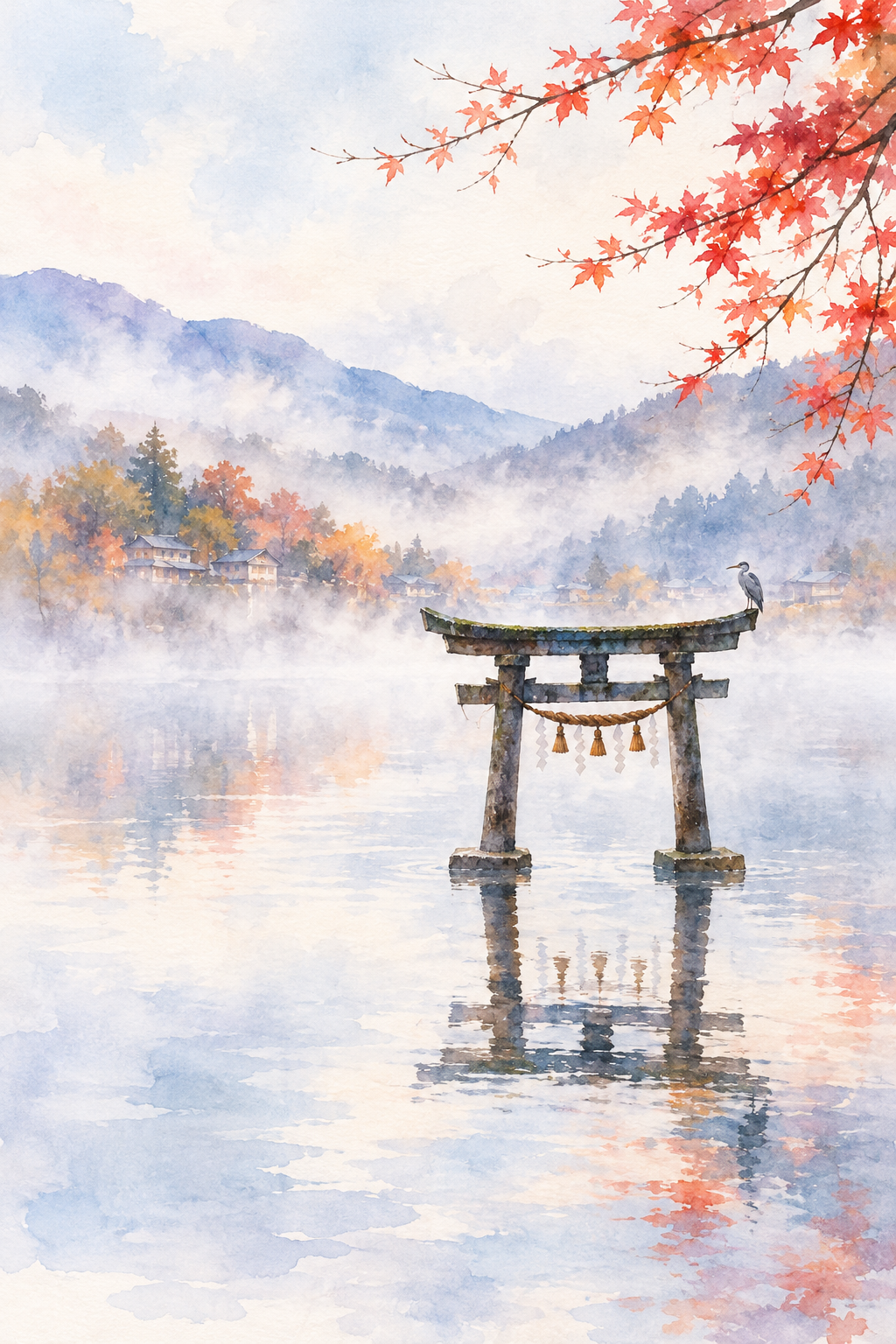
Room for the Silence to Pass
Critique
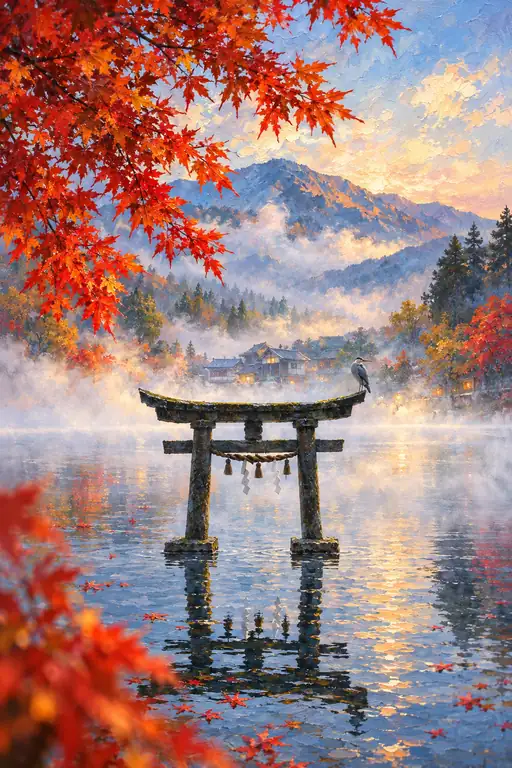
Introduction This painting places a moss-covered torii to the right of a misty lake landscape. A heron stands on its upper right corner, while red maple branches extend overhead from the same side. The broad open water on the left gives the arrangement an airy imbalance that distinguishes the gate from its surroundings. Description The stone pillars support a gently curved lintel above a rope with tassels and folded white paper. Low buildings occupy both banks beneath orange trees and blue mountain slopes. Mist drifts between the houses and water. Near the bottom right, red reflections and the elongated shape of the bird break into ripples around the gate's reflected pillars. Analysis The rightward placement links the gate to the hanging foliage, creating a vertical concentration of detail. The left side provides a contrasting field of pale water and softened architecture. Mountain slopes descend toward a central valley, carrying the eye behind the gate rather than stopping at it. Warm reflected patches distribute the foliage's color through the cool foreground. Interpretation and Evaluation The gate appears as one point within a continuing landscape, not an isolated monument. Its open center allows mist and distant light to remain visible through the structure. The heron's narrow silhouette adds a delicate counterweight to heavy stone. The painting is effective in separating sharp branches, textured masonry, and softened distance without making them feel unrelated. Conclusion An initial reading of a quiet shrine-like landmark expands into attention to asymmetry and spatial continuity. Open water is essential to the gate's prominence and breathing room. The combination of restrained color, layered haze, and carefully varied edges gives the scene a calm but sustained visual movement.
Same Subcategory
Similar Artworks
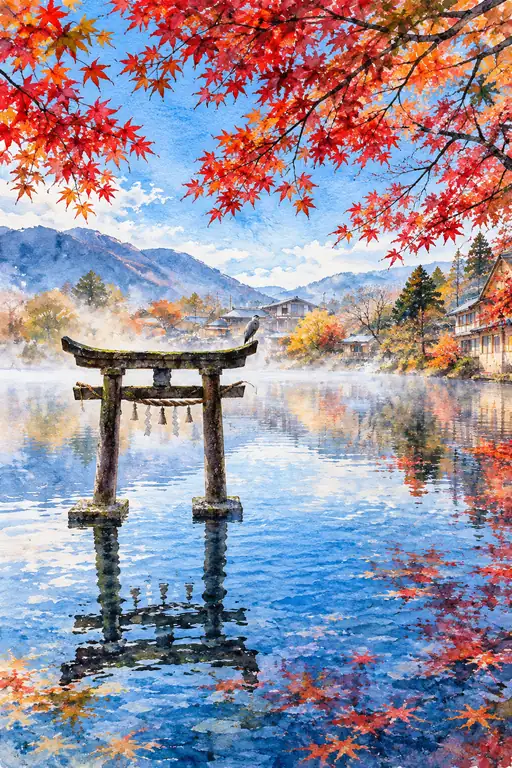 Where Scarlet Keeps the Water Still
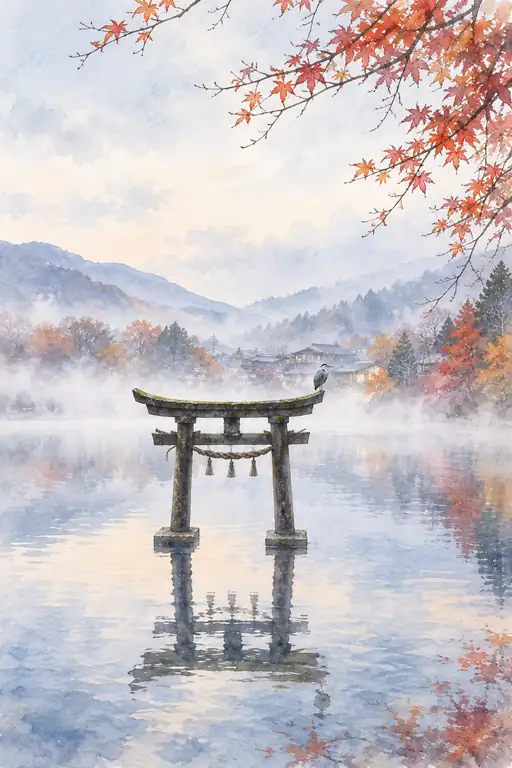 The Mist Leaves One Place to Rest
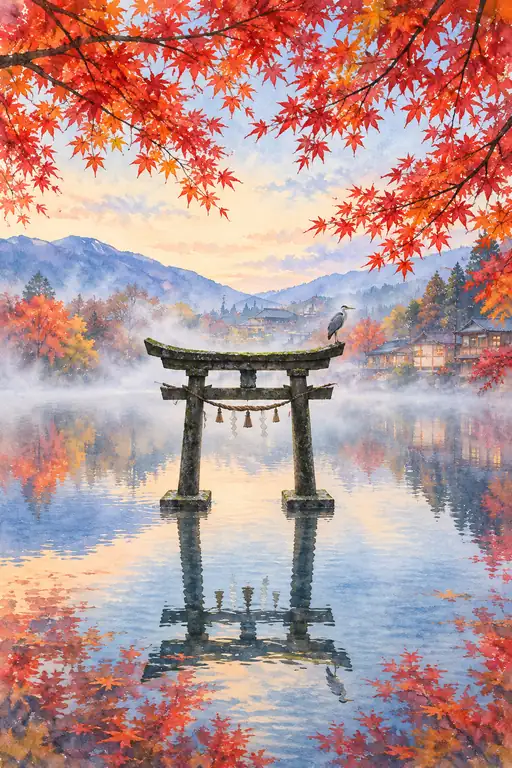 Morning Holds Two Autumns
 Light Finds the Old Prayer
 The Threshold of Silence
 The Gate Between This Morning and the Next
 The Sun Waits inside the Torii
 Two Prayers at the Edge of Winter
 The Sacred Mirror: Eternal Reflection of the Sea Shrine
 The Vermilion Sanctuary of Twilight Waters