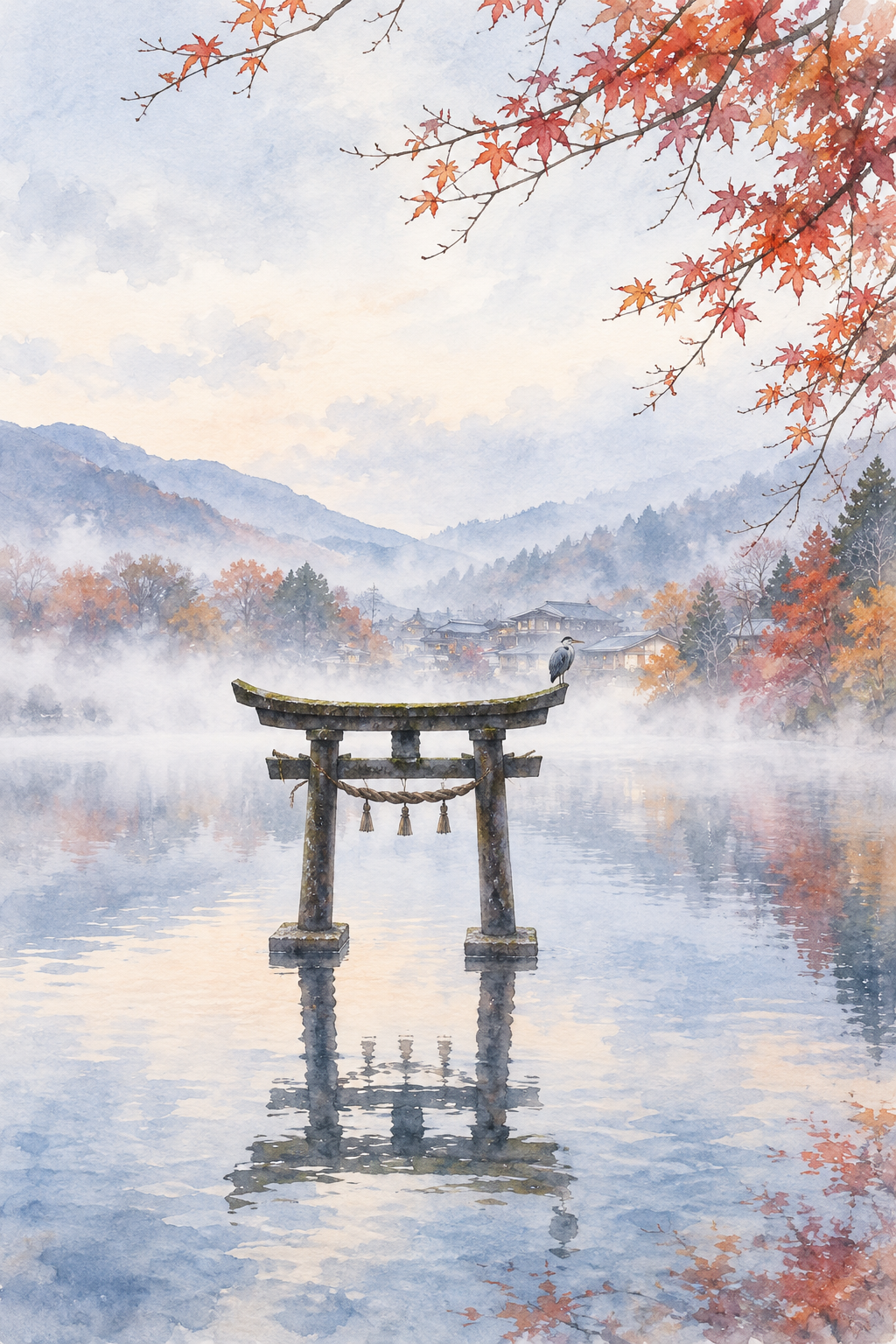
The Mist Leaves One Place to Rest
Critique
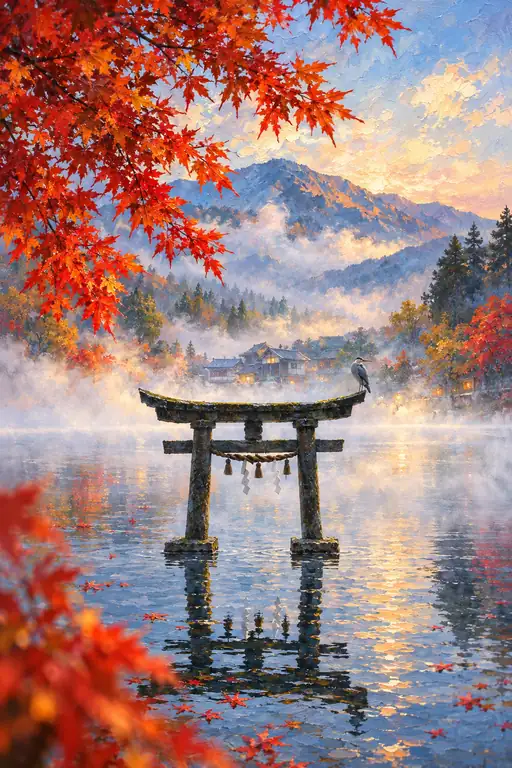
Introduction A stone torii stands near the center of a mist-filled lake, with a heron perched at its right end. Sparse autumn branches enter from the upper right against a broad pale sky. The painting's subdued colors and ample open space make the gate feel isolated without separating it from the distant settlement. Description The gate has a moss-lined curved lintel, weathered pillars, and a rope with three hanging tassels. Its square bases meet gently rippling water. Behind it, houses gather beneath overlapping blue-gray mountains and orange trees. Reflections descend into the foreground, where the gate's darker shape is broken by pale horizontal patches and a faint reflected bird. Analysis The large sky and water areas reduce the relative scale of the gate. Branches at the top right and warm reflections at the lower right provide an asymmetrical frame. Mist obscures the shoreline, so the distant buildings appear suspended between mountain and water. The gate's firmer edges supply the main point of structural certainty amid these dissolving boundaries. Interpretation and Evaluation The heron's upright posture suggests alert stillness rather than dramatic action. The weathered stone and hanging rope introduce human use, while the bird occupies the structure without disturbing its quiet character. The restrained washes make distance persuasive, and the broken reflection prevents the central arrangement from becoming static. Sparse leaves preserve the importance of the open atmosphere. Conclusion What first appears to be a solitary landmark becomes a relationship between durable structure and changing air. The painting's achievement lies in giving mist and empty space active compositional roles. Its modest warm accents enrich the cool setting while preserving a measured, contemplative balance throughout the image.
Same Subcategory
Similar Artworks
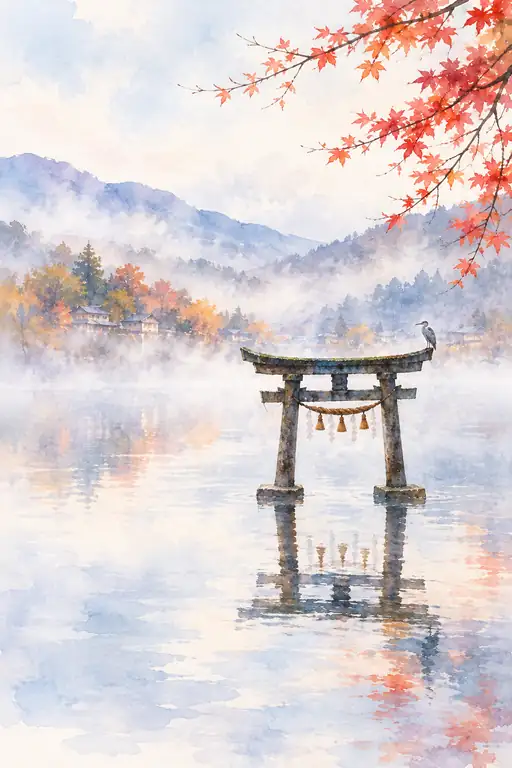 Room for the Silence to Pass
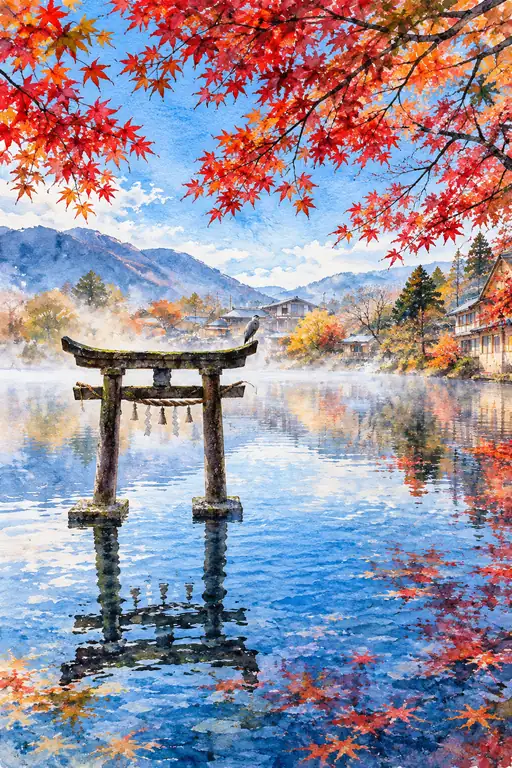 Where Scarlet Keeps the Water Still
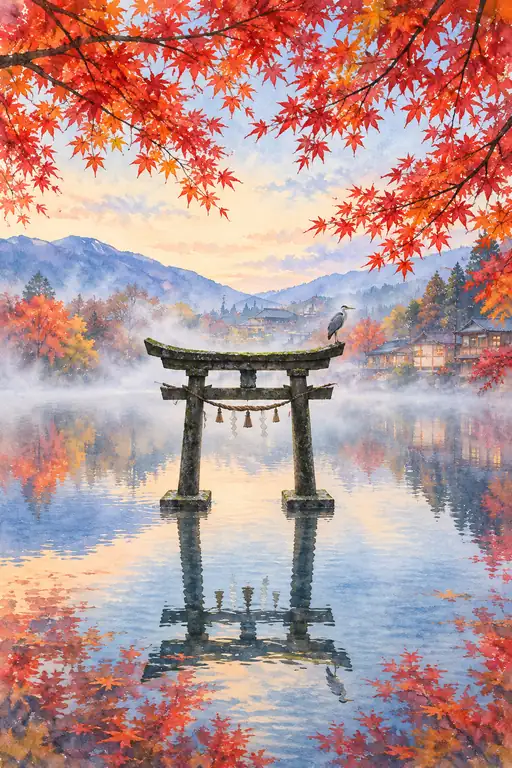 Morning Holds Two Autumns
 Light Finds the Old Prayer
 The Threshold of Silence
 The Sun Waits inside the Torii
 The Gate Between This Morning and the Next
 Two Prayers at the Edge of Winter
 The Sacred Mirror: Eternal Reflection of the Sea Shrine
 Serenity in the Autumn Rain