
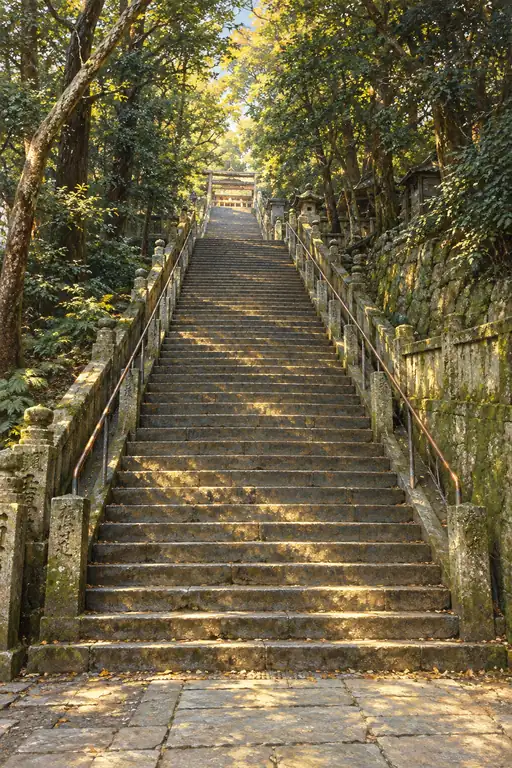
Dew-Kissed Steps to the Shrine
Critique
Introduction This image presents a steep shrine stairway under a dense green canopy. Description Dark, worn steps rise from the bottom edge through a pale stone torii toward a wooden shrine with a curved roof. Metal handrails run beside the stairs, and low stone parapets support rows of weathered lanterns. One large lantern is cropped close to the left edge, its mossy cap and hollow housing looming in front of the others. Trees arch above the route, leaving a bright opening near the gate. The shrine stands beyond a shorter upper flight. No figures are visible. Analysis The large near lantern creates immediate depth and makes the viewer feel close to the path's edge. From there, railings and step lines converge on the torii and the small shrine behind it. The gate frames the destination without hiding the long climb before it. Dense leaves form a dark ceiling, while the pale opening above the gate pulls attention upward. Repeated lanterns mark distance in diminishing sizes. Interpretation and Evaluation The empty path invites an imagined approach to the shrine, and the torii gives that movement a symbolic threshold. Here the heavy shade matters as much as the architecture: it makes the sunlit destination appear earned. The strong central route prevents that weight from unbalancing the scene. Conclusion The image succeeds through its contrast between near shadow and distant light. Its strongest compositional choice is the oversized foreground lantern, which deepens the route toward the gate and shrine.
Same Subcategory
Similar Artworks
 Whispering Lanterns of the Cedar Stair
 Stairway to the Mountain Shrine
 Beams of Light upon the Ancient Stair
 Gateway of Sunlit Devotion
 Ascent Through Ancient Sunbeams
 Dawn Piercing the Sacred Canopy
 Pathway of Stone Lanterns to the Sacred Peak
 Sunlit Sanctuary in the Cedar Grove
 Silent Steps through the Sacred Forest
 Sanctuary of the Ancient Cedars