The Grace of Letting Light Through
Critique
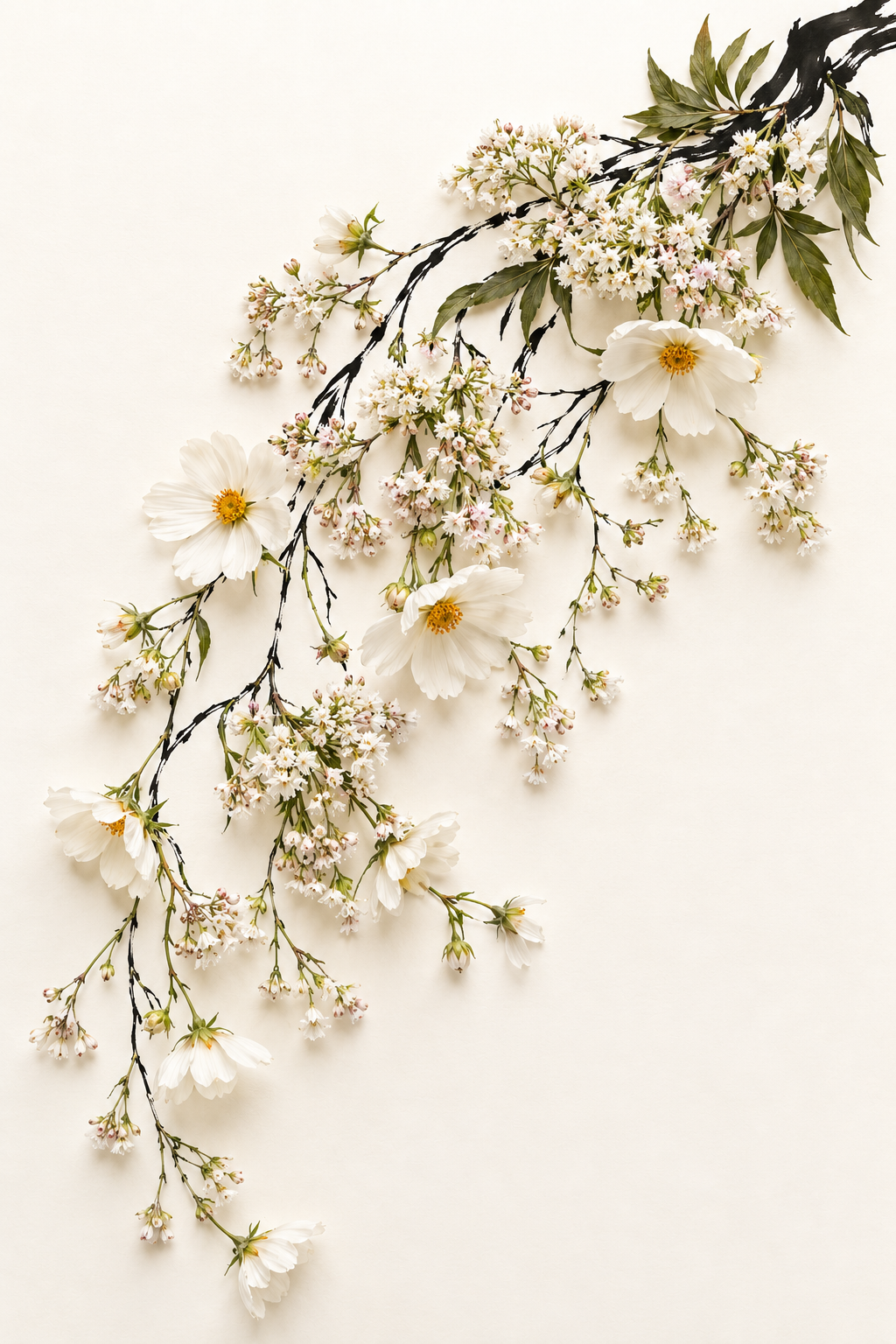
1. Introduction A flowering branch enters from the upper right and descends across an otherwise empty pale field. Large white daisy shaped flowers punctuate much finer sprays of blossom. The image concentrates on the changing weight and direction of one extended plant form. 2. Description The thickest branch begins near a dark ink mass at the upper edge and divides into many thin, drooping stems. Clusters of tiny white flowers carry faint pink buds. Several larger blooms show yellow centers and broad cream petals, some facing outward and others hanging downward. Narrow green leaves gather near the upper branch and appear more sparingly below. The lowest stems nearly reach the bottom edge. 3. Analysis The diagonal black branch establishes a strong path from upper right toward lower left. Its offshoots repeat that descent with smaller turns, creating a gradual loosening of density. Broad petals interrupt the fine grain of the small blossoms and become focal pauses. Soft shadows beneath flowers and leaves suggest their overlap, while extensive white space keeps even the most delicate stems distinct. 4. Interpretation and Evaluation The picture gives an ordinary flowering branch the scale of a complete landscape of forms. Its long fall suggests growth reaching beyond the frame. The composition is effective because dark structural lines and light flower heads perform different tasks: one guides movement, the other measures intervals. Careful rendering of buds, leaves, and petals adds botanical specificity without requiring a surrounding setting. 5. Conclusion The branch reveals a controlled sequence of weight, branching, and release. Varied white blossoms sustain movement. Restrained color and precise placement make one plant a complete visual study.
Same Subcategory
 Still Reaching After All These Years
Similar Artworks
 The Hours Hidden in a Bloom
 Breath of the Spring Bough
 Purity of White Blossoms on Ink Silhouette Branches
 Slender Tree Blossoming with Lilac Dreams
 White Cherry Blossoms Blooming on Ink-Brushed Branches
 Almost Weightless, Still Here
 Where the Garden Wishes to Go
 Spring Travels Along the Blush-Touched Bough
 Dew-Kissed Plum Blossoms by White Porcelain
 Small Constellations of Courage