Until Our Breaths Become One
Critique
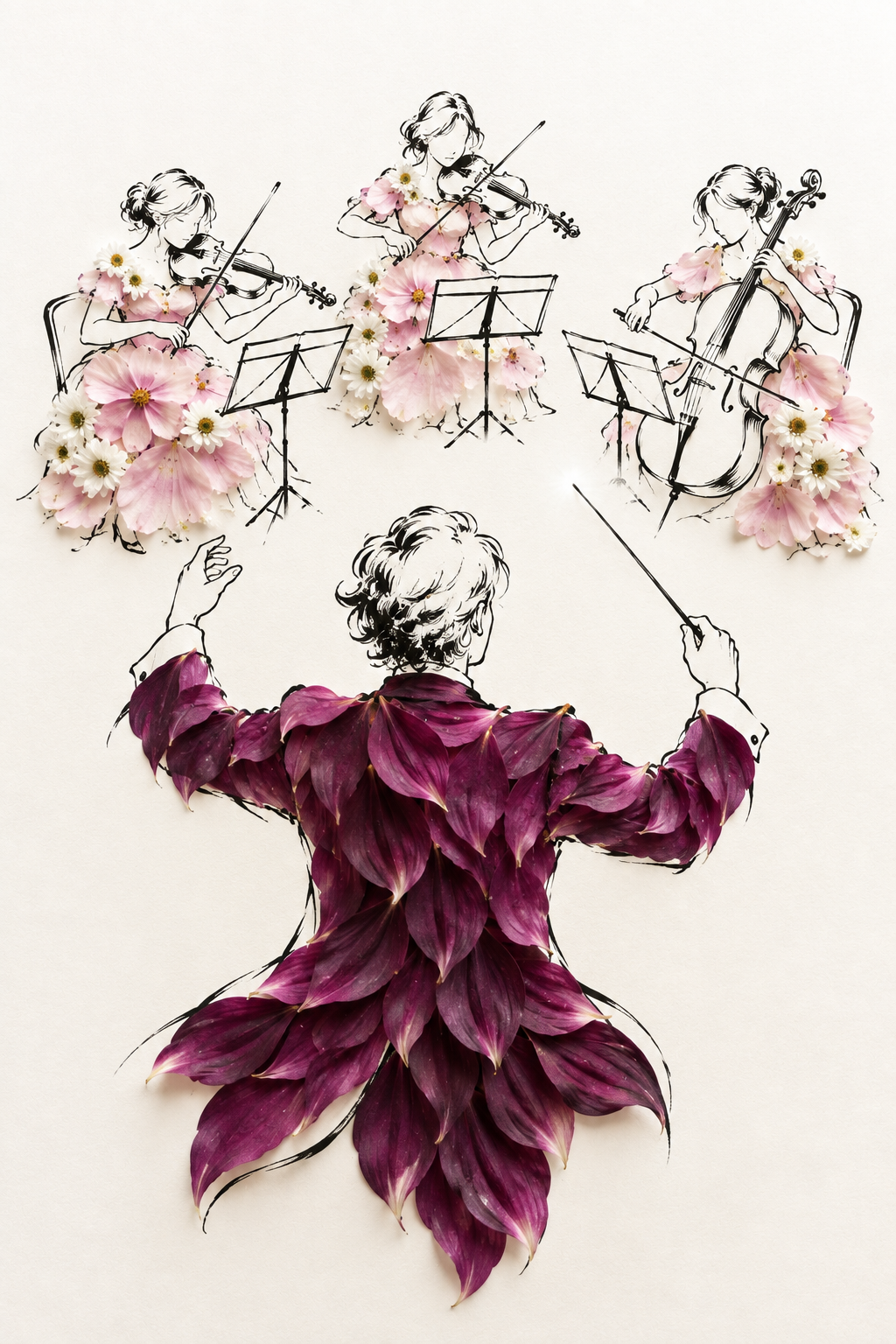
1. Introduction A conductor seen from behind faces three string players arranged across the upper image. Dark burgundy layers cover the foreground coat, while pale pink and white flowers form the musicians' clothing. This contrast establishes two distinct positions: the directing figure nearby and the smaller performers beyond an open interval. 2. Description The conductor raises an open left hand and holds a thin baton in the right. Two violinists sit at left and center, and a cellist occupies the right. Each has a separate music stand. Bows cross the instruments at differing angles, while curved instrument bodies and the cello's long neck remain clearly outlined. 3. Analysis The foreground arms spread across the composition, directing attention toward the three musicians. The baton cuts diagonally through the white gap, linking the nearest figure to the ensemble. Dark clothing creates weight below, balanced by smaller pink clusters above. Repeated stands establish continuity, while varied bow angles prevent the group from appearing mechanically symmetrical. 4. Interpretation and Evaluation The image describes coordinated action through differentiated gestures rather than through a visible audience or stage. The conductor's open hand and baton suggest guidance, and the players' lowered faces indicate attention to their instruments. Clear hand positions retain the specificity of string performance. Color grouping makes hierarchy readable without reducing the musicians to identical figures. 5. Conclusion An initial contrast between dark and pale clothing becomes a spatial account of musical coordination. The central white interval is essential because it makes gestures and directions legible. The composition joins individual instrumental actions into a shared arrangement while preserving differences in instrument scale, bodily posture, and line movement.
Same Subcategory
Similar Artworks
 All Our Hearts on One Beat
 When Our Melodies Meet
 Three Breaths, One Unwritten Song
 Resonance of the Final Bow
 Trio Harmonizing in the Autumn Breeze
 We Hear Each Other with Closed Eyes
 Resonating Concerto in Rose
 Cadence of Breath and Strings in Bloom
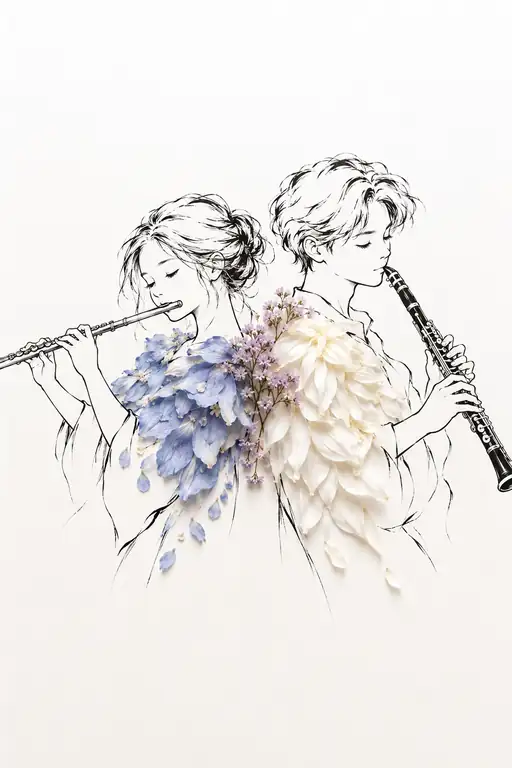 Our Separate Breaths, One Song
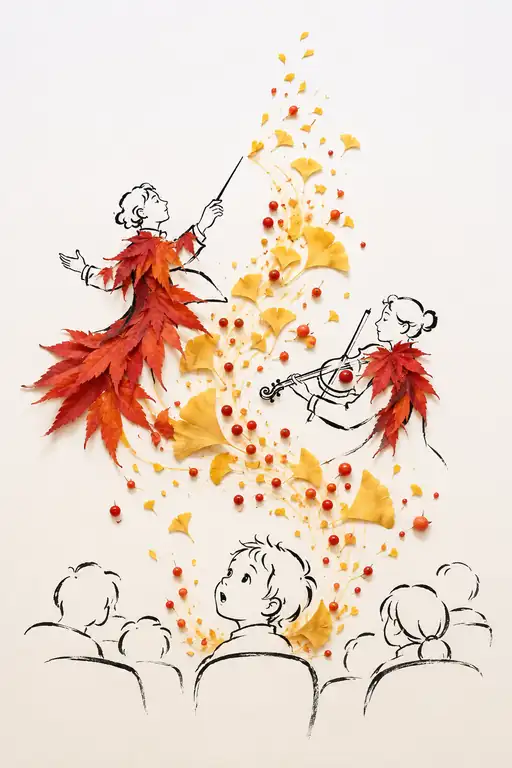 The Golden Rhapsody from the Baton