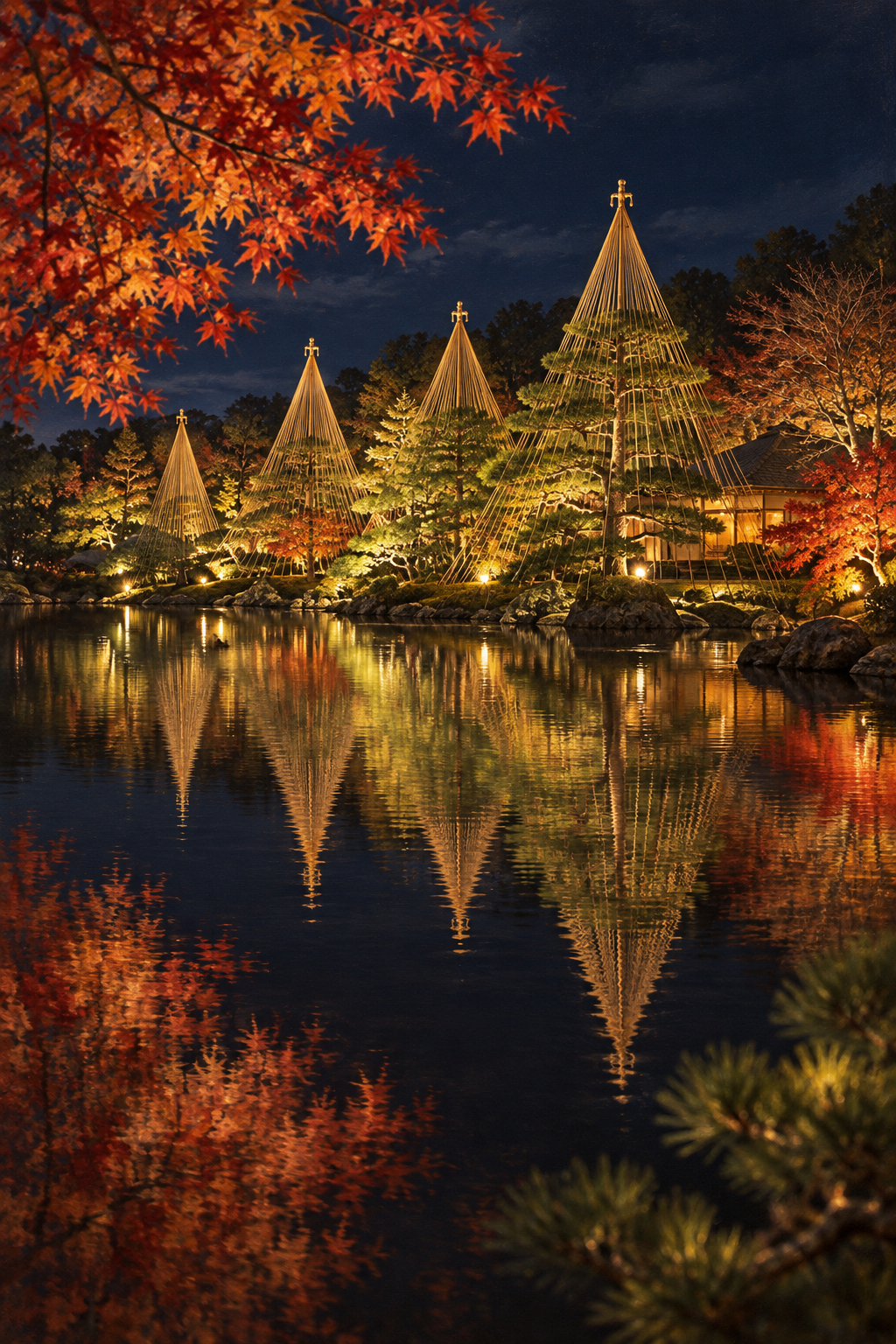
The Night Holds What We Protect
Critique
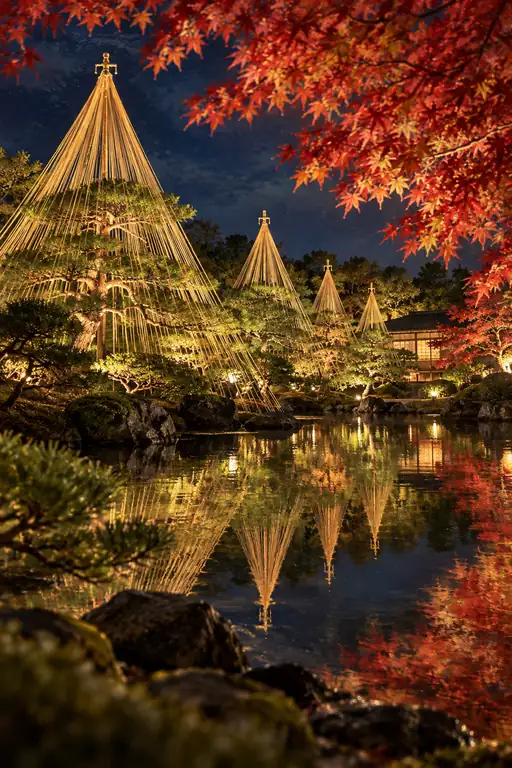
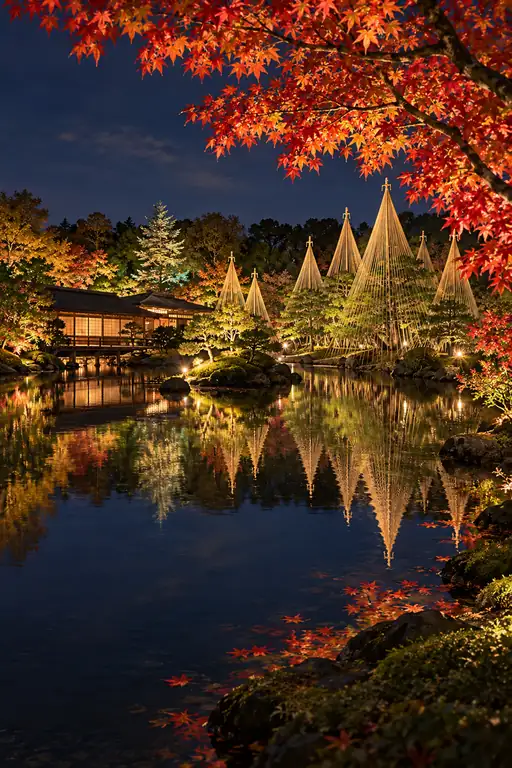
Introduction An illuminated garden extends across a dark pond beneath red autumn leaves. Tall conical ropes protect or frame trees along the far bank, and their golden reflections repeat below. Tended forms meet water that disturbs their symmetry. Description Branches of orange and red maple leaves fill the upper left corner. Across the pond, four rope cones rise at different heights, the largest just right of center. Small lights reveal pines, shrubs, rocks, and a low building behind them. Water mirrors the cones as wavering golden triangles. A broad red reflection spreads at lower left, while dark pine needles enter at lower right. The sky remains a deep blue-black. Analysis The staggered cones lead the eye across the bank from left to right, with the largest providing a clear focal point. Their straight cords contrast with irregular foliage and the broken vertical streaks on the water. The foreground maple canopy presses down from above, balancing the large dark pool below. Warm light collects around the trees and then lengthens in reflection, linking land and water. Deep blue areas between these lights prevent the scene from becoming uniformly bright. Interpretation and Evaluation The ropes make the garden's care visible as part of its beauty. Their repeated triangles impose order, yet the water converts that order into fleeting patterns. This gives the scene structural interest. Red leaves and gold lights are distributed with restraint against the cool darkness. Foliage, rock, rope, and reflection establish depth. Conclusion The first impression is of a brilliantly lit garden. Looking longer reveals a measured dialogue between fixed structures on the shore and their changing images in the pond.
Same Subcategory
Similar Artworks
 Across the Water, a Welcome
 Autumn Counts the Hours Afloat
 Where Gold Forgets Its Edges
 A Thousand Threads Against the Night
 Autumn Breathes Between the Lights
 Crimson at the Edge of Silence
 The Lantern Remembers Sunset
 Ephemeral Fire of the Autumn Court
 From This Shore of Remembering
 Steps Across the Amber Current