
The Invisible Learns to Shine
Critique
Introduction A spider web stretches between two dark branches bearing yellow flowers. Pale threads fill one half; sparse black lines describe the other. The asymmetry makes visibility the subject. Description The branches enter from upper left and lower right, framing a broad white opening. Small yellow blossoms and buds cluster along them beside slender green leaves. The web's hub sits slightly left of center. Delicate radial lines spread outward, crossed by curved strands; on the left, these strands appear thick, creamy, and dotted with bright drops. A dark spider hangs above and right of the hub. Outer threads connect to twigs. Analysis The heavy diagonals of the branches enclose the web without making a rigid frame. From the hub, its geometric lines open across the central void and meet the irregular twigs. On the left, bright drops and thicker threads accumulate near the yellow blossoms; the right remains nearly transparent. The contrast draws the eye toward the spider and center. Small flower heads repeat the points along the web, linking botanical and woven details. Interpretation and Evaluation The web appears both an engineered structure and a surface that catches light. Its left portion has a tangible, almost fabric-like presence, while the right reveals the fine plan beneath. Changing density makes details emerge and disappear. Yellow accents are controlled and lead across the branches. Distinct bark, petals, drops, and silk preserve clarity. Conclusion The first impression of a spider in a flowering tree becomes a closer examination of what makes a nearly invisible web perceptible. Branches, droplets, and open white space all contribute to that discovery.
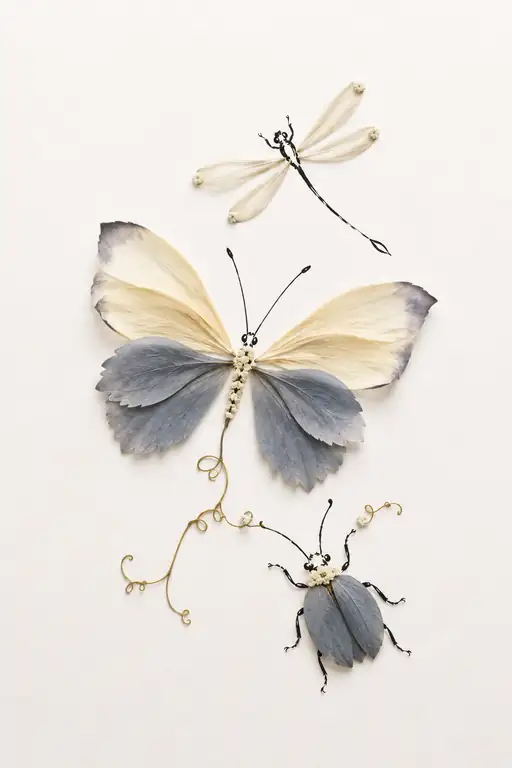 Wings of Petals and Leaf Shells
 Golden Ease on a Familiar Branch
 We Drift Beyond the Hours
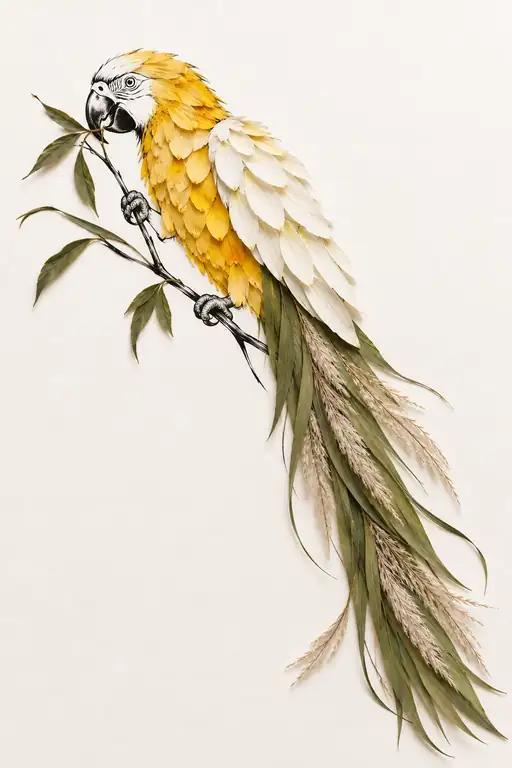 A Golden Word Unspoken
 Dawn Belongs to My Next Step
 One Heartbeat Above the Water
 A Little Courage in Yellow
 The Crimson I Cannot Hide
 Sleep, I Am Here
 Tenderness Takes the Sky
 The Gentle Arch of Morning Blooms