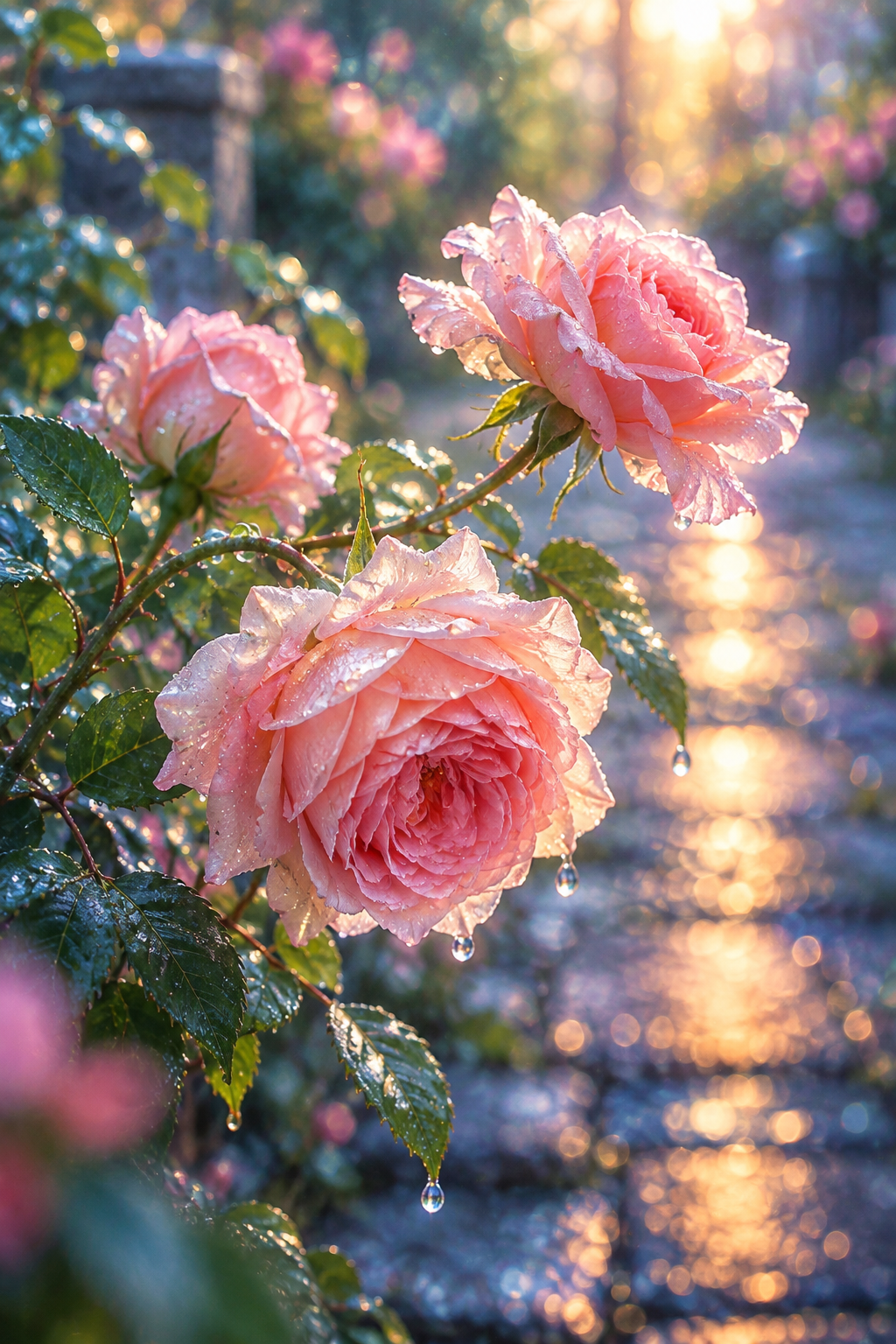
The Garden After Its Tears
Critique
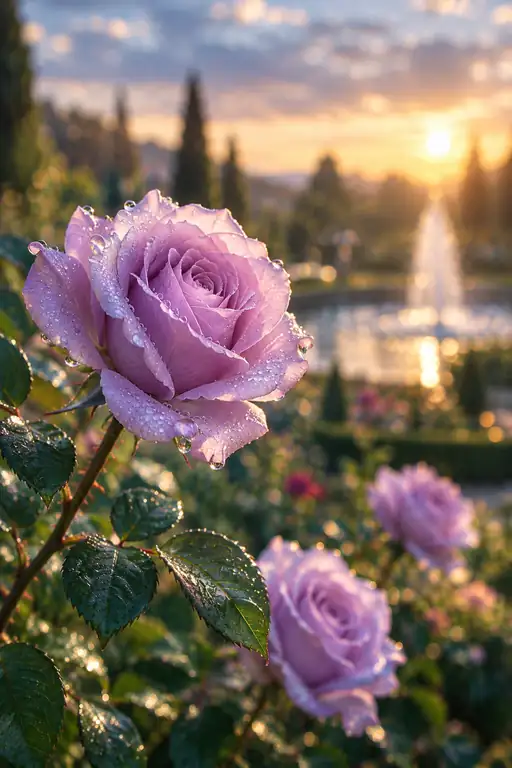
1. Introduction Three pink roses appear beside a reflective path. The nearest hangs in the lower center; another opens at upper right. Droplets and backlight draw attention to wet surfaces. 2. Description The front rose has dense petals around a dark recess. The upper rose faces sideways; a third sits left in softer focus. Water beads on edges and hangs from pointed leaves. Thorned stems cross between blooms. A narrow gold band runs down the path amid dark green and violet. 3. Analysis The three blooms form an uneven triangle, and branching stems hold them together. Pink petals stand against cool blue-green shade, while gold reflections create a second vertical attraction at right. Backlight outlines wet edges and lets some thin petals glow. The largest flower remains sharp enough to show nested folds. Softer background circles keep the path recognizable as light without competing in detail. 4. Interpretation and Evaluation The droplets make the flowers appear at a particular moment after moisture has settled. Their weight on the petal edges contrasts with the blooms' light color. The composition is effective in balancing flower mass with the path's open strip. Pink, gold, and cool greens create a controlled color relationship. Careful rendering of droplets and folded petals supports observation, while selective focus preserves atmosphere. 5. Conclusion The roses first seem to be the sole subject, but the wet path gives their light a wider source and direction. Close detail and distant reflection remain connected. The image's distinction lies in how water makes both petals and surroundings newly visible.
Same Subcategory
 The Morning Opens Gently
Similar Artworks
 After Rain, the Road Glows Rose
 Dewdrops on the Blush Rose by the Window
 Lavender Rose by the Shuttered Window
 I Followed the Roses Home
 Where the Rose Path Warms
 The Morning I Opened Fully
 Crimson Velvet Beside the Sunlit Pool
 Dewlit Sovereign of the Fountain Garden
 A Drop Holds the Autumn Sun
 Twilight Reverie in Violet