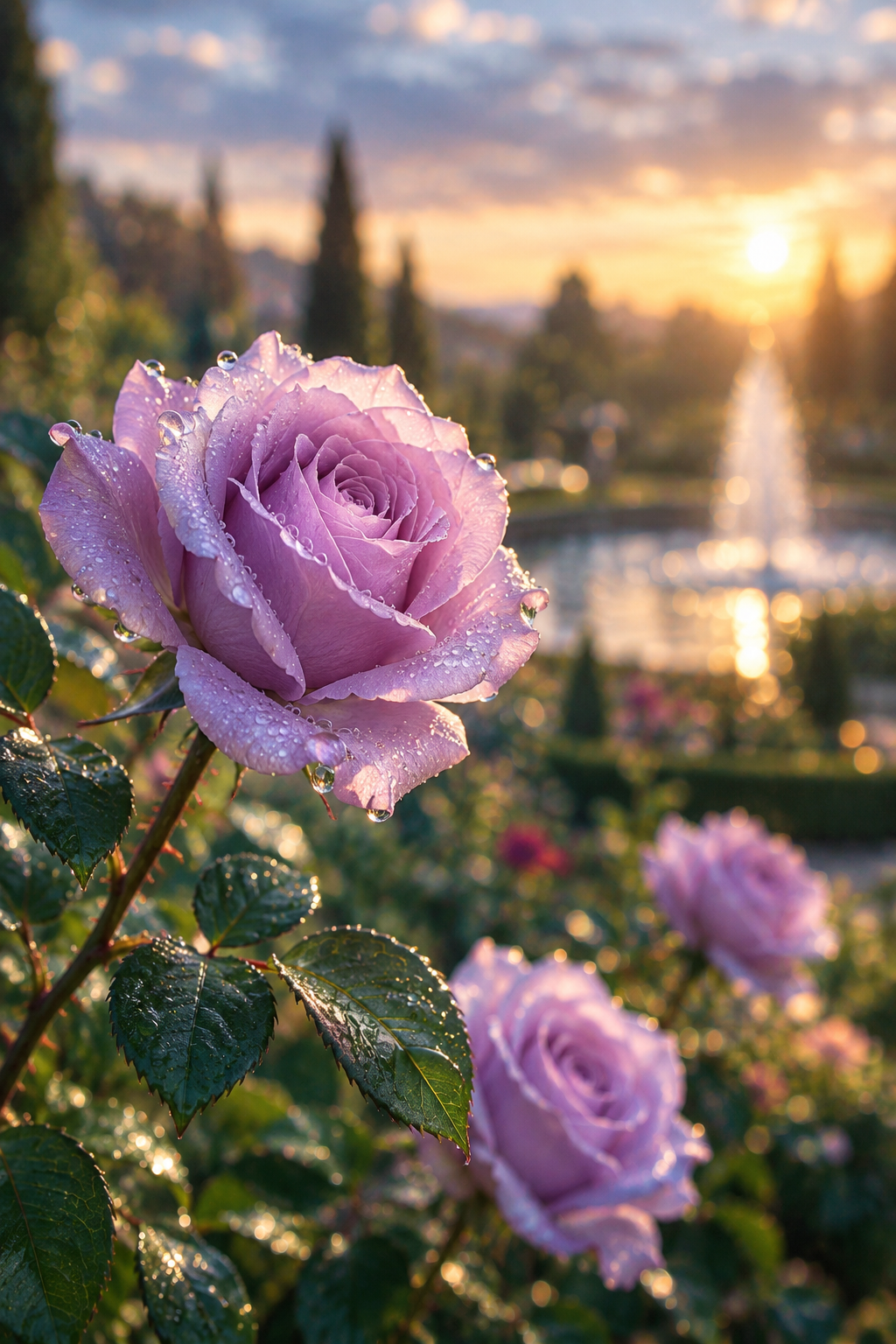
Twilight Reverie in Violet
Critique
1. Introduction A lavender rose fills the left half of a garden at sunset. Its layered center is sharp, while a low sun and its reflection occupy the distant right. These points of interest place floral detail within a broad setting. 2. Description Droplets cover curled petals and collect along their lower edges. Dark, serrated leaves spread beneath the bloom, carrying moisture. Two more roses appear below and to the right, but their contours are softer. Beyond them lie a pond, a vertical strip of reflected sunlight, and narrow tree silhouettes. 3. Analysis Nested petals form a spiral leading inward. Backlighting outlines thin rims, while the interior remains deeper violet. The pond's vertical reflection balances the flower on the left. Repeated blooms lead diagonally into depth, and dark leaves anchor the lower portion. Shallow focus softens distant trees and water. 4. Interpretation and Evaluation The image joins a close study of a rose with a wider view of changing light. Moisture on the petals suggests a recently wet surface, giving the bloom a transient quality without requiring a story. The composition distributes attention effectively between near flower and far sun. Its delicate rendering of droplets and controlled violet-gold color relationship are strengths, though the softened background favors atmosphere over precise landscape description. 5. Conclusion At first, the glowing sky may make the image seem chiefly concerned with sunset. Looking longer brings the rose's folds, droplets, and surrounding leaves into equal importance. The work uses scale and focus to connect a particular flower with a garden and pond, sustaining both close attention and a sense of distance.
Same Subcategory
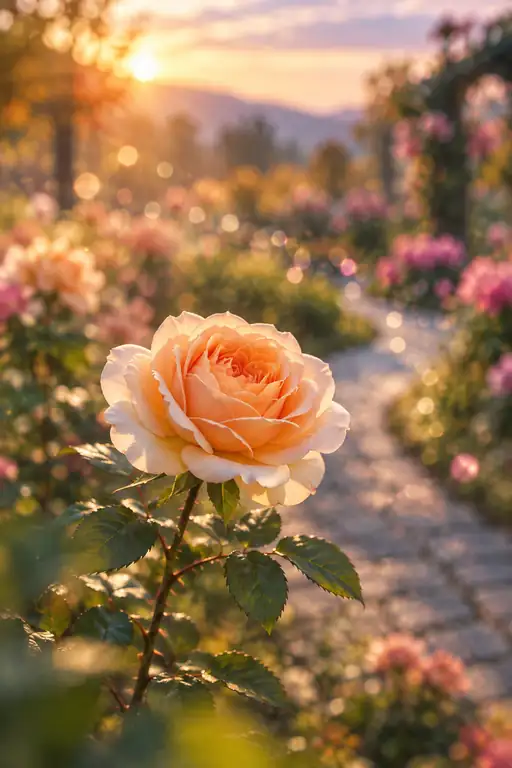 Sunset Elegance on the Cobblestone
Similar Artworks
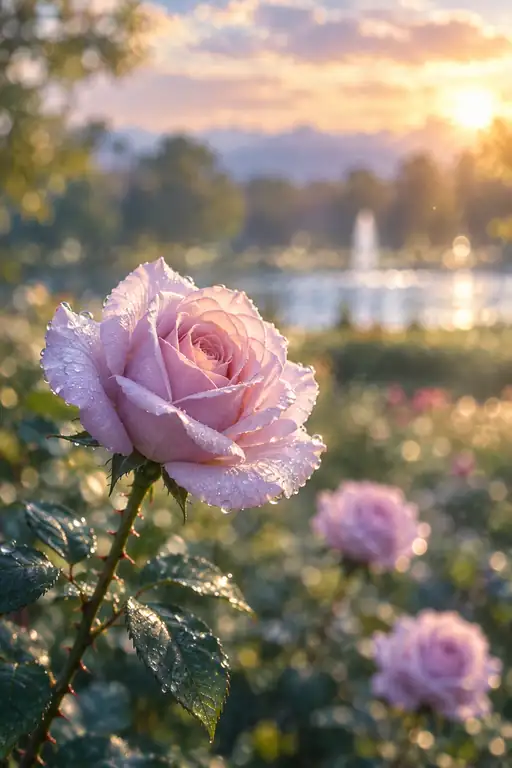 Morning Dew on the Lavender Rose
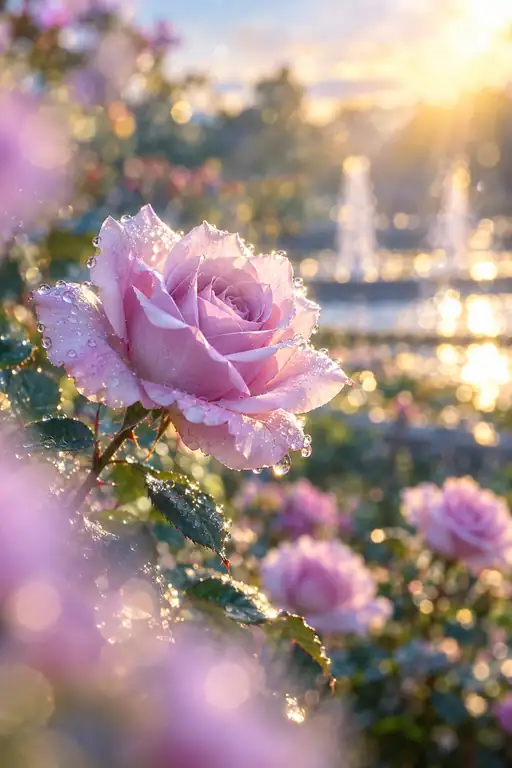 Dewlit Sovereign of the Fountain Garden
 The Morning Opens Gently
 What the Water Remembers
 Lavender Rose by the Shuttered Window
 Apricot Gold Beside the Reflecting Pool
 Glow of the Wrought-Iron Arch
 Lilac Rose by the Fountain Light
 Dewdrops on the Blush Rose by the Window
 Crimson Velvet Beside the Sunlit Pool