
Golden Lights Ascending the Rain-Washed Hill
Critique
Introduction This work depicts a sloping European street after rain, combining ink architecture with leaves, tiny blossoms, and scattered white petals. A row of buildings climbs toward a distant church tower, while golden windows and wet reflections give the pale scene a restrained evening warmth. Description The nearest three-story house fills the left foreground and continues into progressively smaller façades at right. Broad gray-green leaves form pitched roofs and tree canopies, with yellow florets threaded along eaves and vines. Numerous windows contain clustered golden petals. The street rises sharply toward the tower, but its reflected yellow and black strokes run downward through a field of loose white petals. Analysis Two converging diagonals—the roofline and curb—establish strong recession. Repetition of windows, trunks, and lamps measures the climb, while their shrinking scale carries the eye into depth. Dark ink provides architectural structure; overlapping leaves interrupt its rigidity with lifted edges and visible veins. Warm window light balances the cool roofs, and broken reflections prevent the broad street from becoming empty. Interpretation and Evaluation The image suggests a town animated less by visible inhabitants than by stored light and organic growth. Leaves shelter the buildings as roofs and trees, making nature part of the settlement's fabric. The perspective is persuasive, the limited green-gold palette is coherent, and the linework distinguishes masonry, ironwork, and water. Transforming petals into both illuminated panes and rain-slick reflections is technically inventive. Conclusion At first the ascending street appears simply picturesque, but closer viewing reveals a carefully coordinated exchange between built order, vegetation, and weather. The repeated lights turn depth into a gradual rhythm and give the unpeopled scene a quiet sense of occupancy.
Same Subcategory
 Twilight Glow on the Heritage Wall
Similar Artworks
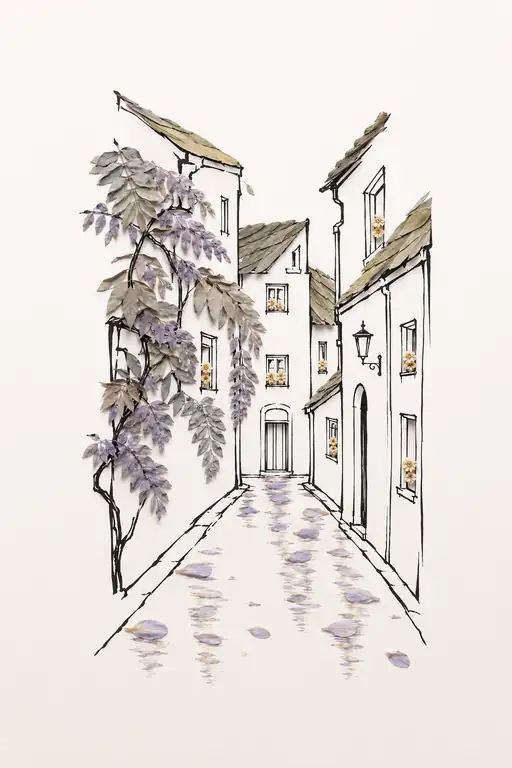 Wisteria Lane Overlooking Cobblestone
 Deep into the Wisteria Lane
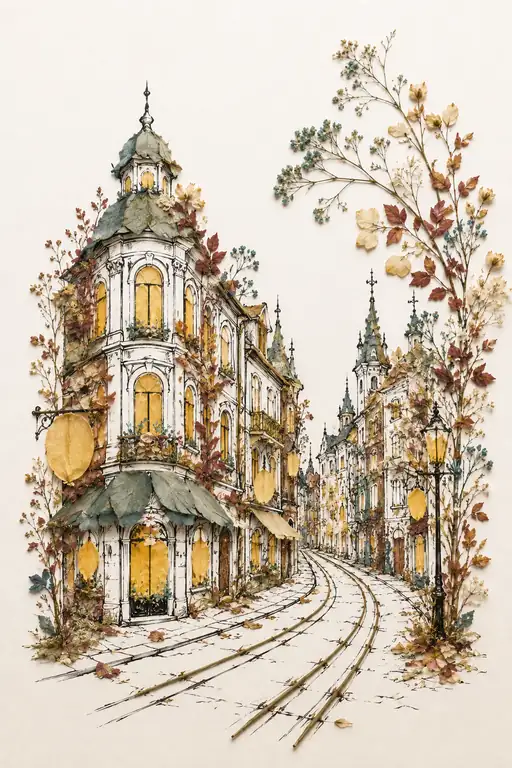 Autumn Nocturne Along the Tramline
 Under a Blue Kindness
 Quiet Convergence After the Rain
 Autumn Rain on the Avenue
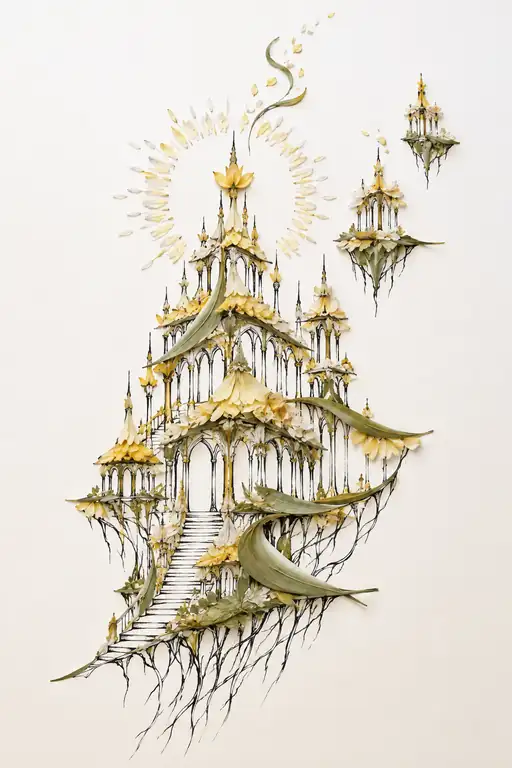 Floating Cathedral Reaching for the Golden Halo
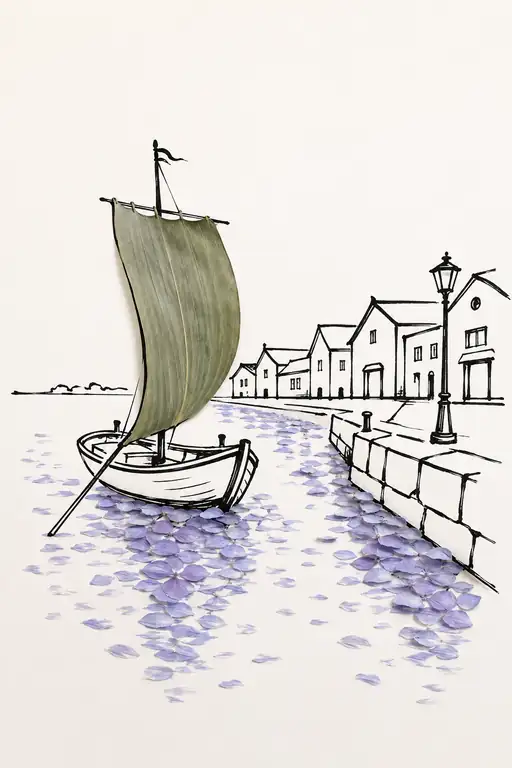 Canal Journey Under Pale Skies
 The Day Has Room for Joy
 Stepping into the Golden Streetlamp Glow