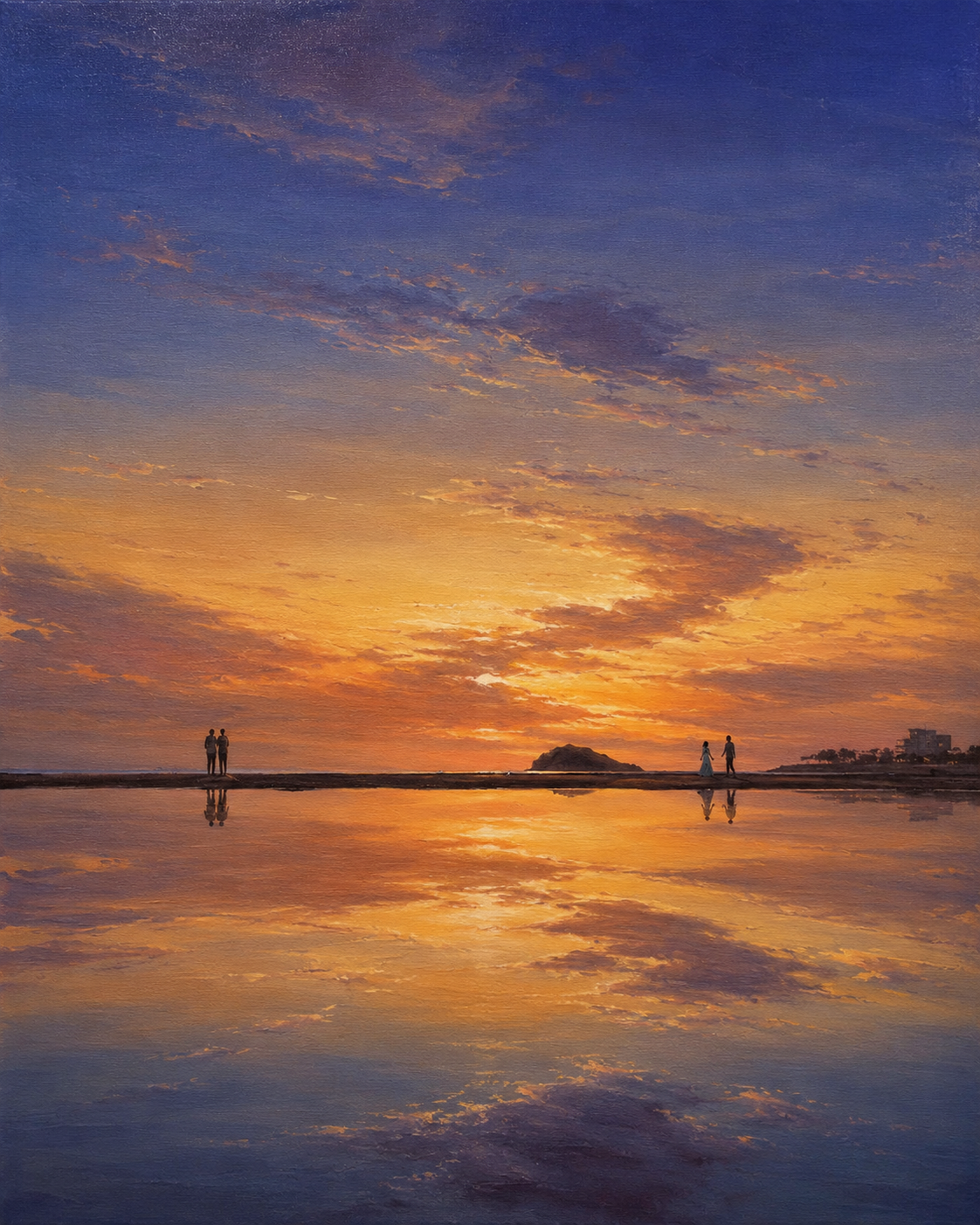
Boundary of Sky and Sea
Critique
Introduction This minimalist twilight scene reduces coast, people, and reflection to a few measured elements. An enormous orange-violet sky and its mirrored double make the narrow horizon feel like a delicate boundary between two worlds. Description The frame is divided near the middle by a thin dark tidal strip. Two pairs of figures stand far apart upon it, each reflected below. A low island silhouette sits near center, while sparse buildings and trees gather at far right. Layered clouds spread across a sky shifting from orange near the horizon to deep blue above; shallow water repeats the colors below. Analysis Horizontal symmetry is the central device, but ripples and broken cloud reflections prevent mechanical duplication. The figures act as sparse vertical notes across an immense field. Their unequal positions balance the island and distant shore without formal centering. Warm orange occupies the central band, enclosed by cooler violet-blue above and below. The very low detail level at the horizon concentrates attention on interval, silhouette, and reflected light. Interpretation and Evaluation The image makes companionship appear both intimate and cosmically small. Each pair occupies its own silence, connected by a shared horizon rather than direct interaction. The tidal strip resembles a threshold suspended between sky and water, and reflection doubles each presence while also making it less substantial. The composition risks sentimentality through its glowing sunset, yet extreme restraint and abundant empty space keep it contemplative. The distant island provides a quiet measure of earthly permanence amid changing light. Conclusion Through radical simplification, mirrored atmosphere, and carefully spaced figures, the work gives twilight a meditative scale. Its emotional force comes from how little it needs to say about being together.
Same Subcategory
Similar Artworks
 Standing in the Golden Tide
 Walk into the Golden Horizon
 In the Mirror of Dusk
 Golden Hour at the Crossing
 Standing in Another Sunset Sky
 Cape Lighthouse and Sunset Caryopteris
 The Tide Returns Our Footsteps to Light
 A Prayer Above the Burning Sea
 The Horizon's Burning Farewell
 Golden Embrace of the Twilight Tide