
Ray of Grace on the Sand
Critique
Introduction Under a broken, dramatic sky, this tidal sandbar becomes a path of light toward a wooded islet. Successive pairs of walkers and descending sunbeams give the coastal scene a meditative, almost processional character. Description The sandbar begins at the lower right and curves toward an island at upper left. Couples walk away at regular distances, casting long shadows. Dark blue water and clear green shallows border the path. Heavy gray clouds occupy the upper half, opening near the upper right to release gold-edged light and visible rays across the sea. Dark foliage frames the bottom. Analysis The path's luminous diagonal counters the broad horizontal layers of sea, hills, and clouds. Repeated pairs shrink toward the island, marking both depth and duration. Warm sand and sunlit water oppose blue-gray sky and shadowed sea. Rays descend in fanlike diagonals, converging visually with the sandbar's route. The island is a dark, compact terminal shape; distant ridges extend the space beyond it. Foreground foliage and rocks establish a shadowed viewing ledge. Interpretation and Evaluation The transient crossing becomes a metaphor for accompanied passage under uncertain conditions. Dark clouds do not erase access; light selectively reveals the route. The pairs may suggest intimacy, solidarity, or simply shared timing imposed by tide. The repeated motif approaches symbolism, but varied spacing and natural postures keep it grounded. Dramatic rays verge on the sublime, while detailed shallows and footprints preserve physical immediacy. The island is destination, yet the procession itself holds the emotional center. Conclusion Through opposing diagonals, measured figures, and weather-driven illumination, the work turns temporary geography into a reflective journey. Its hope is persuasive because it remains surrounded by shadow and change.
Same Subcategory
 Golden Beach of Petals Under the Twilight Sun
Similar Artworks
 Before the Tide's Promise Unravels
 Golden Hour at the Crossing
 The Road the Tide Lends to Lovers
 The Sandbar Draws a Promise on the Sea
 Golden Passage of the Receding Sea
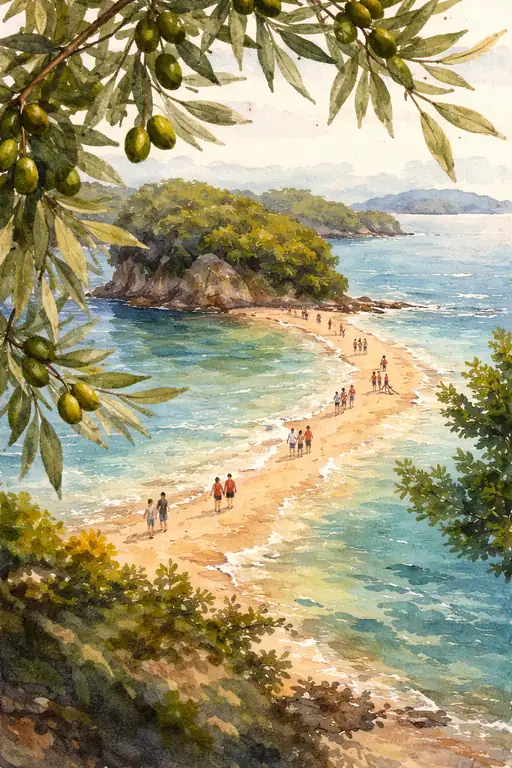 The Path That Appears with the Tide
 Footsteps Along the Road of Angels
 Where Sea and Sky Exchange Silence
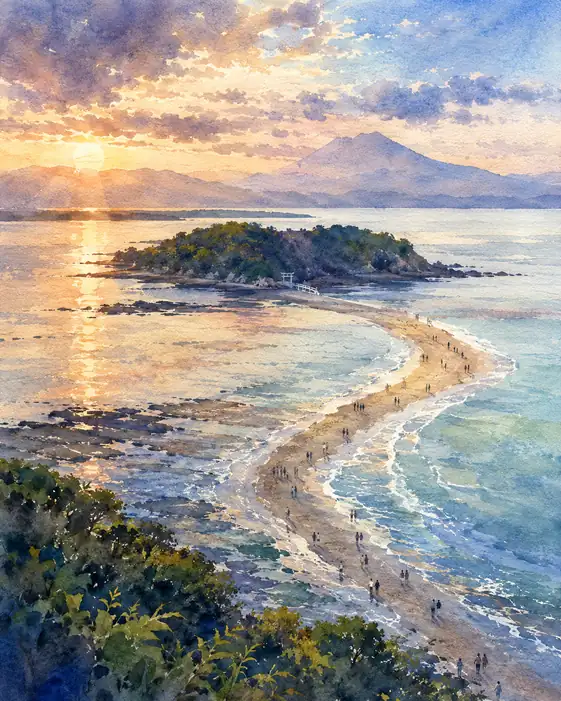 The Tide Lays Down a Path to Prayer
 Boundary of Sky and Sea