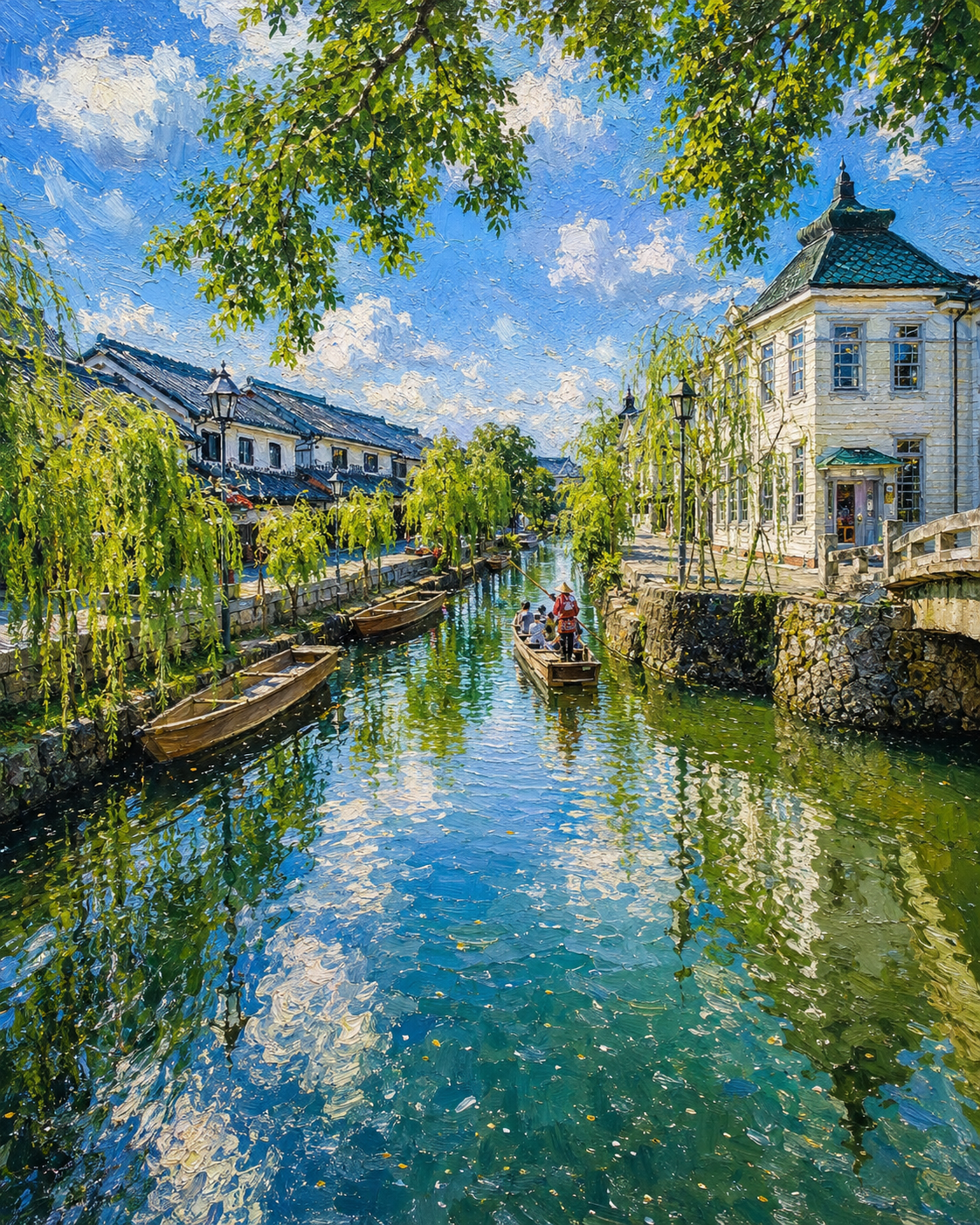
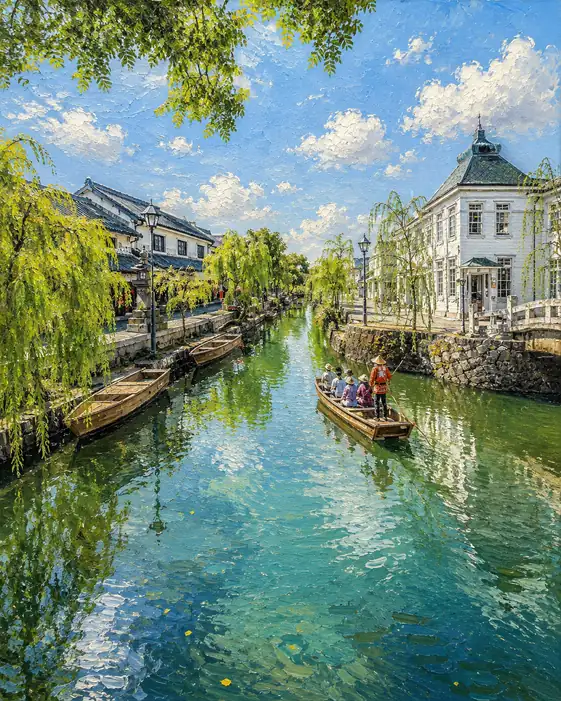
Summer Sky upon the Historic Canal of Kurashiki
Critique
Introduction This canal view uses overhead trees and a centered passenger boat to balance intimacy with distance. The scene becomes a sheltered route through layered architectural history. Description Green-blue water stretches from the foreground toward a narrow center, where a boatman in red poles a small craft carrying passengers. Empty wooden boats lie along the left bank beneath willows and tiled white storehouses. At right, a large white building with a dark tower roof rises above stonework and a bridge. Broad green branches arch across the top. White clouds and bright walls appear as broken reflections among darker tree shapes and scattered floating leaves. Analysis The boat occupies the central axis but remains small enough to preserve the canal's breadth. Overhead branches form a dark-green arch echoed by drooping willows along both banks. Architectural masses balance asymmetrically: low, horizontal storehouses oppose the tall civic building. Empty boats establish a diagonal sequence from lower left into depth, while the passenger craft advances on a separate central line. Reflected clouds open pale intervals in the water, countering dense foliage. The pole introduces a fine oblique that makes otherwise stable symmetry active. Interpretation and Evaluation Passage is sheltered but not enclosed. Trees offer canopy, buildings define civic edges, and water retains an open route. The boatman negotiates these systems physically, while passengers experience history through movement. Moored boats indicate continuity beyond tourism. Architectural traditions remain different, yet the canal creates a shared scale of use. Middle distance lets viewers identify labor while perceiving the larger urban pattern supporting it. Conclusion Centered movement, framing, and contrasting scales join journey to civic continuity. The canal becomes an opening where history remains traversable.
Same Subcategory
Similar Artworks
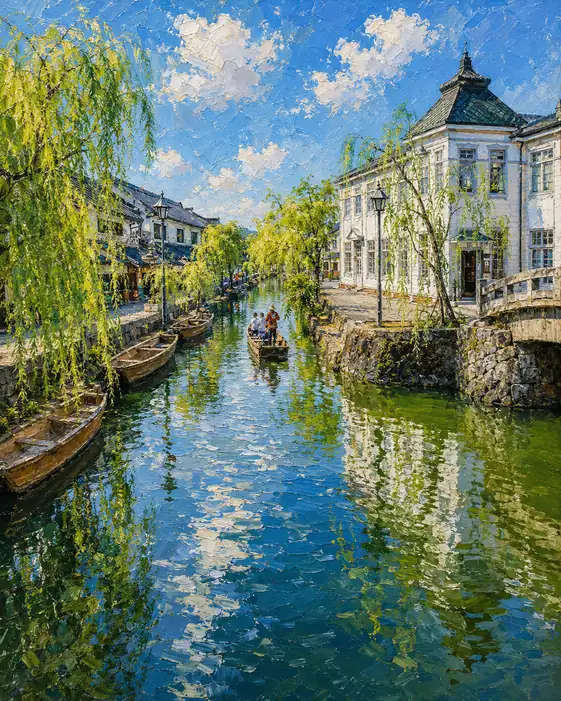 Azure Reflections on the Willow Canal of Kurashiki
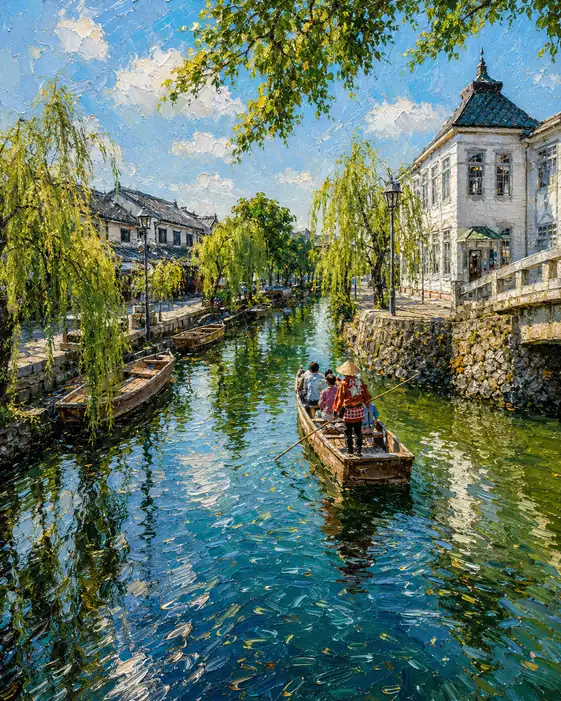 Shimmering Canal and the River Boat of Kurashiki
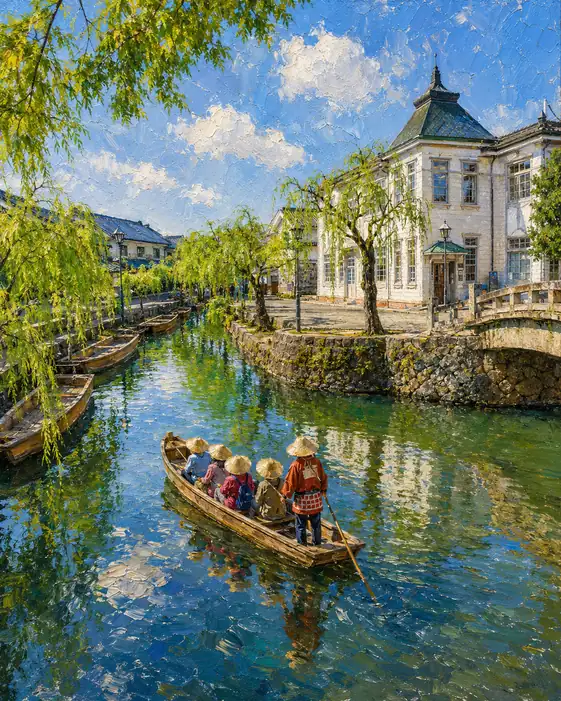 By Boat Between Willows and White Walls
 Punting along the Willow Canal of Kurashiki
 Whispers of the Willow in the Morning Light
 Opening of the Sunlit Waterway
 There Is Still Time to Wander
 An Afternoon Carried by Water
 Ripples of Forgotten Time
 Golden Ripples of Yesterday