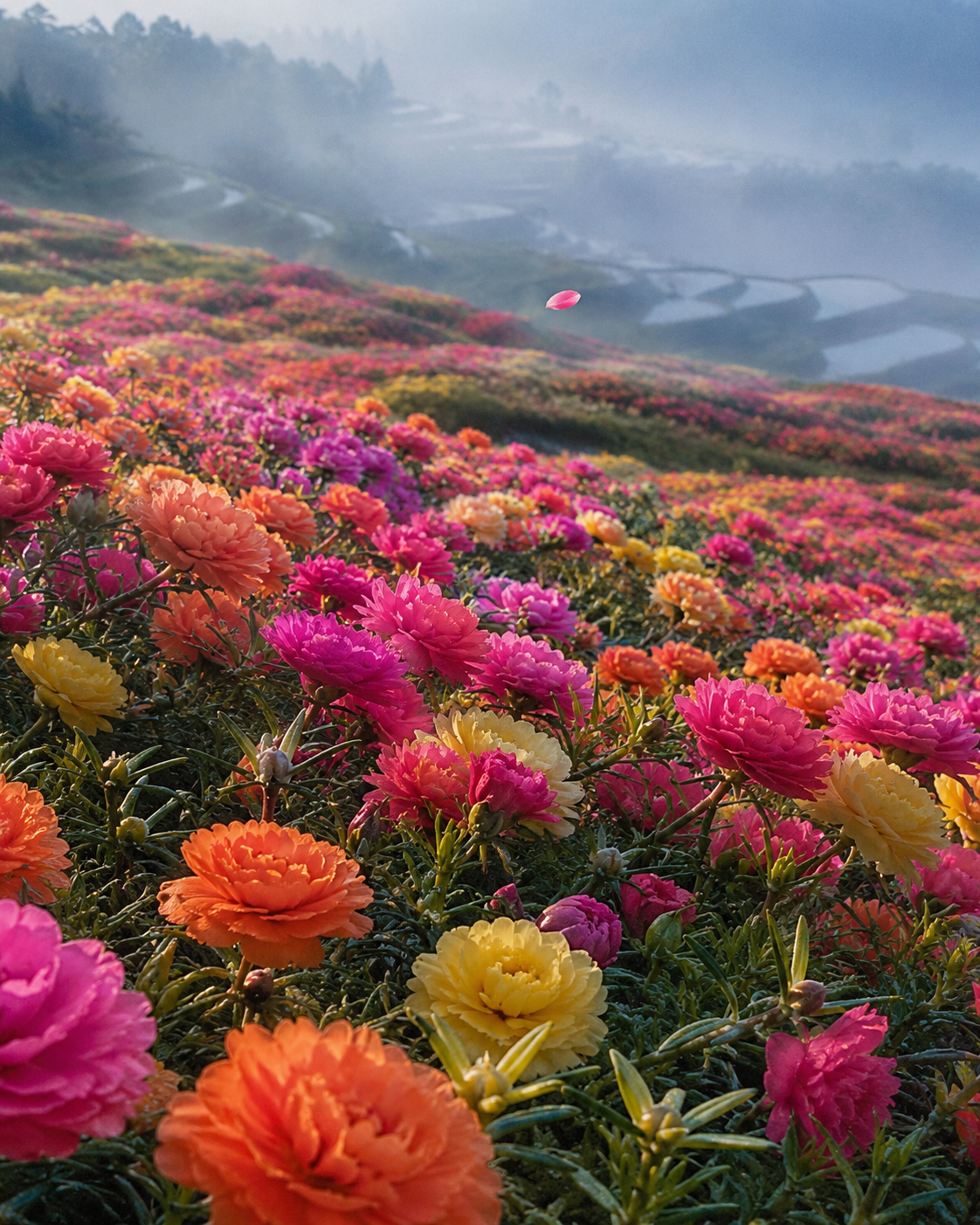
Moss Rose Meadow above the Misty Rice Terraces
Critique
Introduction This misty hillside turns an extensive portulaca planting into bands of living color. One airborne pink petal becomes a tiny event between the sharply present flowers and the nearly dissolved terraces beyond. Description Orange, yellow, pink, and magenta blossoms crowd the foreground among dark, needle-like leaves and numerous buds. Their bands continue diagonally across the slope, becoming smaller and softer with distance. Near the center, a single pink petal floats against pale haze. The upper half contains bluish wooded ridges and curving stepped terraces or covered plots, all partly obscured by mist. Light enters from the left and catches selected petals. Analysis Repeated color bands articulate the steep terrain more clearly than contour lines. Sharp foreground flowers establish tactile density, while progressive blur and desaturation transform the upper slope into atmosphere. The floating petal occupies the tonal gap between saturated land and cool haze, making a small form unusually legible. Curved terraces echo the planted bands but in muted gray-blue, joining cultivation across depth. Diagonal movement rises from lower right toward upper left, countered by the petal's apparent suspension. Warm and cool zones remain distinct yet interdependent. Interpretation and Evaluation The image sets abundance against disappearance. Each flower belongs to a cultivated pattern, but the detached petal asserts a temporary trajectory. Mist removes detail without erasing land, suggesting memory rather than emptiness. Terraces and repeated beds reveal human shaping without showing workers; care appears as pattern. The petal prevents the panorama from becoming decorative, giving change a visible center. Equivalence between horticultural rows and distant landforms makes cultivation seem woven into the mountain. Conclusion Bands, recession, and one fragment balance flowering with loss. The hillside remains exposed to weather.
Same Subcategory
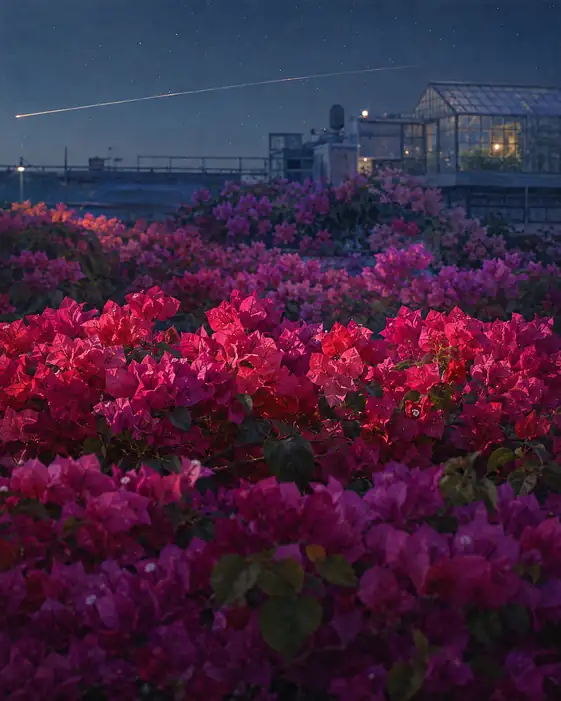 Starlit Bougainvillea Garden and the Illuminated Greenhouse
Similar Artworks
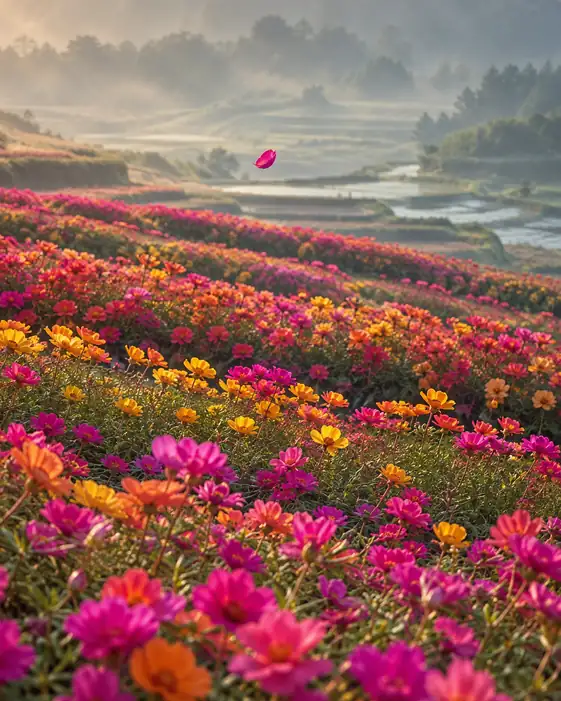 Floating Petal above the Terraced Garden
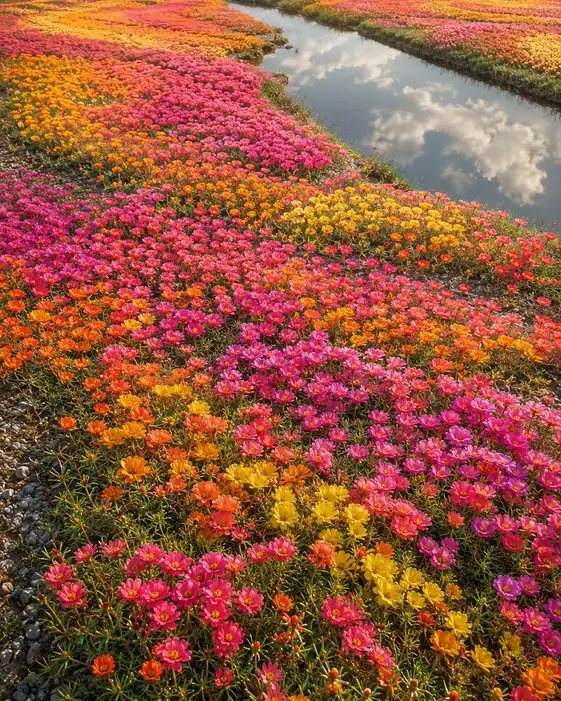 Rainbow Carpet of Moss Roses along the Canal
 Sunset Glow over Coastal Moss Roses and the Distant Lighthouse
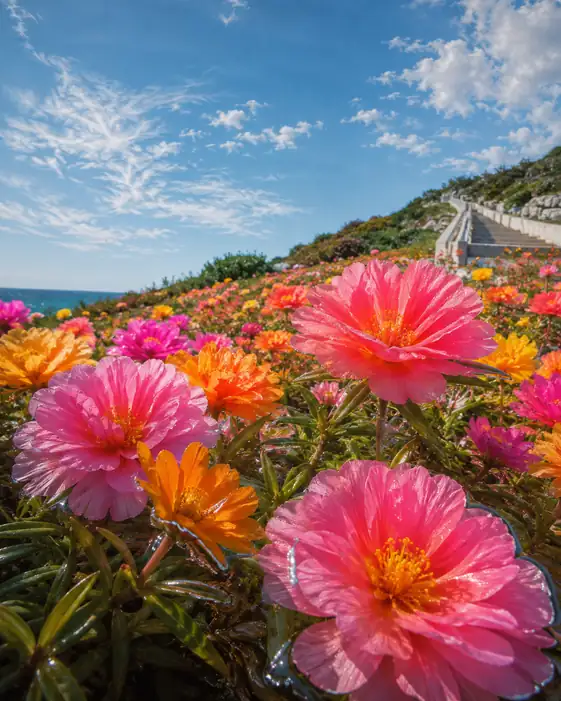 Moss Rose Hills along the Coastal Stairway
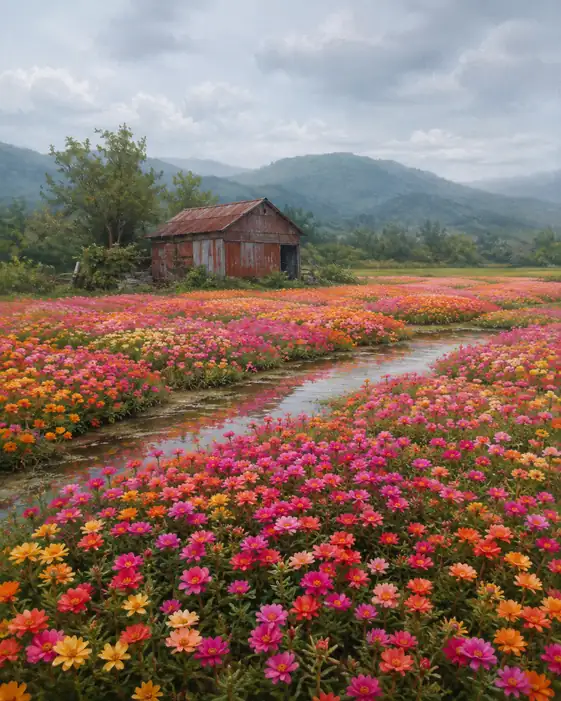 Stream through the Portulaca Meadow
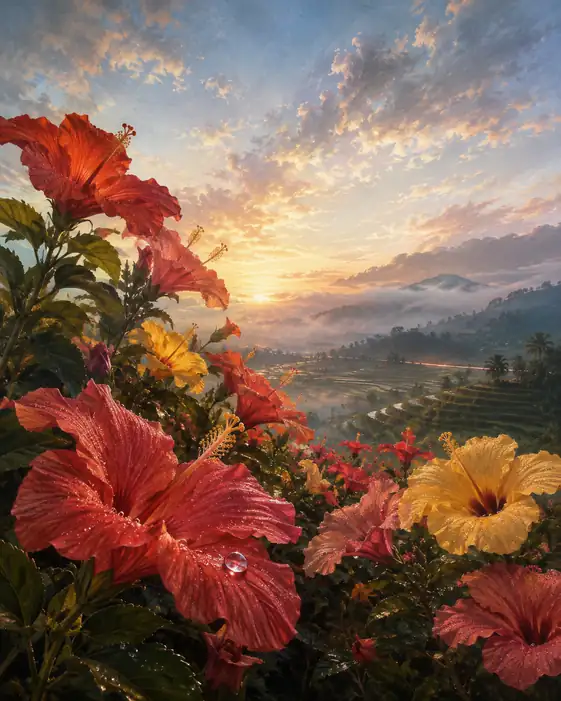 Morning Dew on Hibiscus above the Terraced Valleys
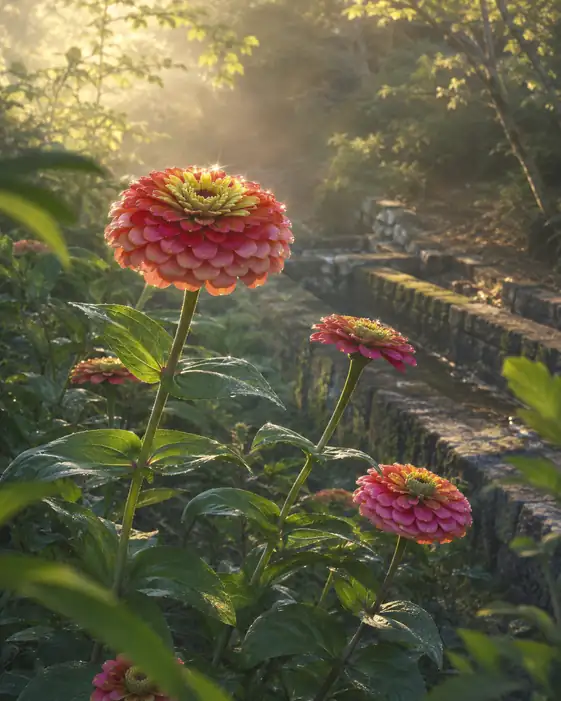 Sunlit Zinnias beside the Mossy Stone Channel
 Coastal Moss Roses overlooking the Pier
 Sunlit Portulaca Blossoms and Rainbow Light
 Dahlia Slopes beneath the Morning Clouds