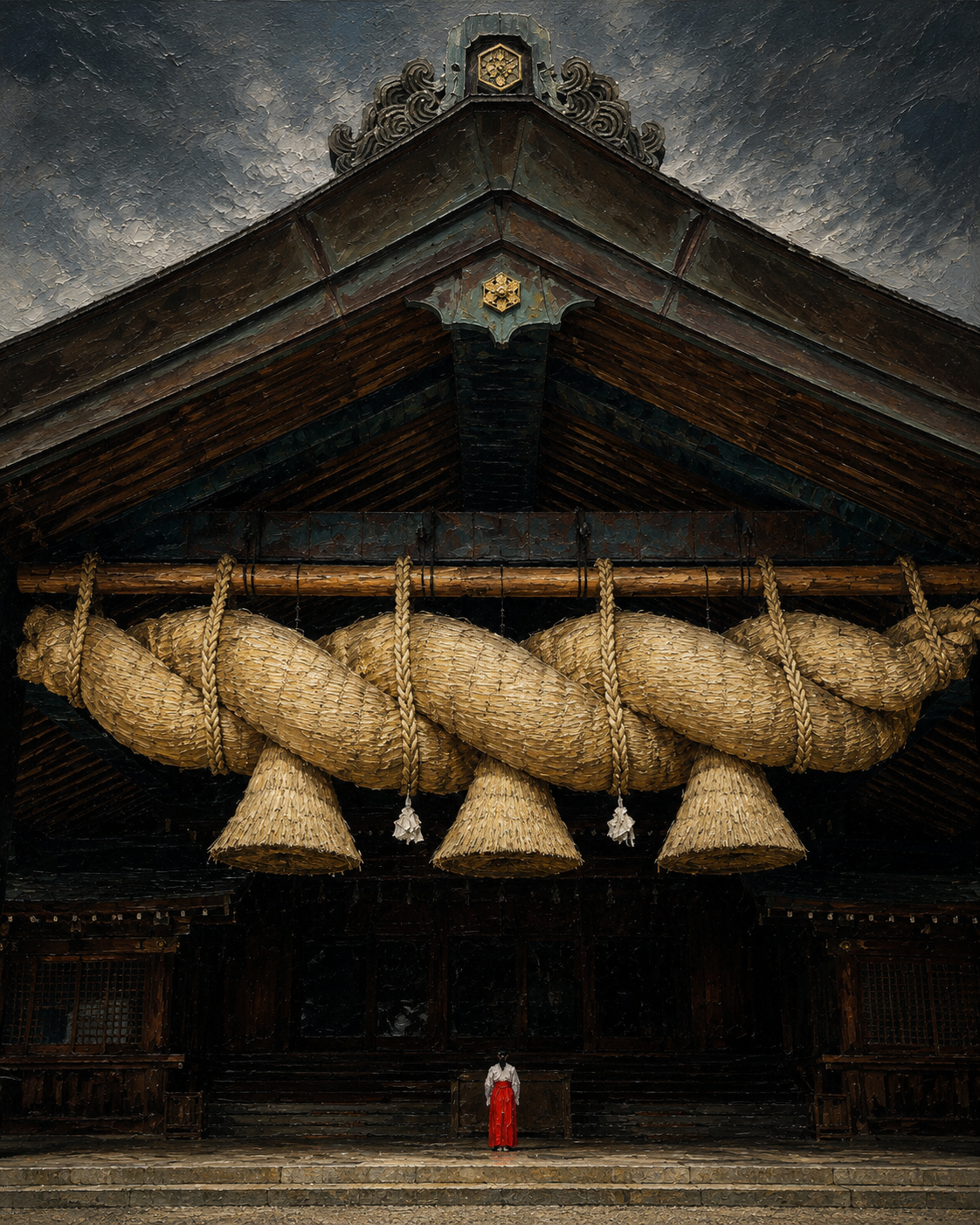
Solemn Gables and the Great Shimenawa
Critique
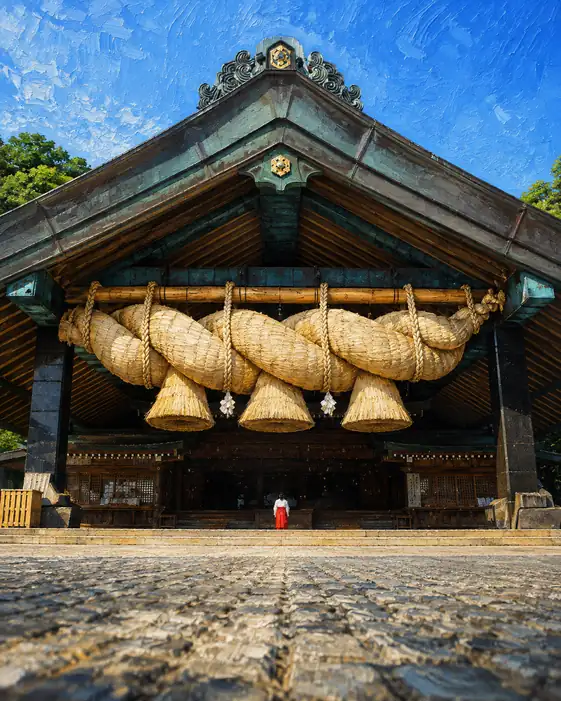
Introduction This tightly cropped façade makes the sacred rope an overwhelming body above human activity. Almost no landscape remains, so scale, weight, and frontal confrontation dominate. Description Dark roof planes rise to a central ridge capped by scrollwork and gold emblem against narrow gray sky. A second crest marks the gable. An immense straw braid spans the middle, secured by cords and bearing three tassels with white ornaments. Shadowed timber, lattice windows, and steps occupy below. A tiny white-and-red attendant stands centrally. Analysis The crop compresses the building into triangle, horizontal rope, and minute vertical figure. The braid occupies the brightest zone; swollen loops create a slow rhythm against converging diagonals. Pale fiber advances from black architecture, while red clothing gives a chromatic endpoint. Thick marks describe straw as interwoven strokes and timber as dark bands. With foreground eliminated, the viewer confronts rather than approaches the threshold. Interpretation and Evaluation The image stages sacred boundary as pressure. Exaggerated rope embodies communal labor and tradition, but also responsibility above the attendant. The centered figure suggests disciplined participation, not helplessness. Gray sky and deep interior suppress celebration, focusing endurance. Symmetry could become diagrammatic, yet weathered color, irregular fiber, and uneven darkness retain life. Denying spatial escape makes reverence emerge through confrontation with weight. Conclusion Through radical cropping, severe tonal contrast, and a single human measure, the work turns a familiar shrine front into an experience of concentrated obligation and awe. The tiny red figure does not lessen the rope's magnitude; it reveals why that magnitude matters.
Same Subcategory
Similar Artworks
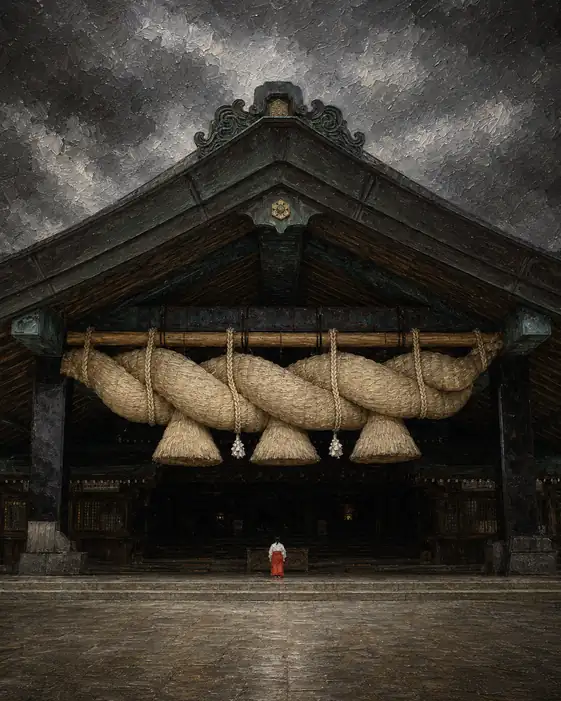 Shrine Maiden under the Storm-Laden Sky
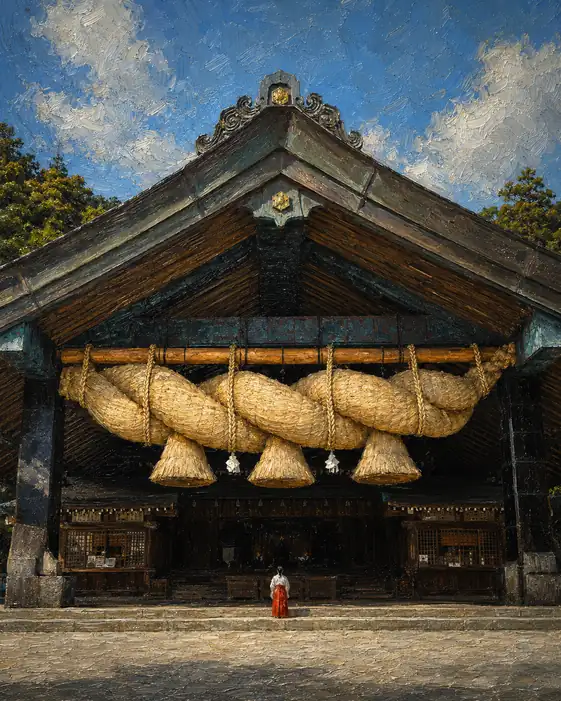 Maiden before the Sacred Shimenawa
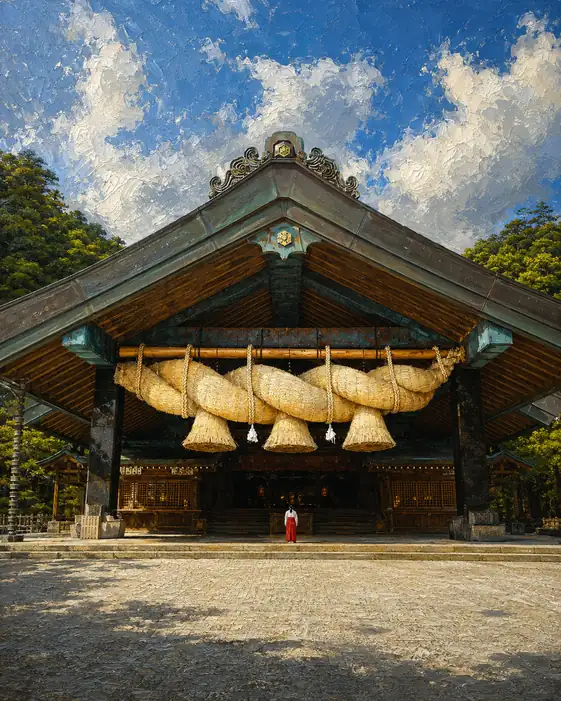 Summer Clouds over the Grand Shimenawa Sanctuary
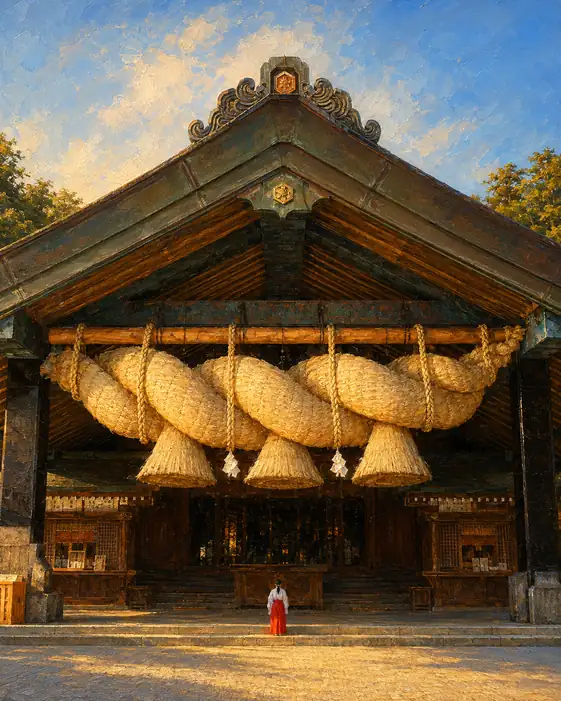 Golden Radiance on the Great Shimenawa
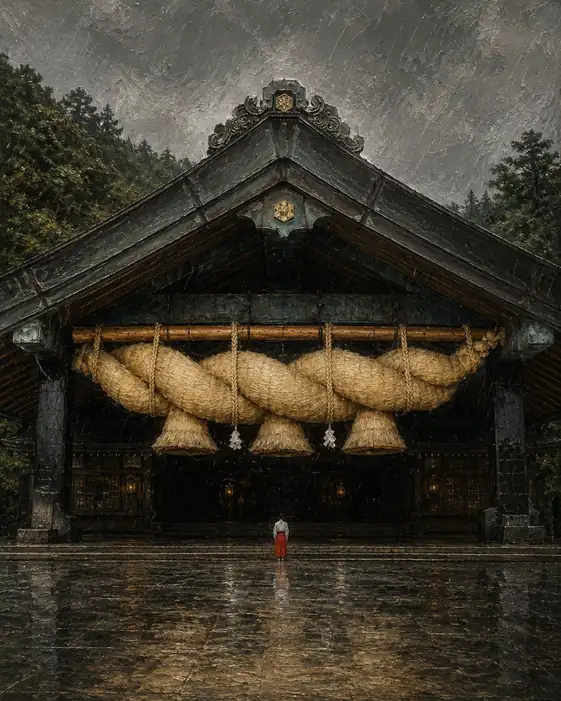 Maiden on Rain-Wet Flagstones before the Great Shimenawa
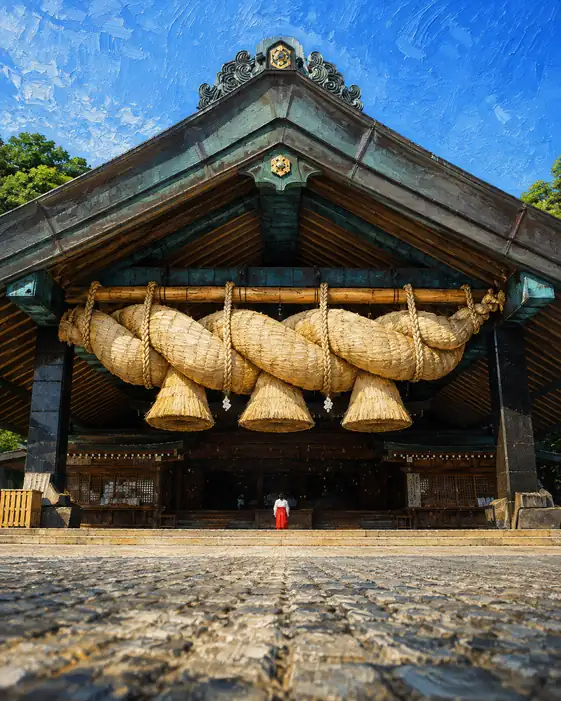 Izumo, a Prayer Binding the Sacred Realm
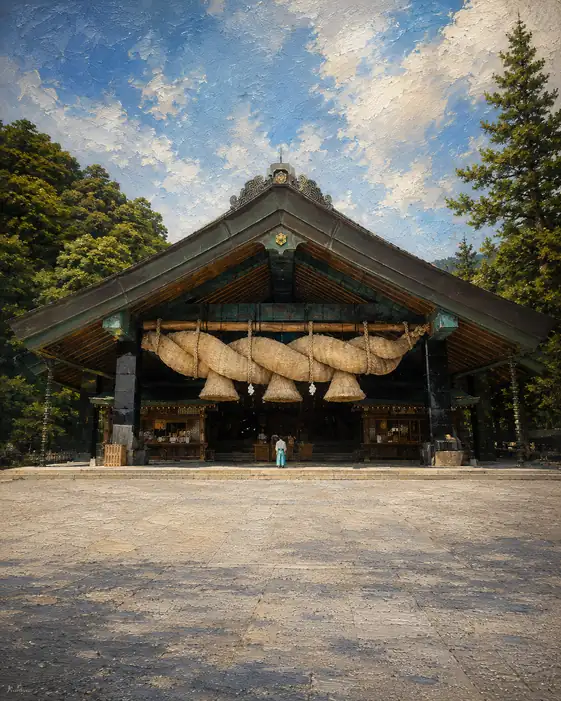 Open Courtyard before the Sacred Shimenawa
 Low Angle View of the Great Shimenawa Sanctuary
 One Prayer Beneath the Great Rope
 Rain Enters the House of Prayer