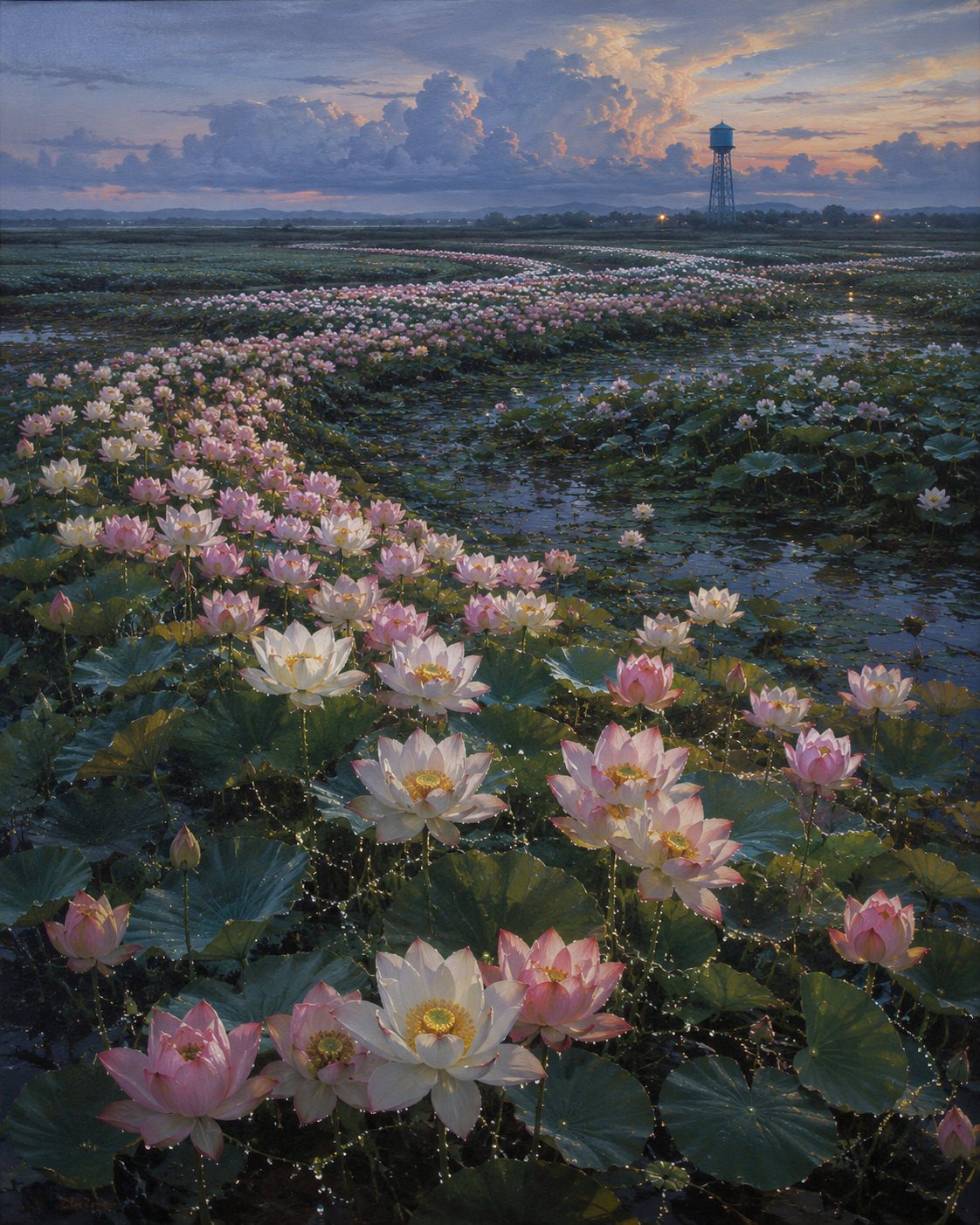
River of Lotus Blooms under the Sunset Cloud
Critique
Introduction This painting depicts a lotus-growing landscape at the transition from daylight to evening. Illuminated white and pink blossoms cluster in the foreground, while winding channels and flowering bands extend toward a water tower beneath clouds. Description Open lotuses and upright buds rise among blue-green leaves across the lower half. Droplets catch along stems and leaf edges, forming gold points. Beyond them, dark water routes curve between rows of paler blossoms and converge near the horizon. A blue tank on a metal frame stands to the right, accompanied by scattered lamps, trees, hills, and violet-gray clouds edged with peach light. Analysis The nearest flowers form a bright triangular field that narrows into repeated ribbons across the middle distance. Water channels act as dark counter-lines, bending the gaze toward the tower and horizon. The tower's vertical balances the clouds' swelling mass and gives the wide terrain a fixed measure. Cool blues and greens dominate, while pink petals, orange lamps, and narrow cloud rims distribute warmth. Reflected points and wet contours sustain depth after direct sunlight has faded. Interpretation and Evaluation The water tower and channels reveal an infrastructure supporting the apparent natural abundance. Their visibility encourages a reading of the landscape as cultivated and maintained rather than untouched. Depiction distinguishes luminous petals, leathery leaves, shallow water, distant vegetation, steel framework, and dense vapor with technical control. The color design is restrained, and the unusual pairing of lotus rows with utility architecture gives the composition an original, unsentimental character. Conclusion What first appears to be a tranquil field of evening flowers gradually becomes an account of a working wetland, where water routes, planted growth, machinery, weather, and human activity remain visibly interdependent.
Same Subcategory
Similar Artworks
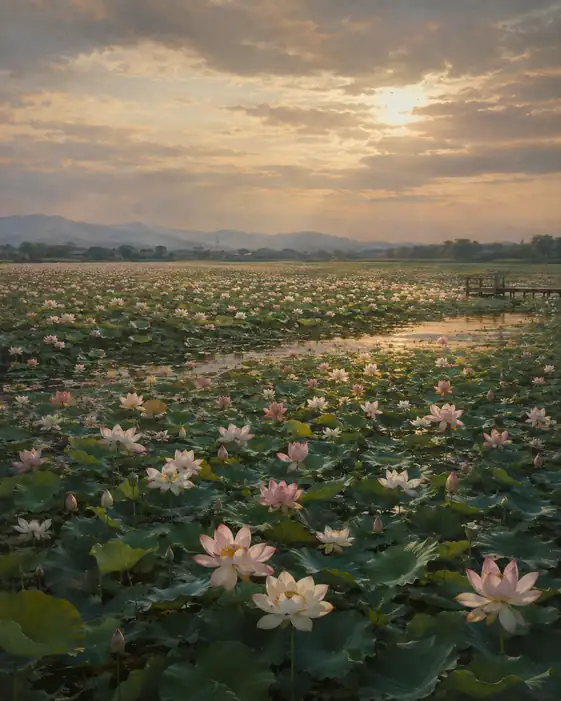 Sunset Radiance over the Vast Lotus Marsh
 River of Lotus Blooms under the Anvil Cloud
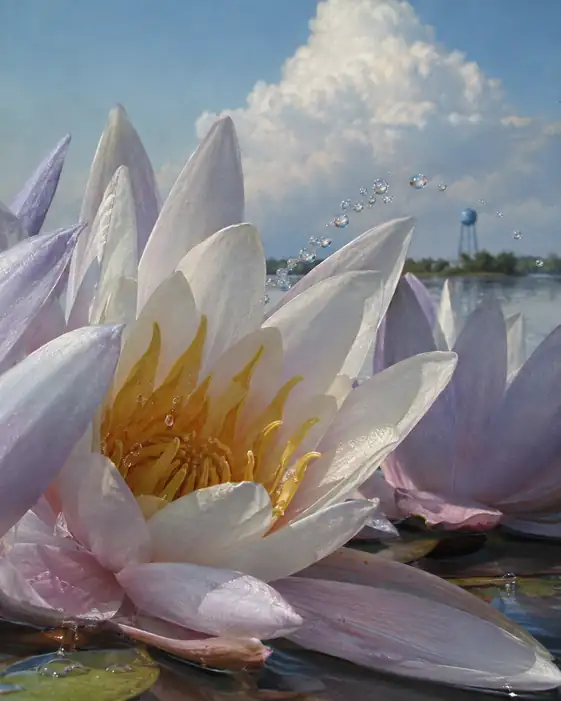 Water Lily and Droplets beneath the Summer Cloud
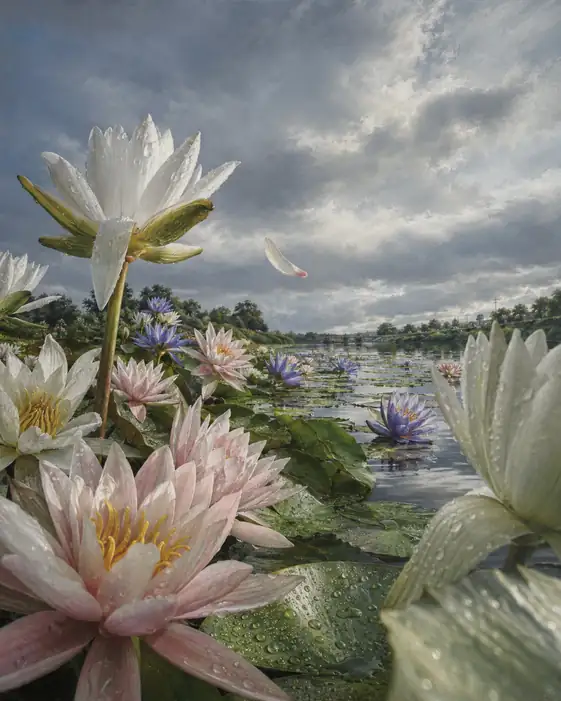 Floating Petal over the Rain-Wet Lilies
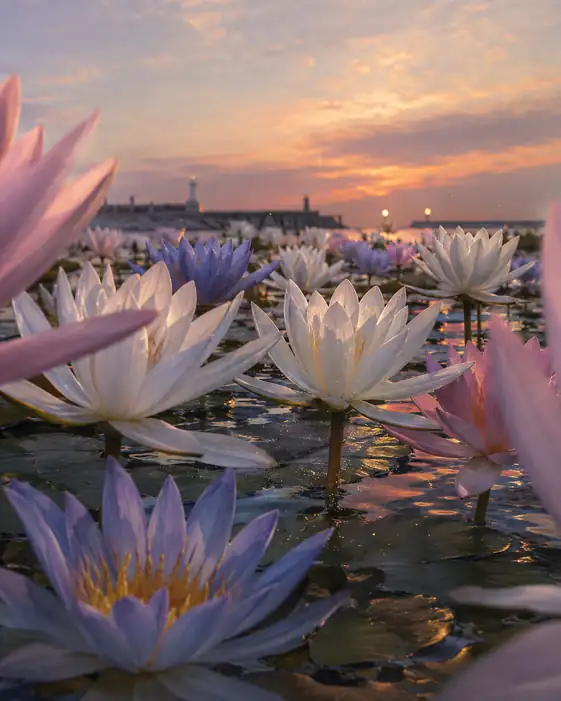 Lilies of the Twilight Harbor
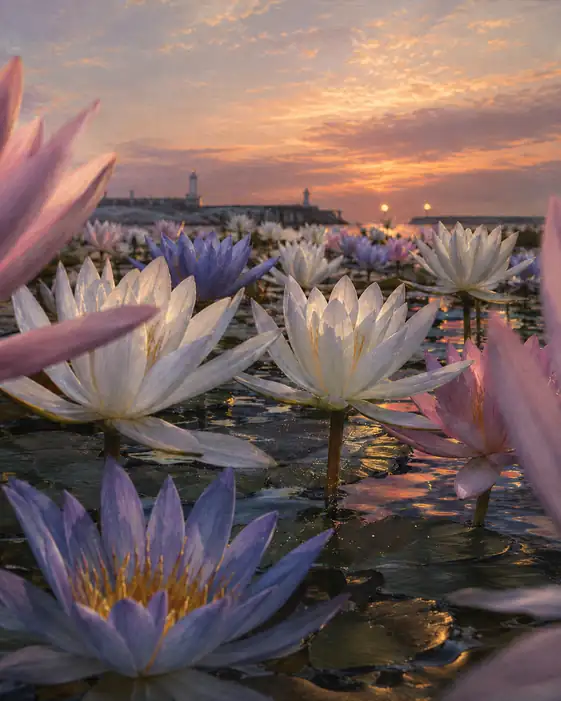 Water Lilies under the Sunset Harbor
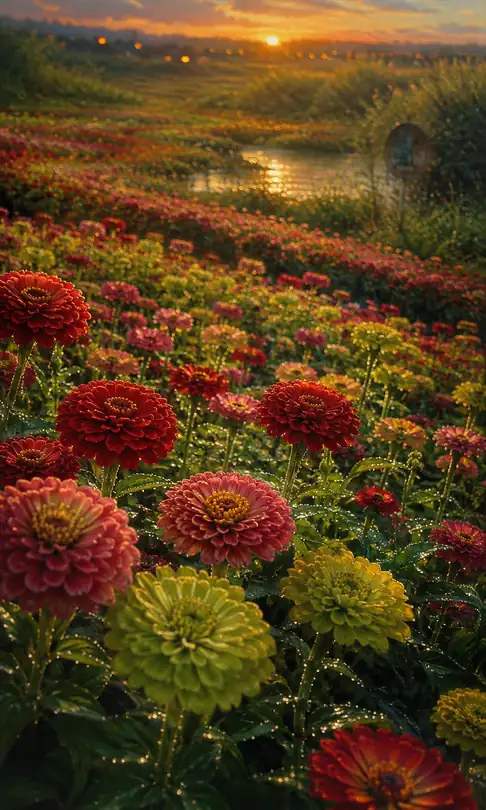 Sunset Glow across the Zinnia Meadow
 Dahlia Slopes beneath the Morning Clouds
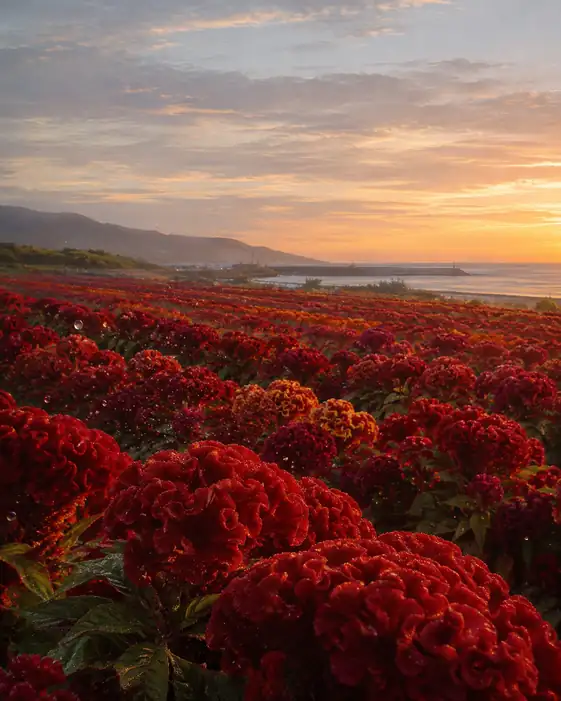 Crimson Slopes of Cockscomb at Sunset
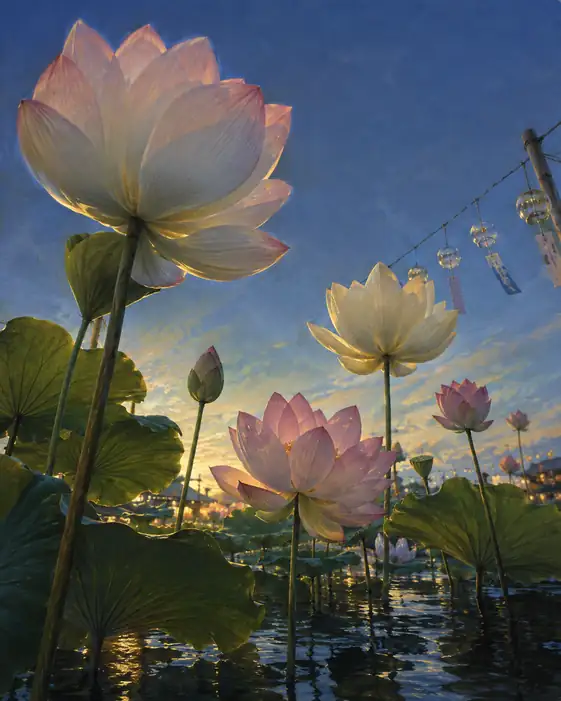 Lotus Blooms and Wind Chimes at Twilight