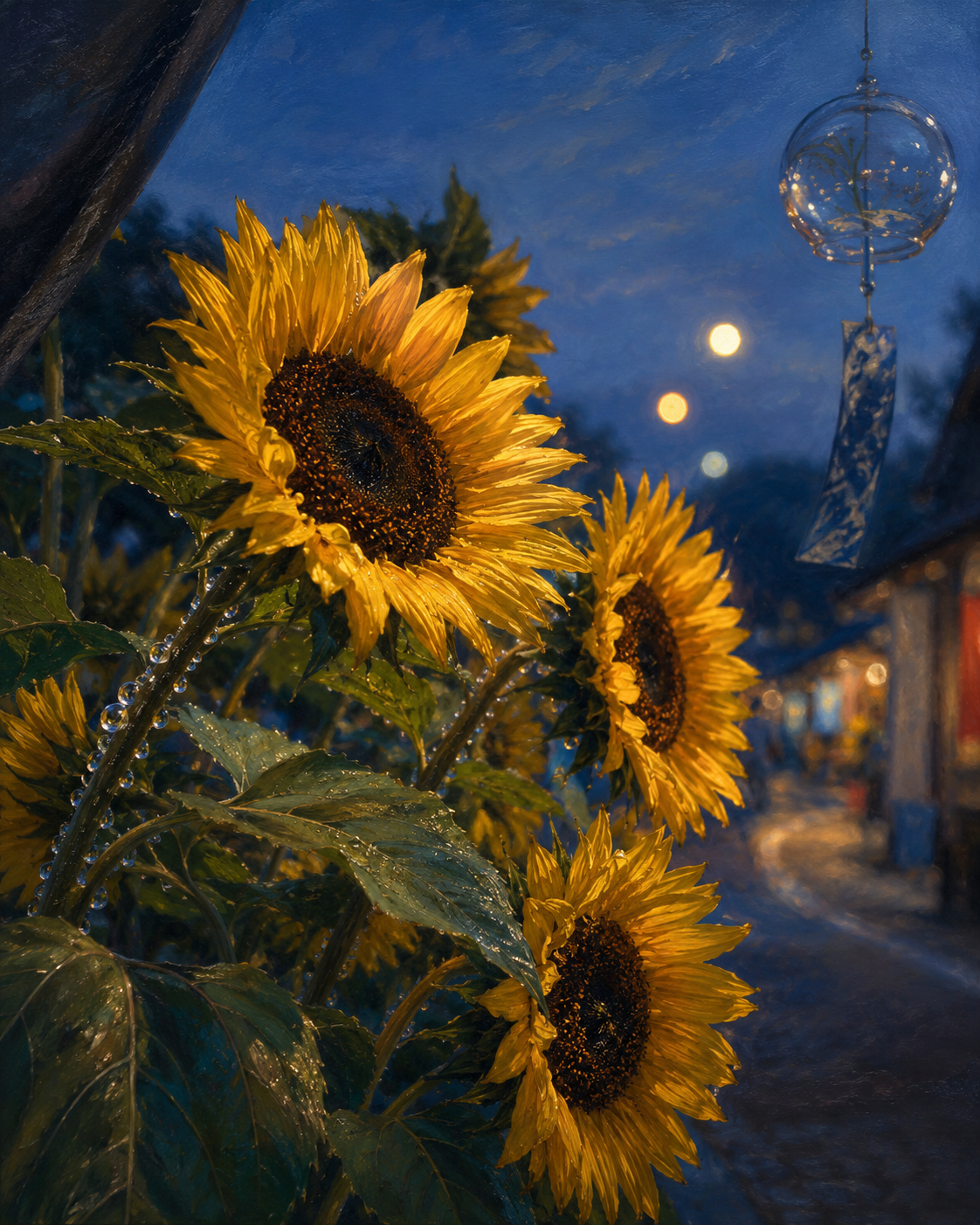
Sunflowers and Wind Chime in the Twilight
Critique
Introduction This painting presents rain-wet sunflowers beside a dim street at blue hour, with a glass wind chime above. The close view and evening lights combine summer vitality with quiet after rain. Description A large sunflower dominates the upper-left foreground, its uneven golden petals surrounding a dark seed head. Two smaller flowers descend diagonally toward the lower right. Broad leaves and thick stems carry clear droplets. At upper right, a transparent spherical chime encloses a delicate plant motif and supports a blue patterned paper strip. Three blurred circular lights recede through the blue background; warm shopfront glows appear at far right. Analysis The flowers form a descending diagonal that leads from the largest head toward the street. The hanging chime balances this weight across the open sky. Sharp droplets, petal ridges, and leaf veins contrast with softened architecture and round distant lights, establishing depth through focus. Warm illumination passes through yellow petals and gathers on water beads. Golden orange opposes saturated blue, while dark green foliage anchors the lower field. Interpretation and Evaluation Sunflowers associated with daylight remain luminous after sunset and rain, suggesting persistence rather than peak brilliance. The wind chime adds implied sound and air movement to a still image. Its glass echoes spherical droplets and blurred lamps. Asymmetrical composition, complementary color, wet textures, and coordination of flower, weather, light, and seasonal object are effective. Conclusion At first the largest sunflower appears to be a straightforward floral portrait, but closer viewing distributes attention among droplets, lights, and suspended chime. The scene becomes a record of several delicate sensations after rain, with visual warmth held inside a cool and spacious evening.
Same Subcategory
 Golden Bands across the Canna Field
 Sunflowers and the White Cottage at Sunset
Similar Artworks
 Crape Myrtle and Wind Chimes Beneath the Twilight Trail
 Crape Myrtle Reflected in the Twilight Puddle
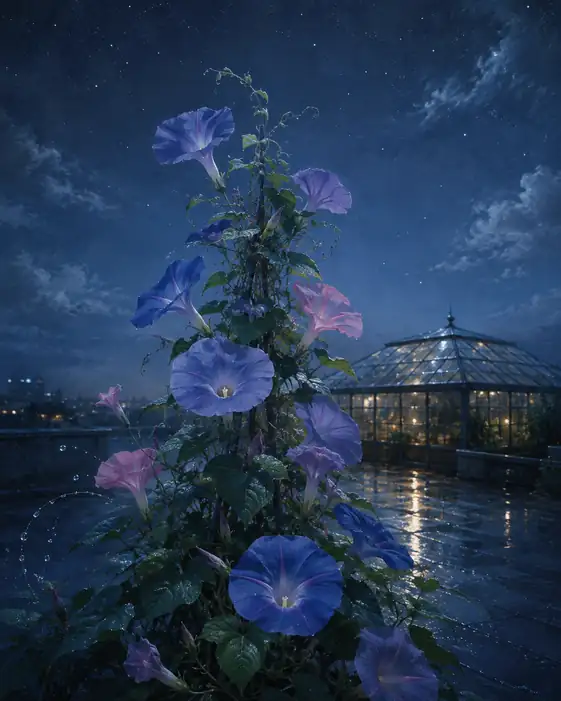 Morning Glory Spire Beneath the Starlit Sky
 Zinnias before the Lattice Doors at Sunset
 Evening Glory by the Sunlit Coast
 Morning Glories along the River Walk
 Two Suns in the Morning Mist
 Hibiscus Glowing against the Sunset Harbor
 Hibiscus along the Coastal Stairway at Sunset
 Zinnias in the Greenhouse Twilight