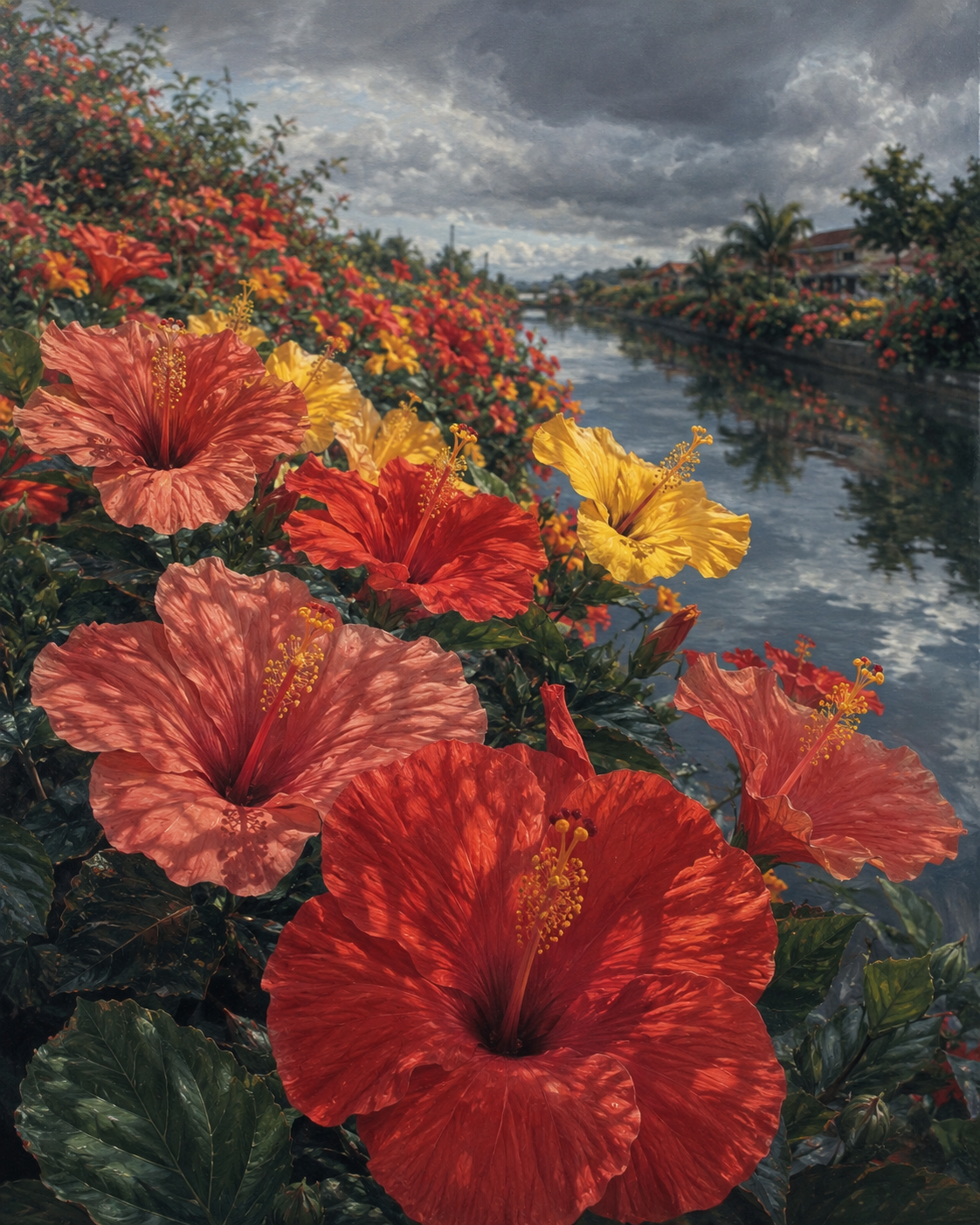
Hibiscus along the Storm-Laden Canal
Critique
Introduction This painting presents hibiscus beside a residential canal beneath storm clouds. Monumental foreground blossoms provide the first impact, while the receding waterway turns floral display into a study of cultivated landscape and unsettled weather. Description Large red and coral flowers fill the lower half and left edge, joined by two yellow blooms near the center. Their projecting stamens, folded petals, unopened buds, and glossy leaves are carefully distinguished. The canal begins at lower right and narrows toward a small bridge. Houses, palms, and flowering banks line both sides, while layered gray clouds occupy the upper sky and repeat dimly in the water. Analysis Overlapping blossoms create a dense foreground screen, and the canal's converging banks open a central route into depth. The largest red flower anchors the bottom center; the yellow bloom above it bridges warm flowers and cool water. Sunlight catches petal ridges and leaf surfaces despite the dark sky, producing sharp local contrasts. Soft distant forms oppose crisp foreground textures. Reds and oranges dominate, moderated by deep green, blue-gray reflection, and neutral cloud. Interpretation and Evaluation The flowers appear decorative and resilient, maintaining color as weather closes over the neighborhood. Their abundance beside practical drainage water suggests beauty integrated with settlement. The composition controls scale changes, and the waterway prevents the crowded foreground from becoming flat. Precise botanical description, luminous color, atmospheric recession, and tension between tropical warmth and impending rain are effective. Conclusion At first the image reads as an exuberant flower portrait, but closer viewing makes the canal and storm equally important. The blossoms become a threshold through which the eye enters a lived landscape, and their reflected, weather-darkened setting gives their brilliance greater weight.
Same Subcategory
 Two Yukata Follow the Lantern River
Similar Artworks
 Hibiscus Field under the Cumulus Tower
 Winding Path of Water Lilies along the Canal
 Morning Glories along the River Walk
 Sunset Glow across the Zinnia Meadow
 Zinnias by the Sunlit Stone Canal
 Floating Petal over the Rain-Wet Lilies
 Hibiscus along the Coastal Stairway at Sunset
 Dahlia Slopes beneath the Morning Clouds
 Zinnias along the Pebble Shore
 Woven Petals along the Sunset Stream