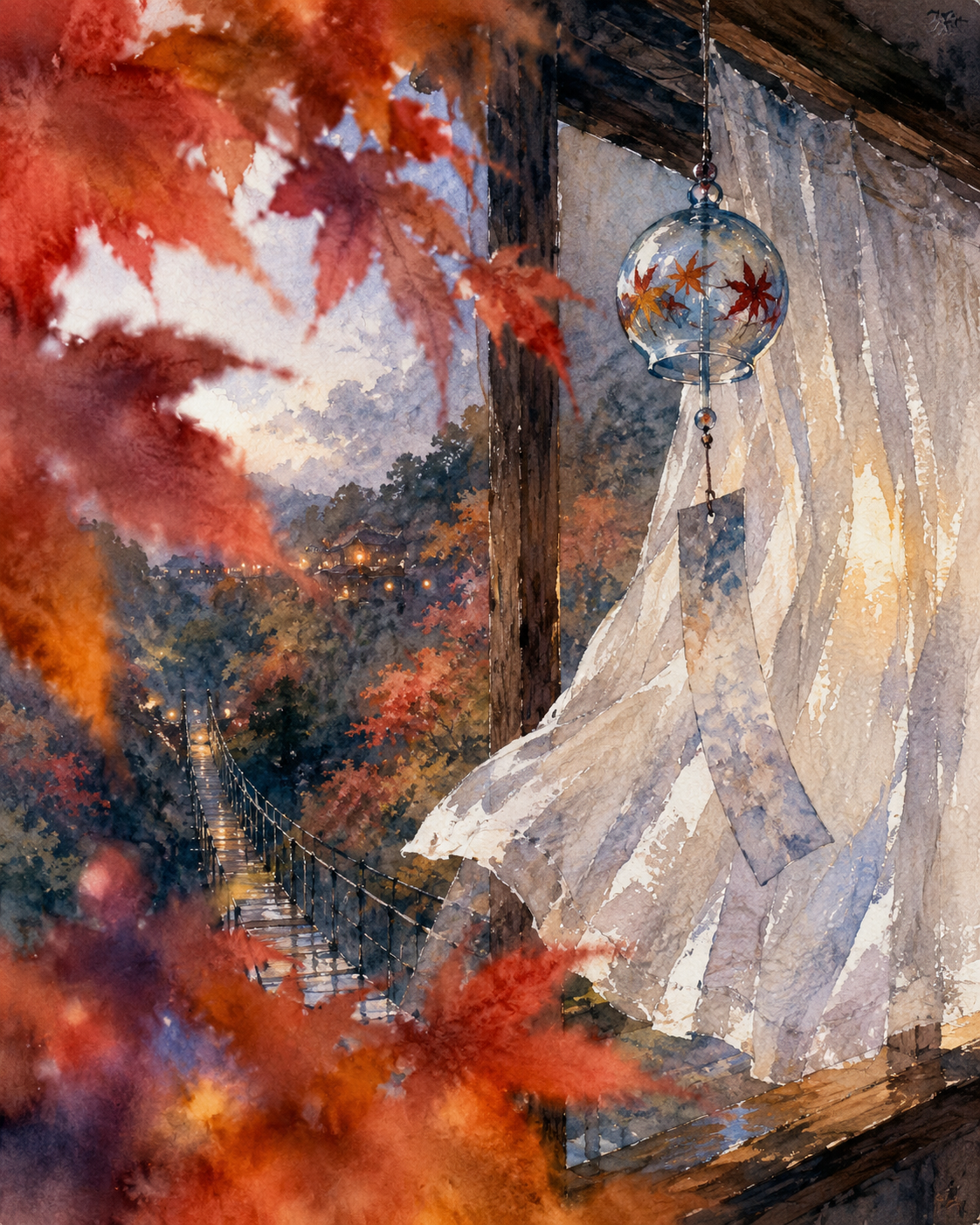
Autumn Chime by the Window of Crimson Leaves
Critique
Introduction An autumn wind chime hangs beside a curtain above a suspension bridge. Air becomes the unseen subject linking shelter, foliage, and an exposed route. Description A clear spherical wind chime occupies the upper right, decorated internally with red and orange maple leaves. A narrow paper strip hangs beneath it. Pale translucent curtains stream diagonally from a dark wooden eave and post, catching warm light from the right. Large blurred maple leaves frame the left and lower edges. Through the opening, a wet suspension bridge descends into a forested valley toward small illuminated houses. Blue-gray mountains and clouded sky recede behind autumn slopes. Analysis The vertical wooden post divides near interior from distant landscape, while curtain folds cross that division and imply airflow. The chime's crisp circle and straight hanging strip contrast with diffuse foliage and cloth. Warm reds dominate the foreground; cool blue-gray establishes atmospheric distance. The bridge creates a narrowing diagonal toward the village, countered by the curtain's outward sweep. Watercolor-like edges and paper texture unify solid wood, transparent glass, mist, and leaves without erasing material differences. Interpretation and Evaluation Wind cannot be seen directly, but its effects organize the image: curtain, paper strip, and leaves all register movement. The chime marks a threshold where private listening meets public passage. The bridge promises connection but remains wet and precarious, while the illuminated village offers a destination. Enclosed maple leaves preserve autumn within glass, yet the living foliage outside continues to change, setting memory beside ongoing time. Conclusion A quiet sensory event carries emotional distance. Sound is implied, movement suspended, and the viewer pauses before crossing. Departure begins by noticing what the present air already moves.
Same Subcategory
 Crape Myrtle over Azure Waters
Similar Artworks
 Candles of Refuge on the Rain-Wet Span
 Pressed Petals and the Lantern Path
 Lantern Basket over the Autumn Gorge
 Sunlit Table and Floating Cosmos
 Crape Myrtle and Wind Chimes Beneath the Twilight Trail
 Mount Fuji Beyond the Cosmos Field
 Crape Myrtle along the Sunlit Coastline
 The White Cat and the Distant Lighthouse
 Crown of Petals on the Mountain Span
 Amber Lanterns on the Moonlit Bridge