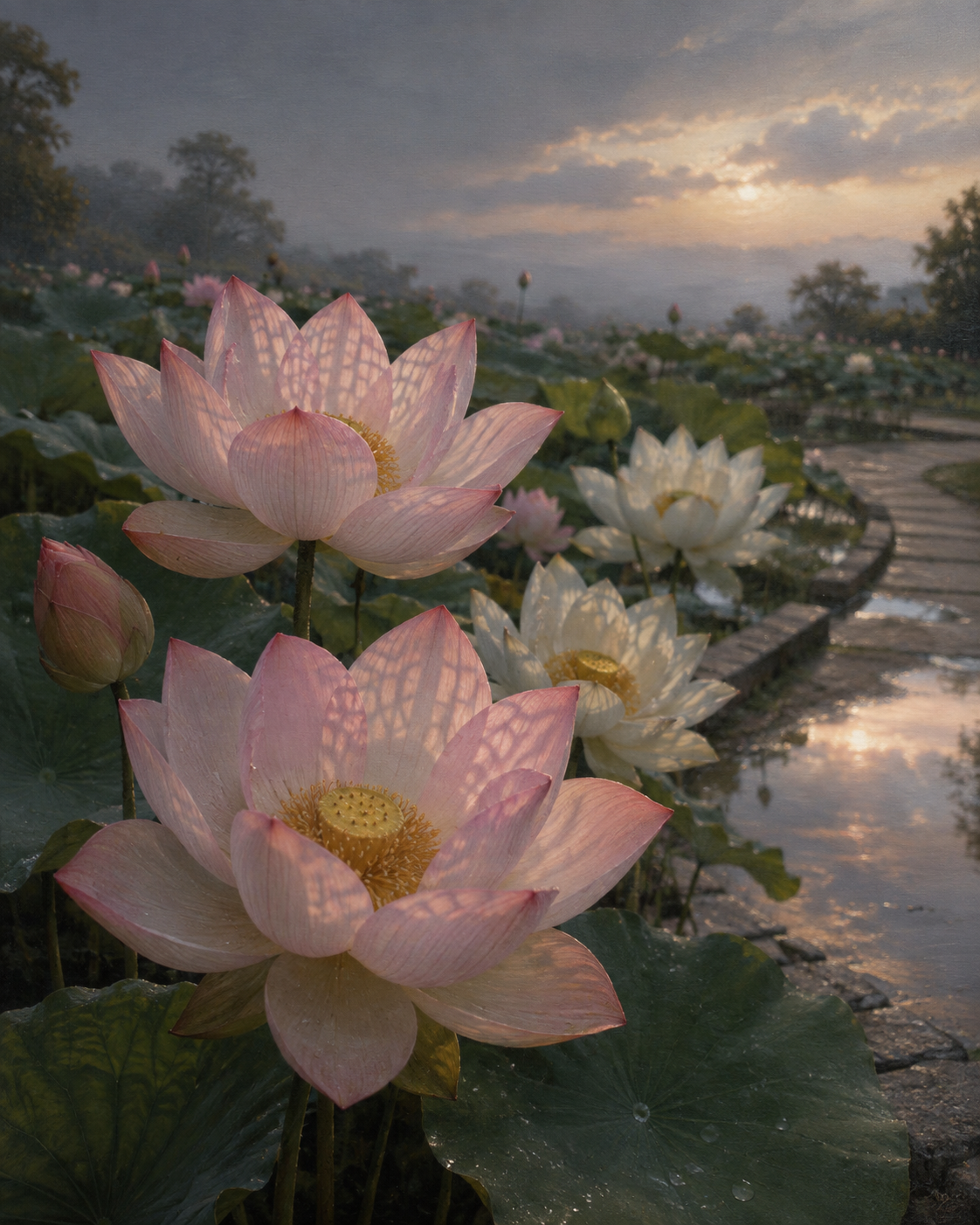
Path of Morning Mist and Petals
Critique
Introduction Rain-washed lotuses accompany a curving path. Translucent petals and reflected sky turn an ordinary garden route into a passage through changing light. Description Two large pink lotuses dominate the left foreground, accompanied by a closed bud. White blossoms rise behind them among broad dark leaves. At right, an uneven stone walkway curves around the pond and disappears into mist. Shallow puddles on the path reflect a warm opening in the gray clouds. The distant pond contains many small pink and white flowers, while shadowy trees soften into atmospheric haze. Fine raindrops remain on petals and leaves. Analysis The path supplies a strong S-curve from lower right to the distant center, balancing the large floral mass at left. Successive blossoms decrease in scale and reinforce depth. Soft gray-green surroundings allow pink and cream petals to glow without harsh saturation. Cloud light repeats in puddles and translucent petals, joining sky, ground, and flower. Shadows from nearby leaves create delicate lattices across the foremost blooms. The contrast between precise near textures and dissolved distance produces calm spatial recession. Interpretation and Evaluation The walkway makes contemplation physical: viewers are invited not only to admire the lotus but to move beside it. Rain has recently interrupted the route, yet puddles become mirrors rather than obstacles. Bud, open blossom, and distant field extend the experience across stages of time. The patterned shadows acknowledge that illumination is never pure or unobstructed; beauty receives the marks of its environment. Conclusion The painting achieves serenity through movement rather than stasis. Curving stone, reflected sky, and flowers guide attention forward. Restrained light makes renewal believable, emerging from wetness, cloud, and an imperfect path.
Same Subcategory
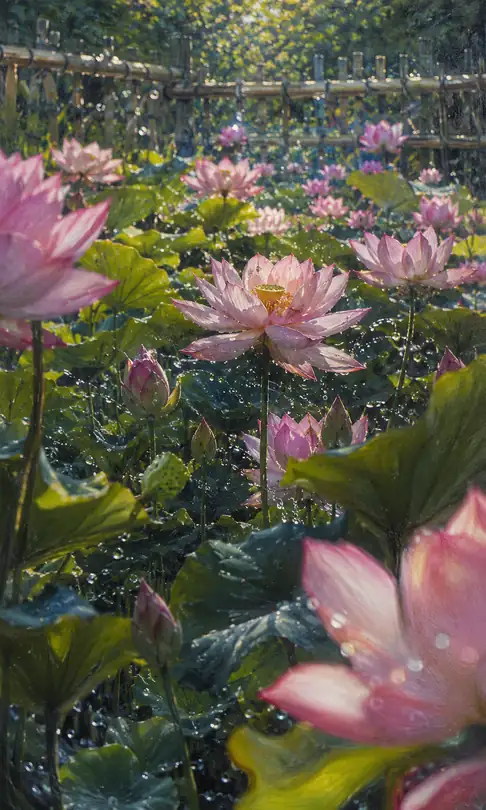 Morning Dew upon the Lotus Garden
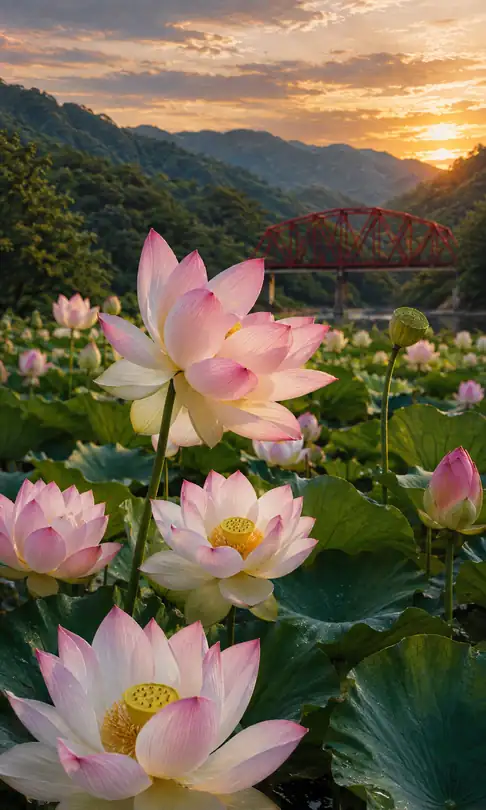 Blooms Beneath the Scarlet Bridge
Similar Artworks
 Petals between the Moon and the City Glow
 Morning Tea by the Lotus Shore
 Water Lilies under the Harbor Sunset
 Crape Myrtle Reflected in the Twilight Puddle
 The Morning Crimson Wishes Met White Prayers
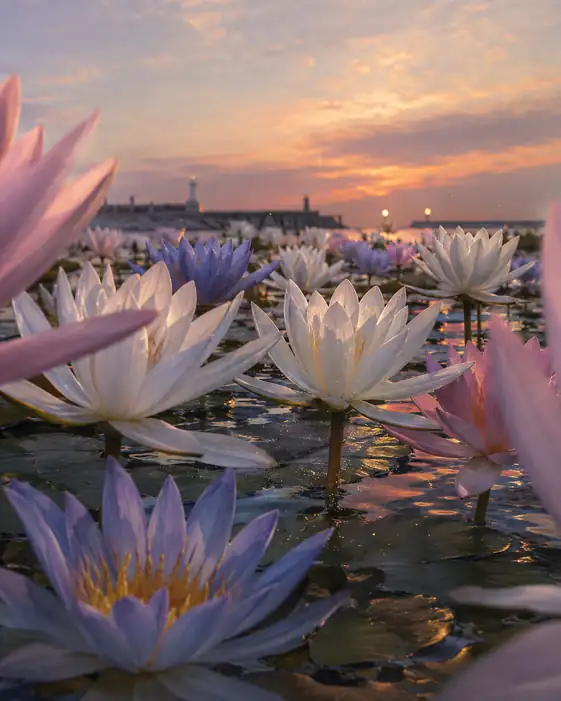 Lilies of the Twilight Harbor
 Lotus River through the Ancient Village
 Sunset Waves of Portulaca Blooms
 Morning Glories along the River Walk
 Golden Bands across the Canna Field