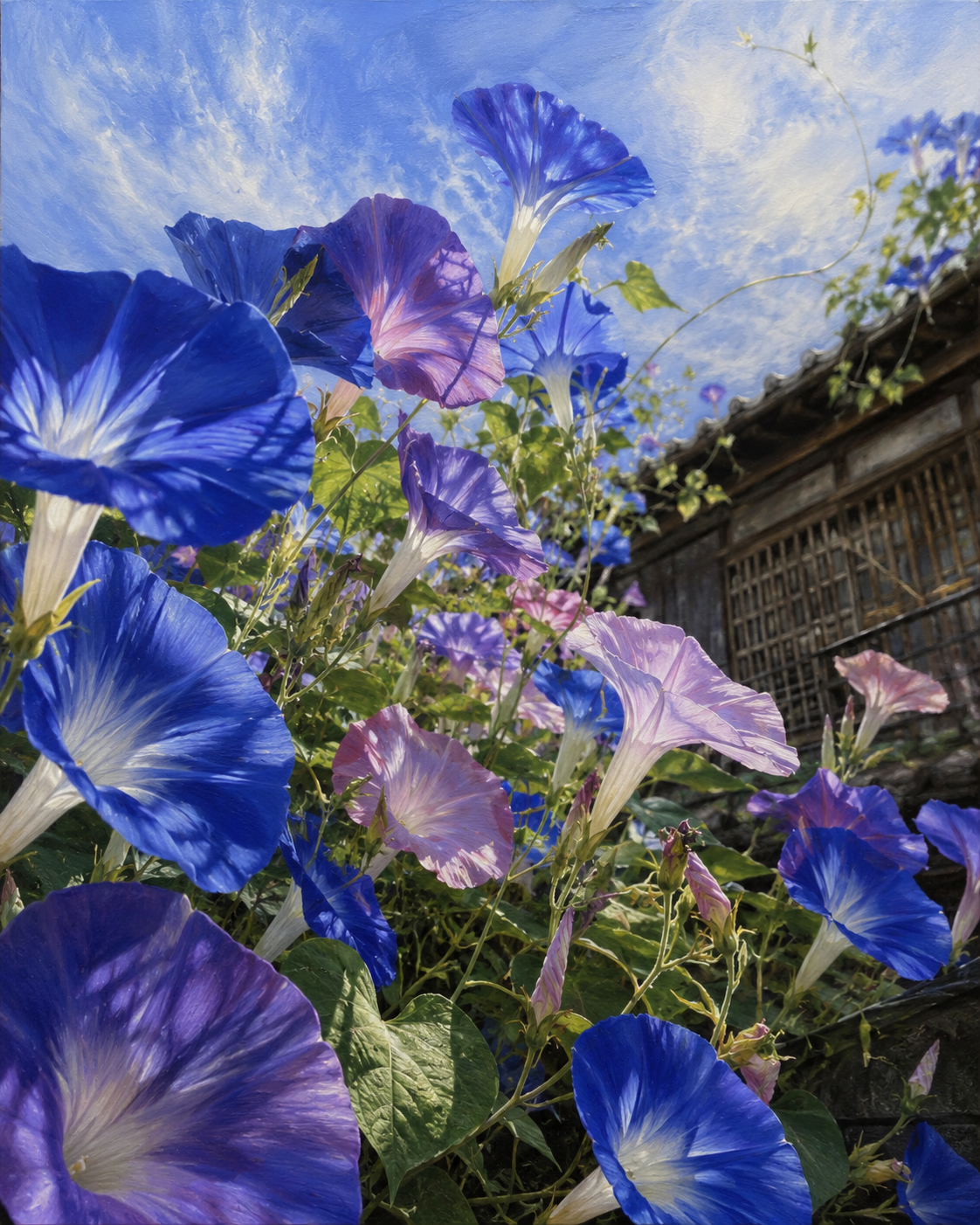
Azure Chorus at the Eaves
Critique
Introduction Morning glories rise beside an aged wooden house into summer sky, joining cultivated history, spontaneous movement, and daily light. Description Blue, violet, lavender, and pale pink trumpet flowers crowd the foreground at many heights. Their white throats, translucent petals, buds, curling vines, and broad green leaves are rendered in strong sunlight. Behind them at right stands a dark weathered house with tiled eaves and latticed windows. The low viewpoint opens a large field of blue sky filled with feathery white clouds. Thin stems extend above the roofline, and smaller blossoms recede along the wall. Analysis Extreme foreground scale makes the flowers architectural, while the house becomes a dark lateral anchor. Overlapping blooms create a rising diagonal from lower left toward upper center. Saturated blue petals echo the sky, and white centers repeat the clouds, visually merging near and far. Pink and violet introduce variation without breaking harmony. Sunlit petals appear almost translucent against deep leaves and timber. Organic curves cross the house's rectilinear lattice, softening its age without concealing it. Interpretation and Evaluation The flowers' brief opening contrasts with the building's accumulated years, yet both depend on repeated care and seasonal renewal. Vines crossing the eaves suggest nature exceeding assigned boundaries, but their relationship with the house remains affectionate rather than destructive. The low viewpoint recalls a child's absorbed attention, granting familiar garden plants grandeur. Buds among open and folded blossoms make time visible as a continuing cycle rather than a single perfected moment. Conclusion The image balances exuberance and clarity. House, cloud, and flower share forms yet retain distinct histories. Transient blooms tower over architecture, making everyday renewal as meaningful as inherited shelter.
Same Subcategory
 Blooms of the Rooftop Cosmos
 Veil of Linen and Twilight Petals
Similar Artworks
 Morning Glories by the Lattice Window
 Morning Glories around the Old Shed
 Morning Dew across the Terraced Valley
 Sunlit Track and the Blooming Mirror
 Zinnias before the Lattice Doors at Sunset
 Morning Glory Spire Beneath the Starlit Sky
 Morning Glories along the River Walk
 Crape Myrtle over Azure Waters
 Morning Dew upon the Lotus Garden
 Crape Myrtle by the Sparkling Pool