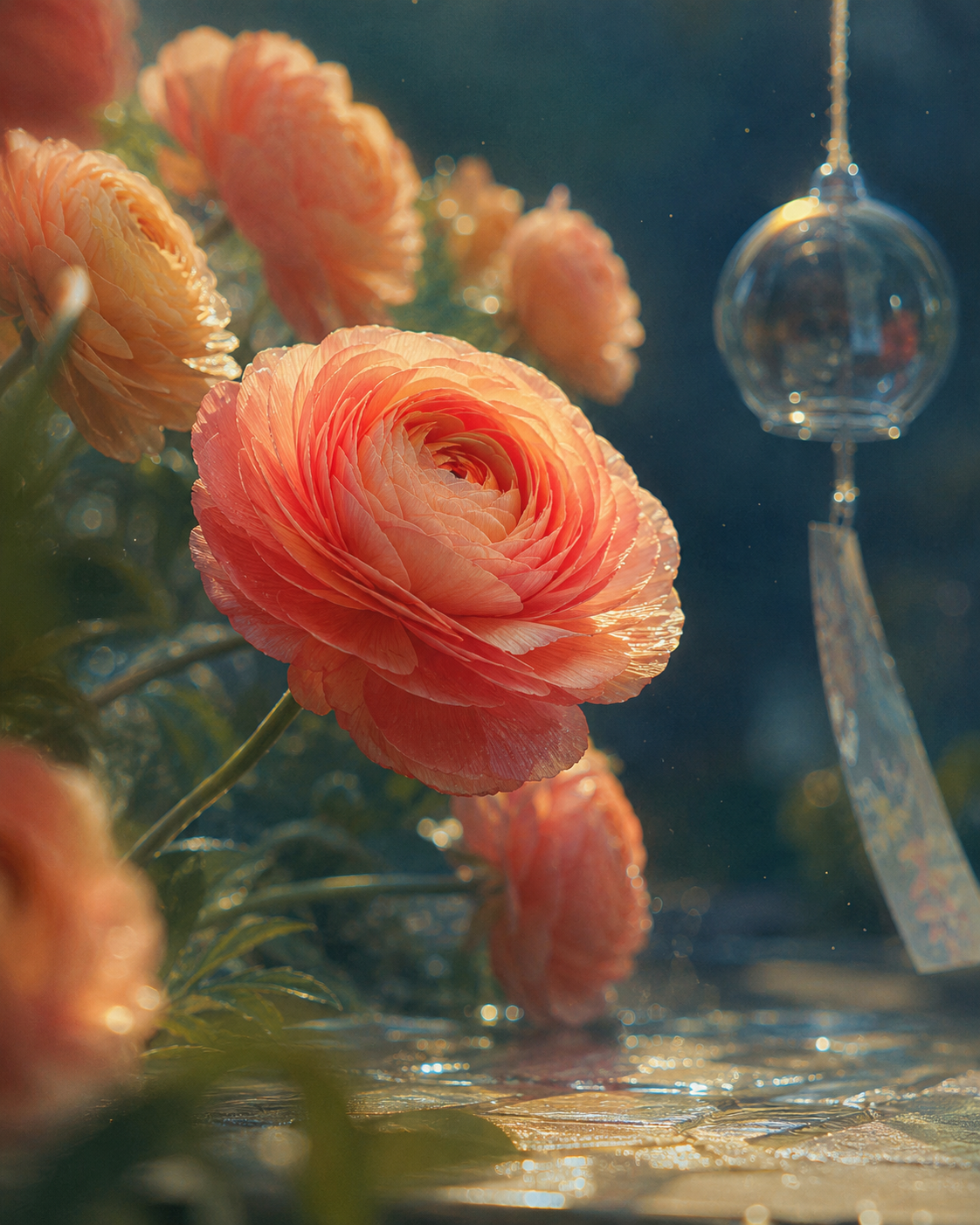
Coral Blossom and the Glass Wind Chime
Critique
Introduction This painting places ranunculi beside a glass wind chime. Flowers and ornament respond differently to invisible air, creating a meditation on motion that cannot itself be seen. Description A large coral ranunculus projects from left-center on a diagonal stem, its layered petals edged with gold light and fine moisture. More blooms recede behind and below. At upper right hangs a clear spherical wind chime from a cord, with a long translucent strip descending beneath it. The dark teal background contains floating gold specks, and the wet lower surface reflects scattered highlights. Analysis The flower's dense circular layers counter the chime's hollow transparent sphere. One gathers material inward; the other encloses air. Diagonal stems and the hanging vertical cord establish opposing directions. Backlight turns petal rims, droplets, glass edges, and floating particles into a connected network of gold points. Selective focus privileges the main bloom, while the chime remains sufficiently clear to balance it. Repeated soft flowers deepen the left field, leaving open blue space around the ornament. Interpretation and Evaluation Wind cannot be pictured directly, but the flower's slight lean, drifting particles, and suspended strip imply its presence. The chime converts air into sound, while the flower converts light, water, and air into growth. Their exchange therefore links sensory and biological transformation. Transparent glass contains a small red reflection, as though carrying a reduced flower image. This echo suggests memory without immobilizing the living bloom. Conclusion The work makes invisible movement tangible through surfaces. Coral warmth and teal depth are sensuous, but clear geometry and controlled focus preserve structure. Flower and chime remain poised at the threshold of motion, inviting the viewer to imagine the next breath and sound.
Same Subcategory
 Sunflower Hill and the White Steps to the Sea
 Coral Petal and the Sea Arch in a Dewdrop
Similar Artworks
 Dew Along the Evening Path
 Breeze through the Crimson Canopy
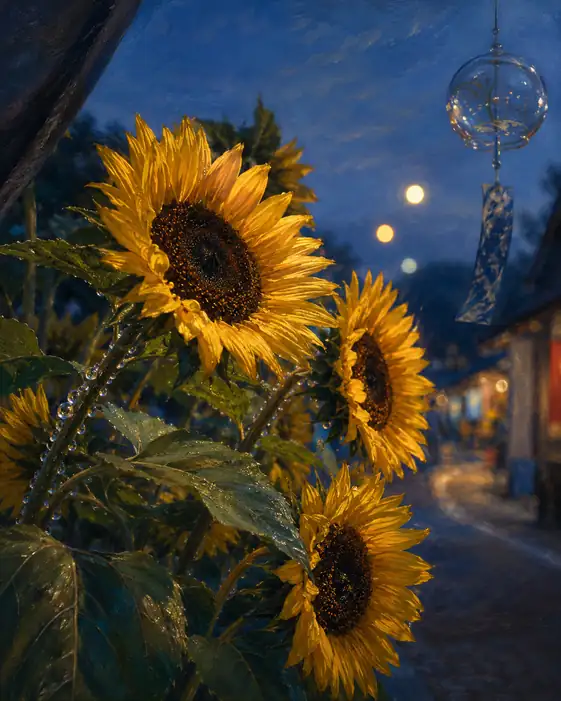 Sunflowers and Wind Chime in the Twilight
 Moonlit Solitude with White Porcelain
 Morning Bell and the Waking Bloom
 Morning Crown Beneath the Azure
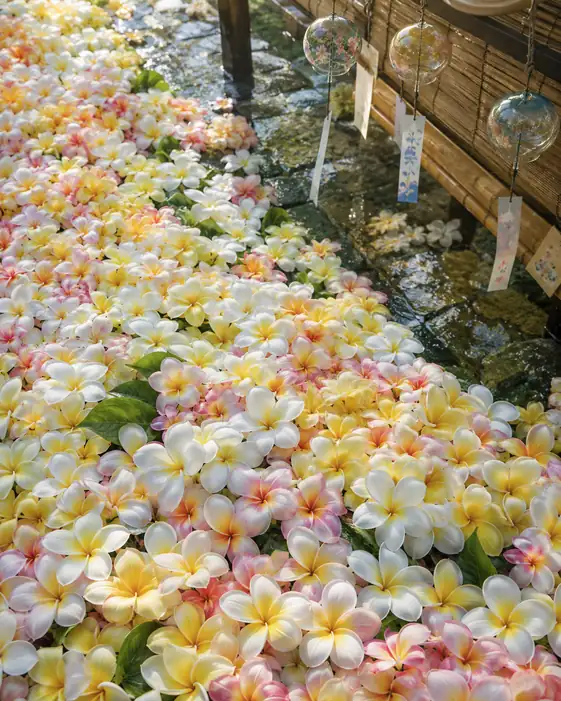 Floating Plumeria Carpet beneath Summer Wind Chimes
 Crape Myrtle Blossoms by the Stone Bridge
 Zinnias by the Sunlit Stone Canal
 Crown of Petals on the Mountain Span