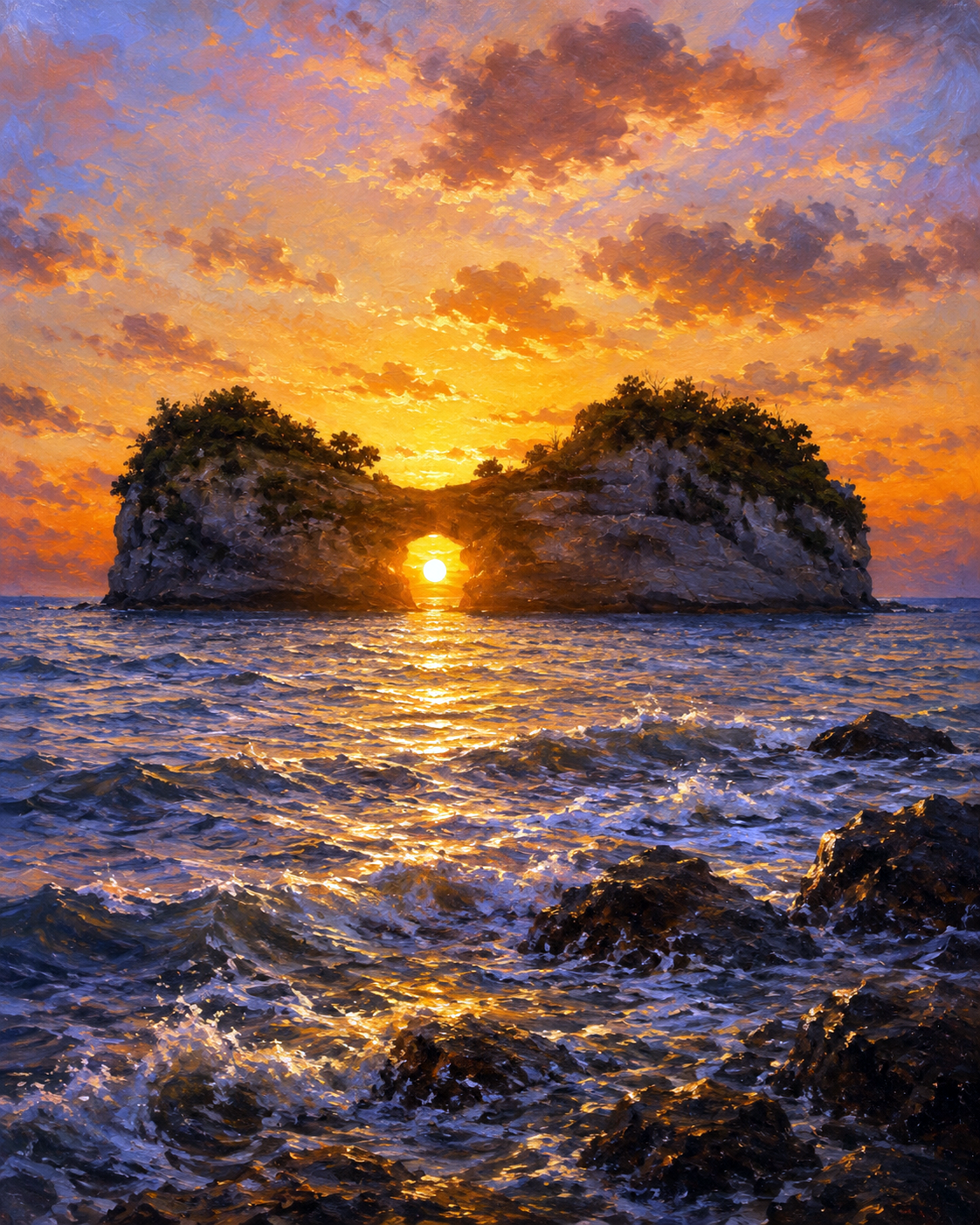
Crashing Waves and the Sunset Arch
Critique
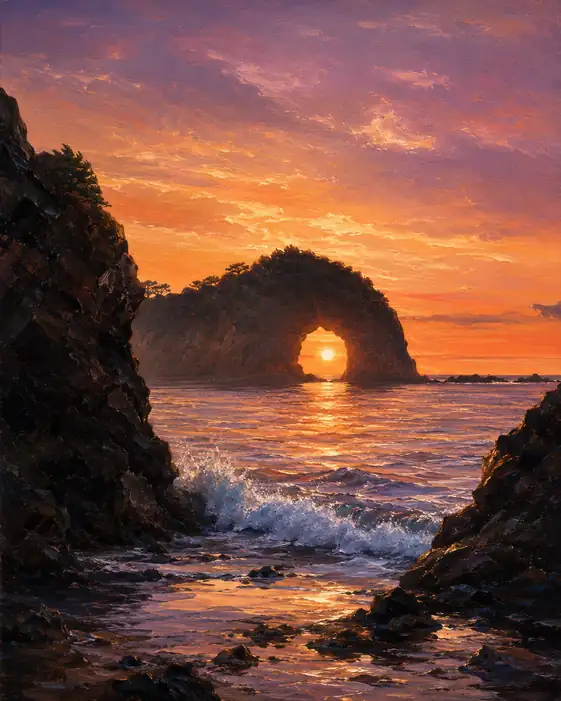
Introduction This painting repeats the island-arch sunset motif but brings turbulent surf and dark foreground rocks into prominence. Passage is no longer calmly offered; it must be imagined through restless water and physical resistance. Description Two tree-covered islets meet around a central arch, where the setting sun touches the horizon. A broken gold reflection crosses vigorous blue-violet waves. Jagged wet rocks occupy the lower-right and lower-center foreground, surrounded by white foam. Above, thick clouds scatter orange light through a lavender-blue sky. Analysis The centered island and sun establish a stable destination, while foreground diagonals and irregular waves disrupt that symmetry. Warm light forms a vertical axis, but foam repeatedly cuts across it. Thick directional texture distinguishes cloud turbulence, rocky mass, and churning water while unifying the surface. Orange and blue-violet intensify one another. The nearest rocks enlarge rapidly and create strong depth, placing the viewer at an exposed shoreline rather than safely offshore. Interpretation and Evaluation The arch remains a threshold, but the sea makes access difficult. Light may indicate hope or orientation, yet its path is fragmented by every wave. The work therefore treats passage as effort rather than simple revelation. Foreground rocks function as immediate realities that resist the perfect geometry of the distant view. Sunset still carries the idea of ending, but the active sea refuses stillness, implying that transition continues through instability. Conclusion The painting gains emotional force from the conflict between centered radiance and turbulent approach. Its saturated color is matched by substantial texture and convincing spatial depth. Beauty is not separated from difficulty; the desired opening shines precisely beyond a restless crossing.
Same Subcategory
Similar Artworks
 Sunset within the Great Sea Arch
 Sunset Gateway and the Golden Sea Path
 When the Sunset Dwells in Engetsu
 Sunflowers Cascading to the Coastal Horizon
 The Sun Passes Through Stone
 The Sun's Eye on the Sea
 Whispers of Pampas at the Sunlit Channel
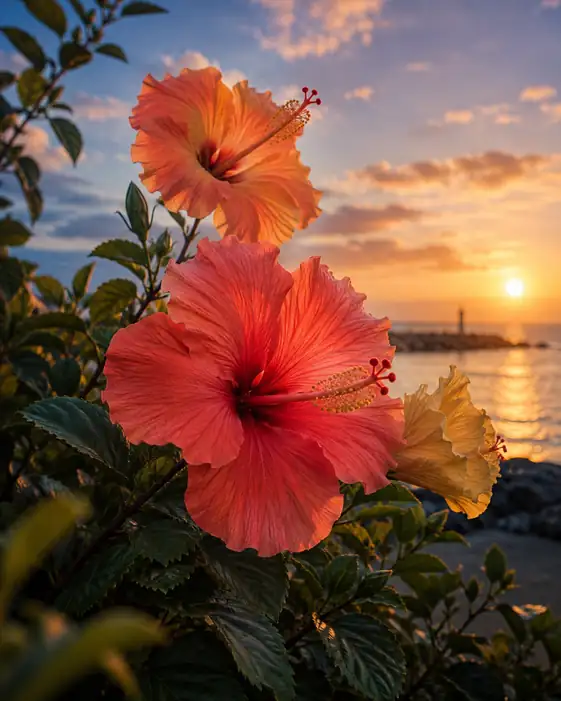 Hibiscus Glowing against the Sunset Harbor
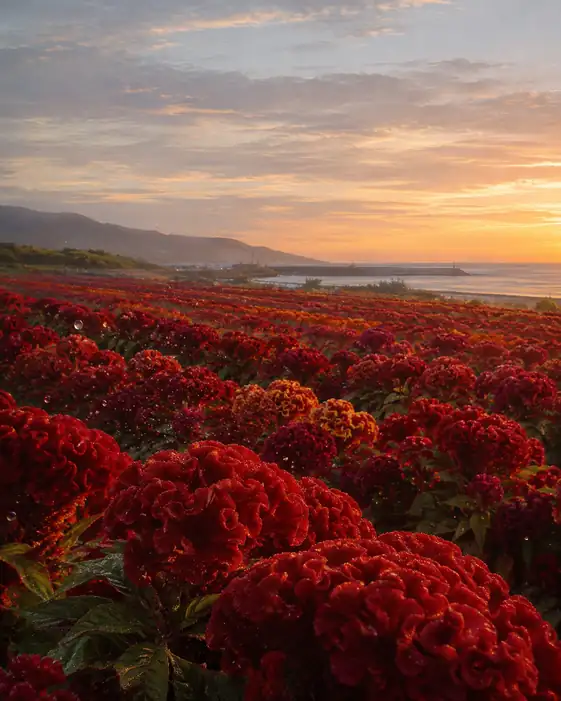 Crimson Slopes of Cockscomb at Sunset
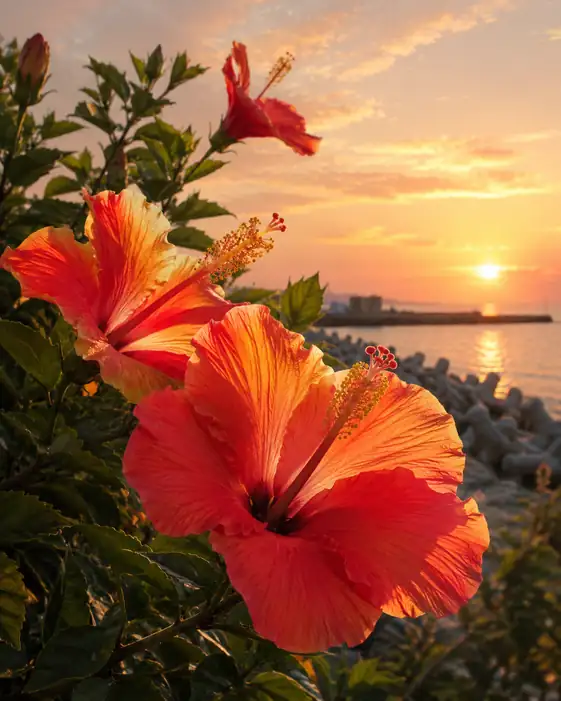 Sunset Radiance on Coastal Hibiscus