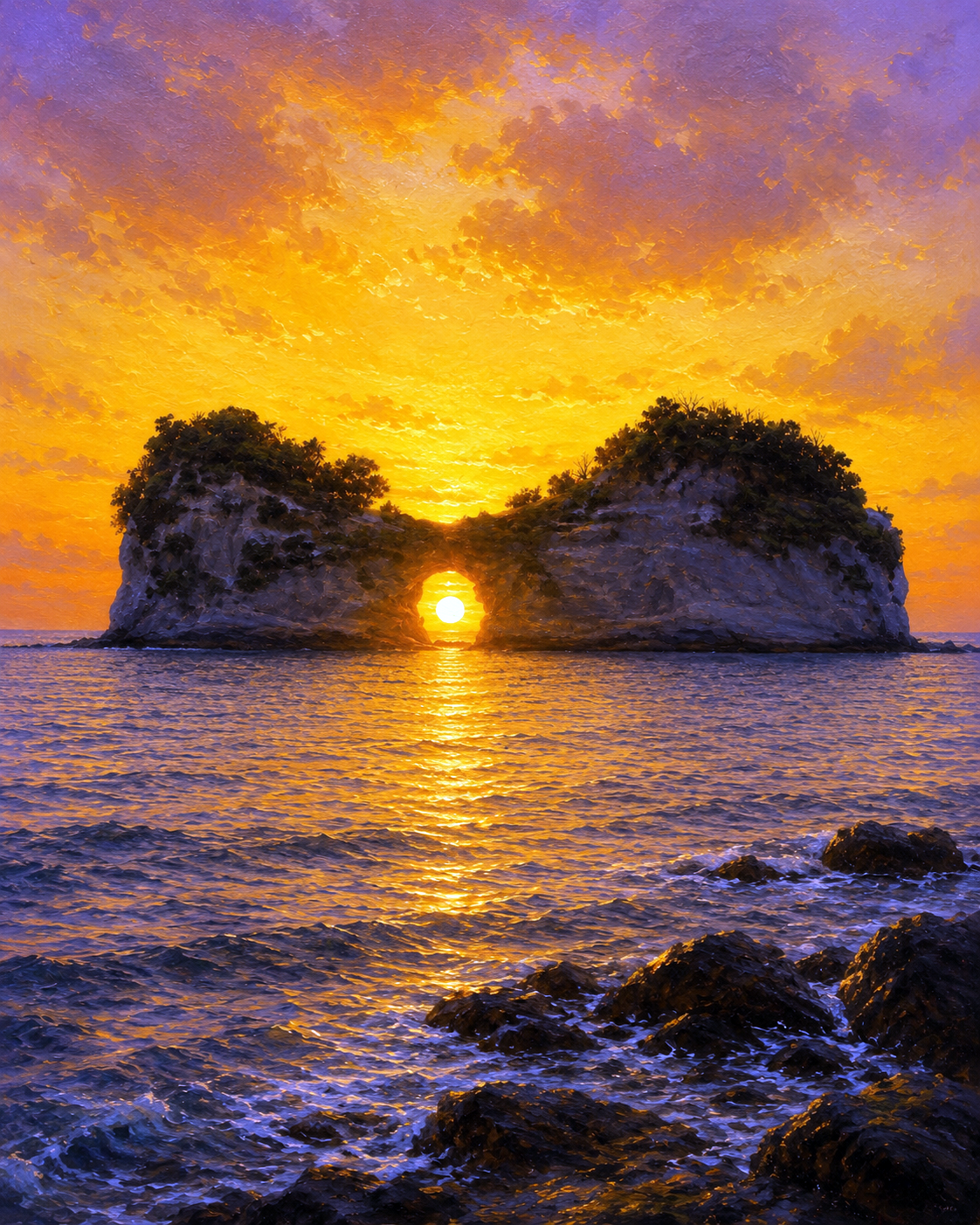
When the Sunset Dwells in Engetsu
Critique
Introduction This seascape centers the sun within a natural arch between rocky islets. The alignment turns sunset color into an image of passage, balance, and concentrated radiance. Description Two vegetation-crowned rocks span the horizon, joined by a narrow bridge. Beneath it, the sun touches sea and casts a gold reflection forward. Violet-orange clouds fill the sky. Blue-purple waves cross the distance as dark rocks break the lower-right foreground. Analysis The near symmetry of the islands gives the composition stability, but differences in their contours prevent rigidity. The arch and sun create nested circles at the exact center, concentrating attention before the reflection pulls it downward through the water. Warm yellow-orange and cool violet-blue operate as complementary fields, intensifying both sky and sea. Thick visible texture unifies cloud, rock, and wave while changing direction to describe each material. Foreground rocks introduce asymmetry, depth, and a tactile counterweight to the distant spectacle. Interpretation and Evaluation The arch can be read as a threshold, and the sun's placement makes light itself appear to pass through stone. Sunset marks an ending, yet the open portal suggests continuation rather than closure. The two islands may evoke separation joined by a narrow bond, while the reflected path offers the viewer an imagined approach. These meanings remain accessible because the geometry is exceptionally clear. The saturated palette heightens emotion without obscuring the physical structure of sea and land. Conclusion The painting succeeds through exact alignment, strong complementary color, and vigorous surface handling. Its central radiance is spectacular, but foreground rocks and restless waves keep the scene grounded. It offers a convincing vision of evening as both culmination and doorway.
Same Subcategory
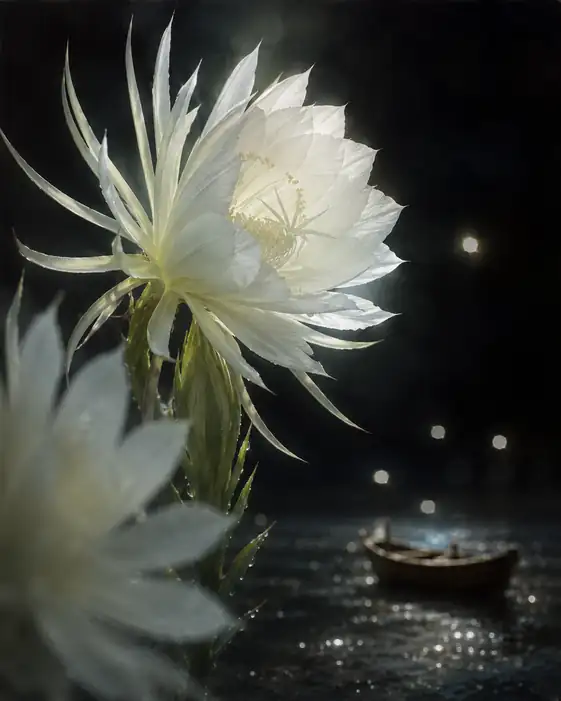 Queen of the Night over the Night Water and Skiff
Similar Artworks
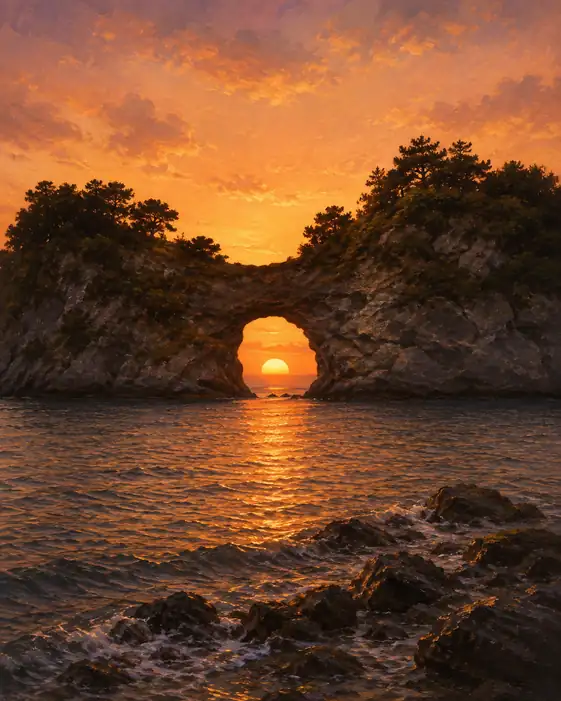 Sunset within the Great Sea Arch
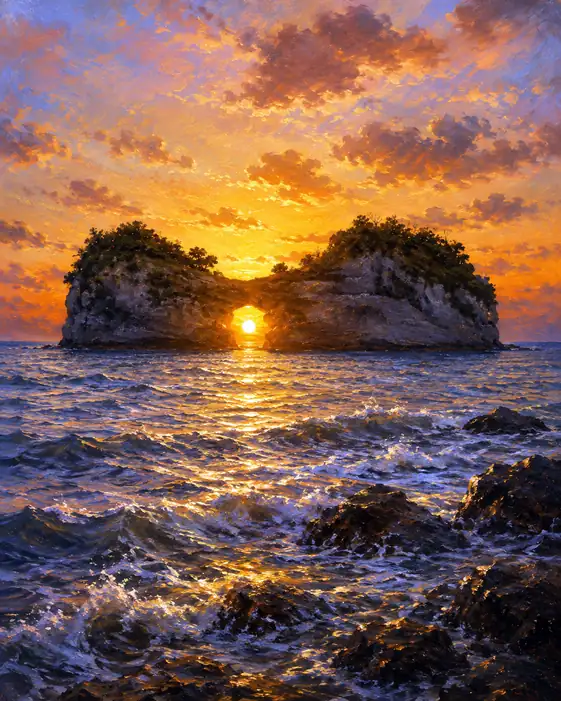 Crashing Waves and the Sunset Arch
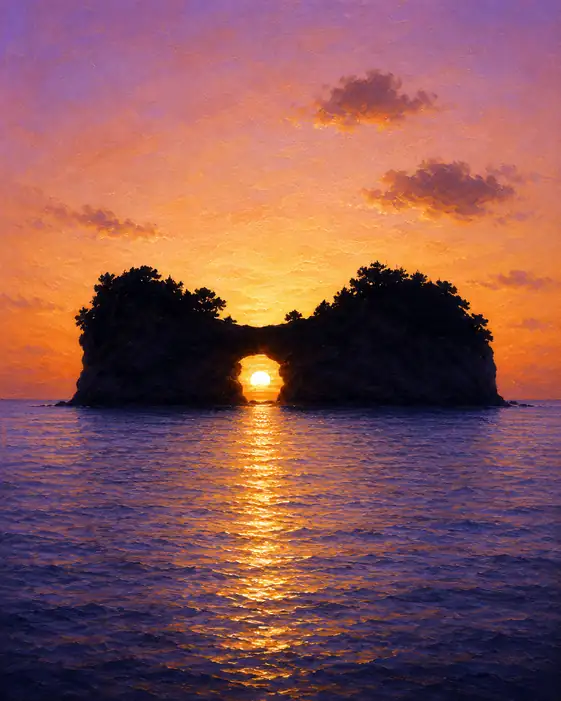 Sunset Gateway and the Golden Sea Path
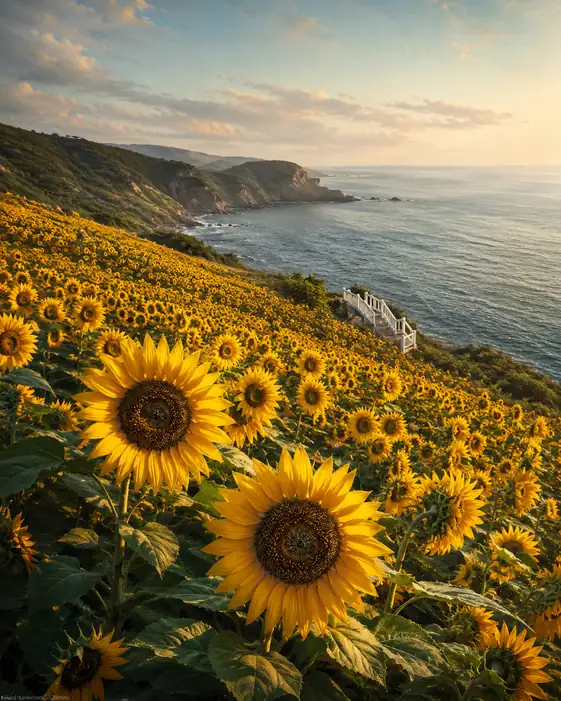 Sunflowers Cascading to the Coastal Horizon
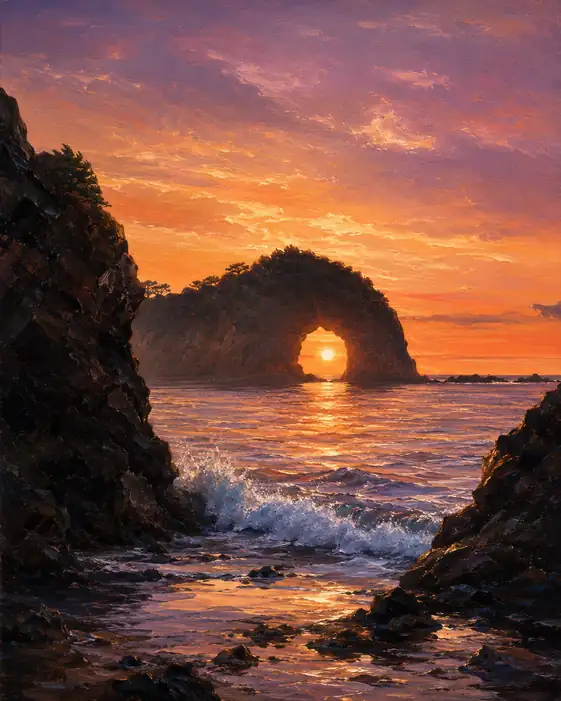 The Sun Passes Through Stone
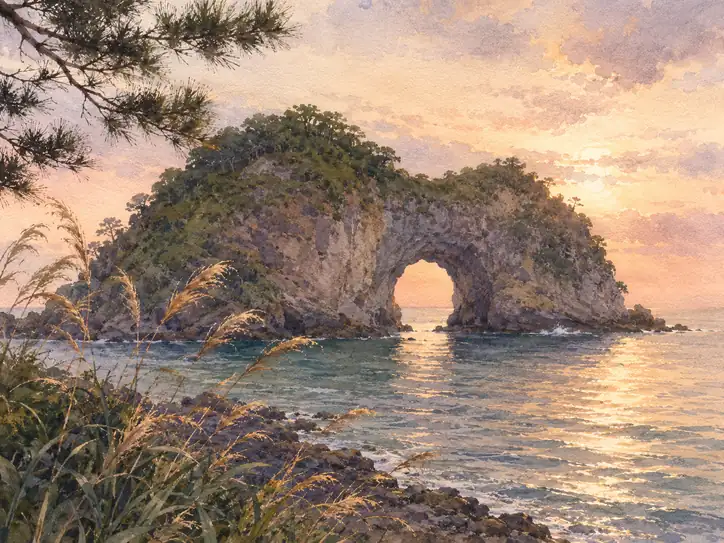 The Sun's Eye on the Sea
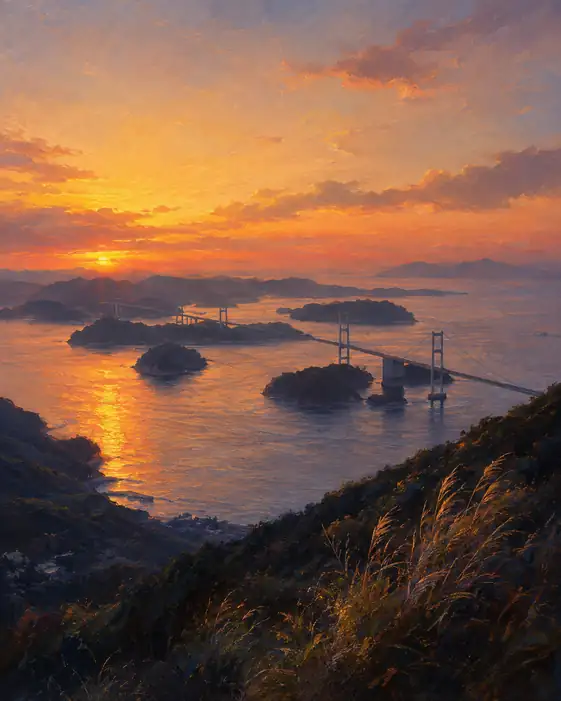 Whispers of Pampas at the Sunlit Channel
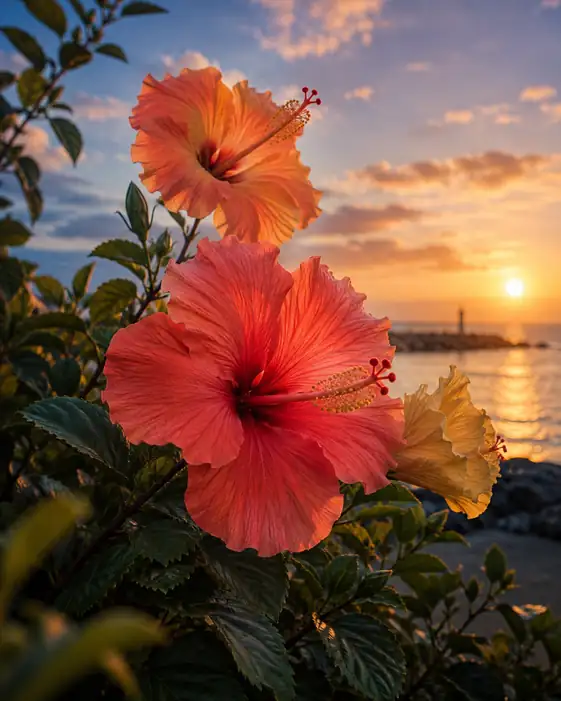 Hibiscus Glowing against the Sunset Harbor
 Crimson Slopes of Cockscomb at Sunset
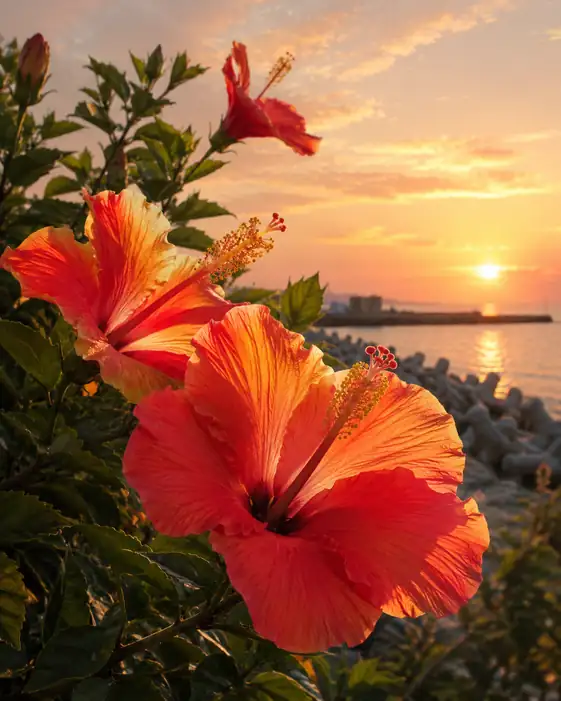 Sunset Radiance on Coastal Hibiscus