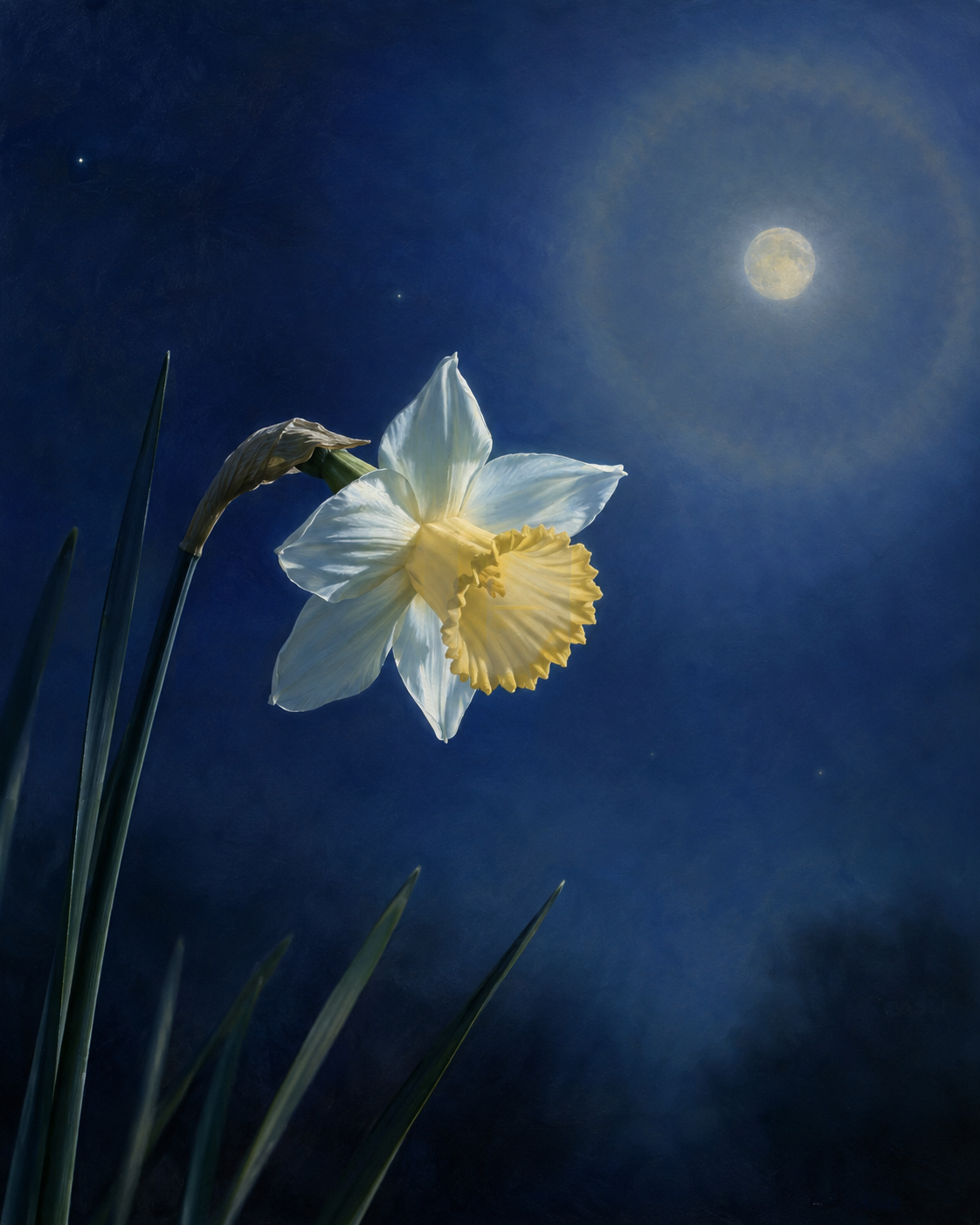
A Golden Song Beneath the Full Moon
Critique
Introduction This painting presents a daffodil beneath the moon. Enlarged against blue night, the flower corresponds serenely with celestial light. Description A white daffodil rises from the lower left on a tall green stem, its yellow trumpet facing right. Long blade-shaped leaves climb from the bottom, and a dry sheath bends behind the flower. In the upper-right sky, a full moon glows within a broad circular halo. Several small stars punctuate the deep blue atmosphere. Analysis The flower and moon form two luminous centers along a rising diagonal. One is sharply articulated through veined petals and a ruffled cup; the other is softened by distance and haze. White and pale yellow repeat across both, while dark leaves provide vertical counterweights. The large unoccupied sky grants the bloom unusual solitude and scale. A faint cloudlike spiral around the moon echoes the radial opening of the petals, joining near and far through shape rather than literal contact. Interpretation and Evaluation The daffodil can suggest renewal, but at night its symbolism becomes quieter and less seasonal. It seems to receive or answer the moon's light, as though blooming were a form of attention. The dry sheath beside the fresh flower preserves a trace of its earlier enclosure, so emergence remains visible within maturity. Flower and moon also embody different cycles: one lasts briefly, while the other repeatedly wanes and returns. Their pairing gives transience a larger rhythm without diminishing its fragility. Conclusion The work achieves grandeur through restraint. Deep blue space, sparse stars, and two carefully placed lights allow a common garden flower to feel contemplative rather than decorative. Its upward gaze turns blooming into an act of quiet participation in the night.
Same Subcategory
Similar Artworks
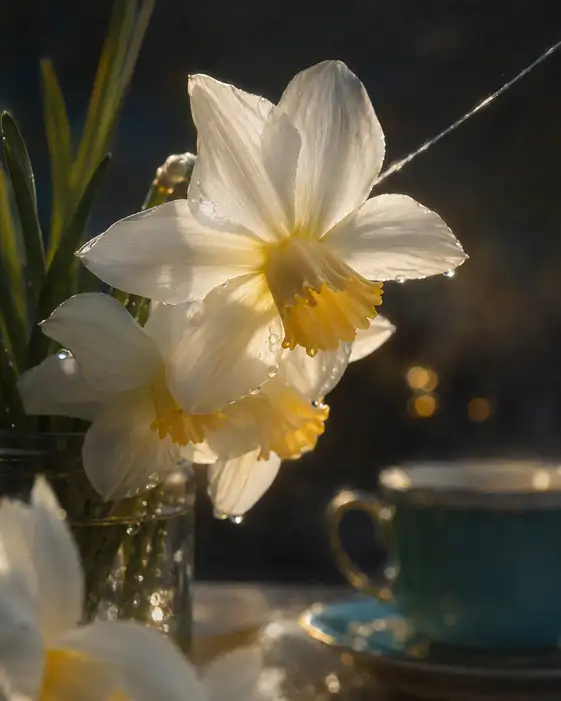 Morning Tea and Daffodils by the Window
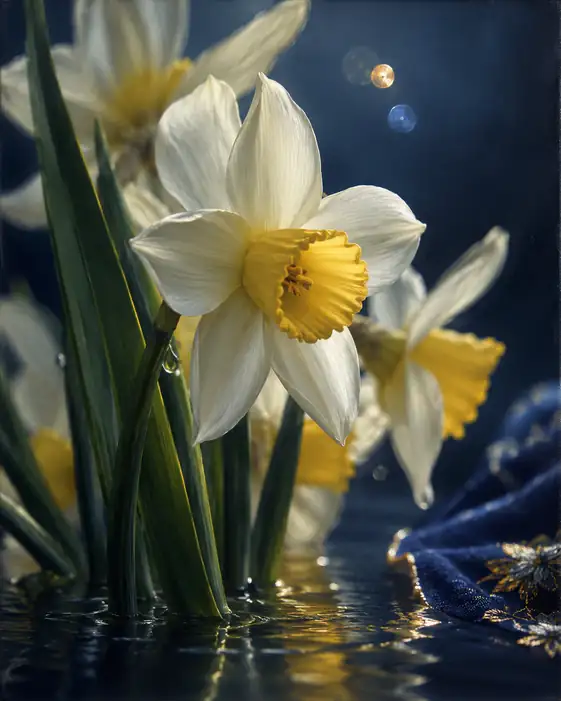 Daffodils over the Gold-Woven Silk
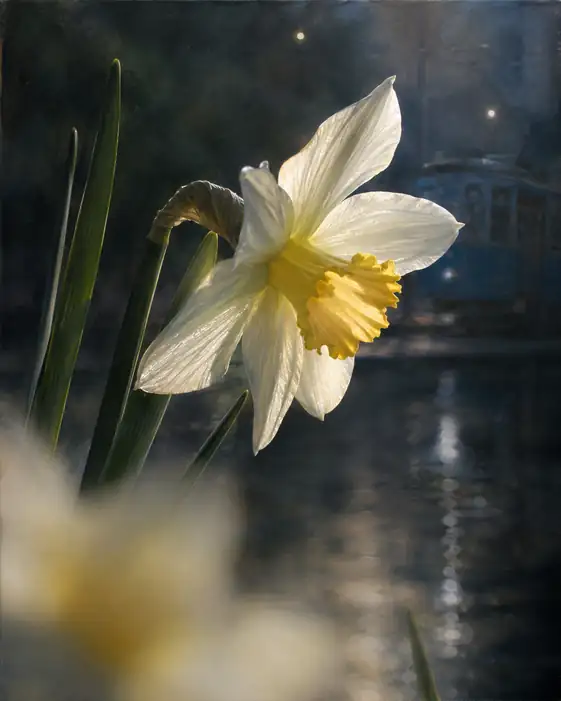 Daffodil along the Night Rails
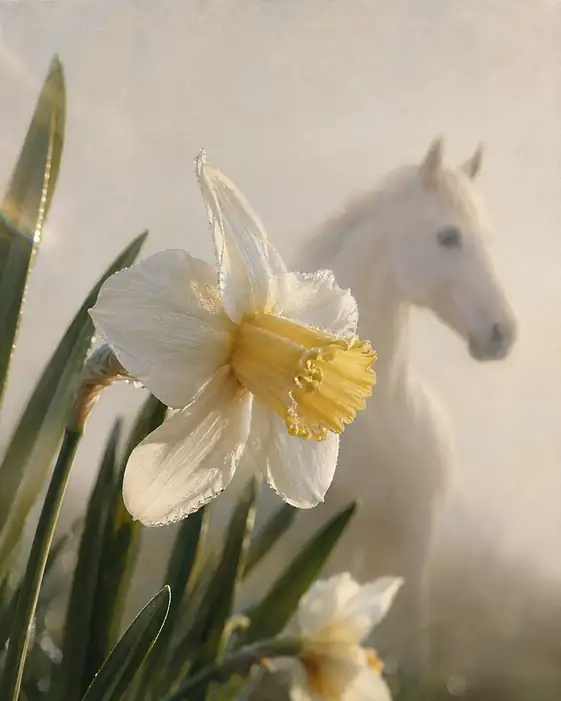 Daffodil and the White Steed in Morning Mist
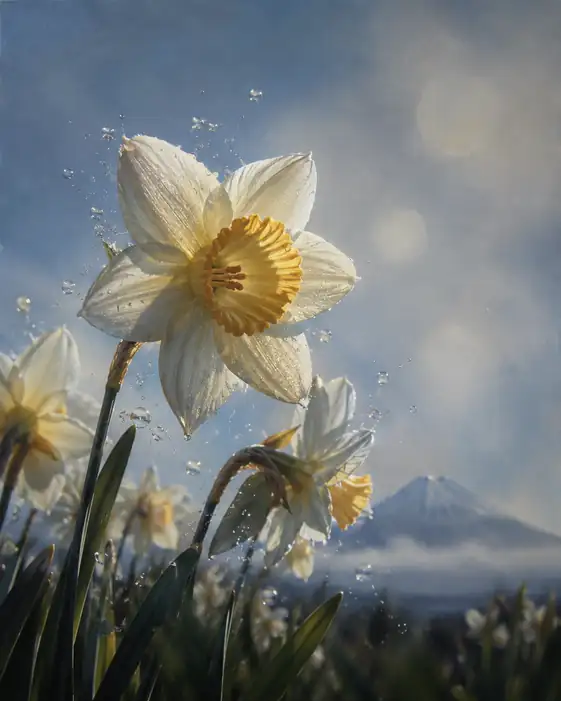 Daffodils and Water Splashes Facing the Sacred Peak
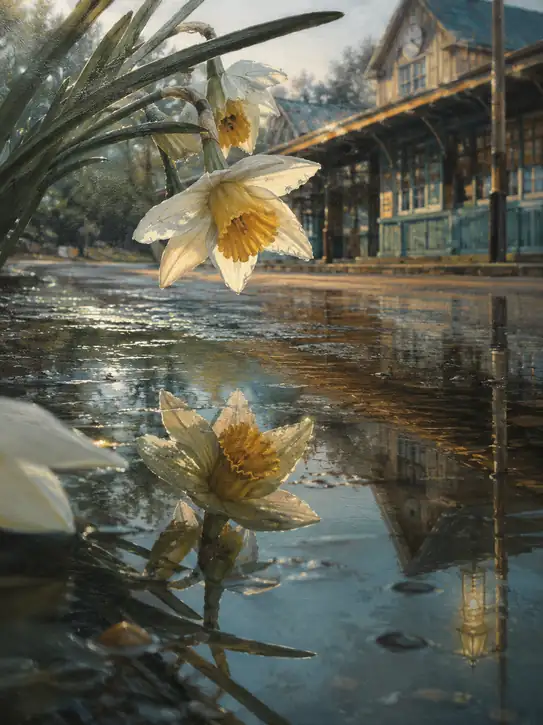 Daffodils and the Rainlit Platform
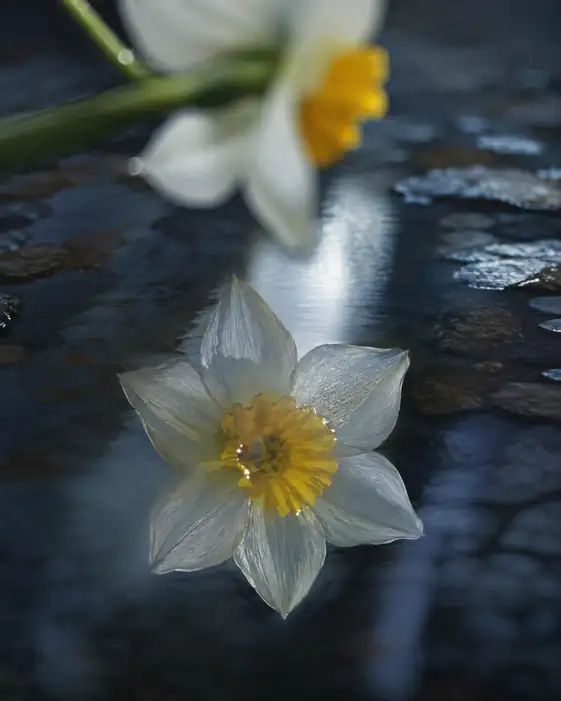 Fallen Daffodil on the Rainy Cobblestones
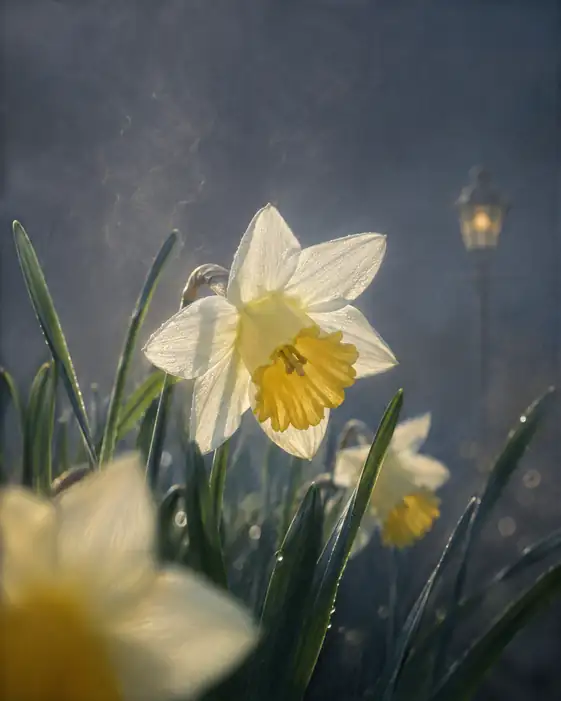 Misty Daffodils and the Distant Lantern
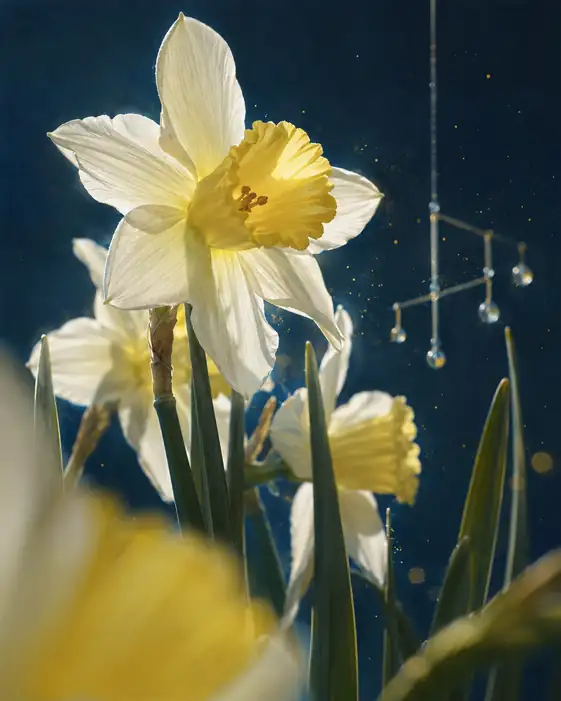 Daffodil Melody in Deep Azure
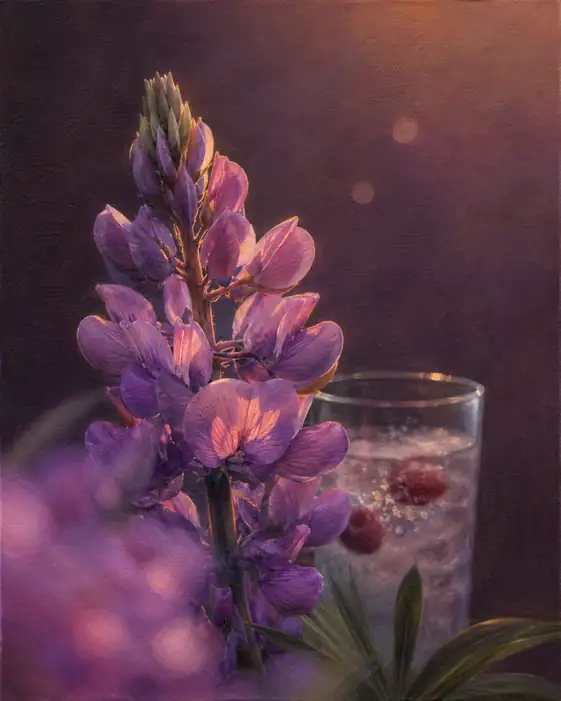 Evening Toast and the Purple Lupine