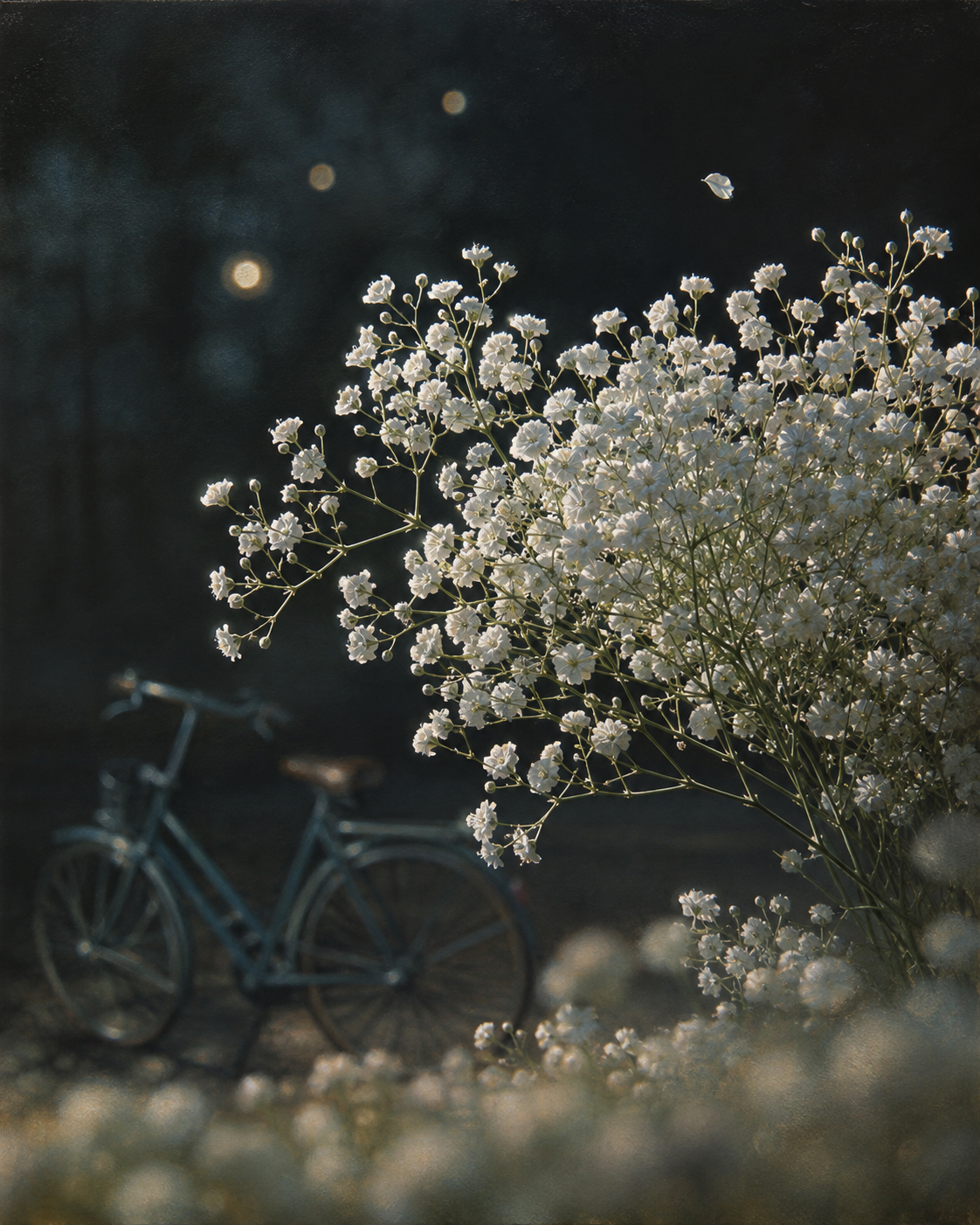
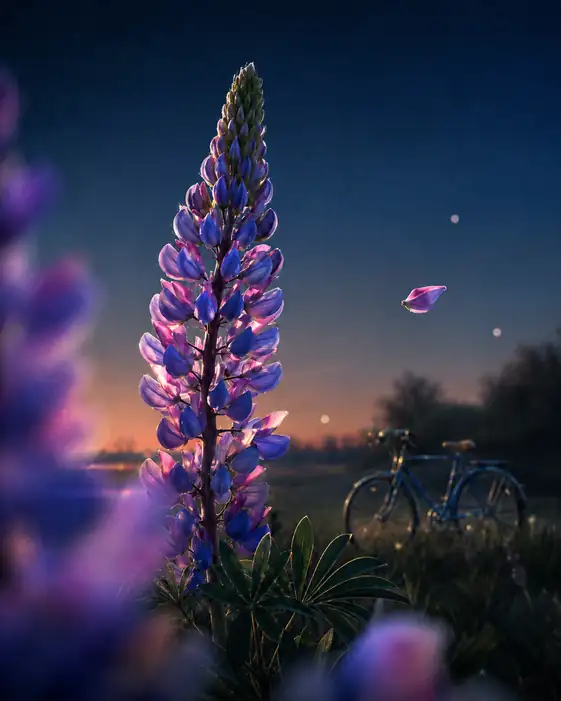
Baby's Breath in Night Mist and the Bicycle
Critique
Introduction This painting places baby's breath beside an unattended bicycle at night. Floral abundance and potential travel create a quiet narrative of pause, departure, or return. Description White blossoms sweep from right toward center, their stems and buds rim-lit. A blue bicycle stands softly in the lower-left background, its wheels recognizable. Warm lights rise through green-black distance. One detached petal floats above the flowers. Analysis The flowers form a bright diagonal wedge that presses into the dark field, while the bicycle provides a low horizontal counterweight. Selective focus privileges the nearest blossoms and converts the vehicle into an atmospheric sign. Repeated circles link bicycle wheels, buds, and distant lights across widely different scales. The airborne petal occupies the open upper center, preventing the negative space from becoming inert and establishing a subtle upward movement. Warm rim light on white petals softens the otherwise cool, nocturnal palette. Interpretation and Evaluation An empty bicycle often implies an absent person, yet no specific rider or destination is supplied. It therefore holds travel in a state of possibility. The rooted flowers seem still, but the released petal shows that they too participate in movement and loss. Abundance on the right and absence on the left create an emotional exchange: what remains brightly present faces what waits in shadow. The work handles this implication delicately, allowing formal echoes rather than anecdote to carry meaning. Conclusion The painting turns a simple roadside arrangement into a meditation on waiting. Its luminous flower mass is generous, while the bicycle and detached petal introduce restraint and uncertainty. The result balances enchantment with a persuasive sense that someone has just left or may soon return.
Same Subcategory
 Fallen Daffodil on the Rainy Cobblestones
Similar Artworks
 Sunlit Baby's Breath and the Blue Butterfly
 White Baby's Breath and the Milky Way
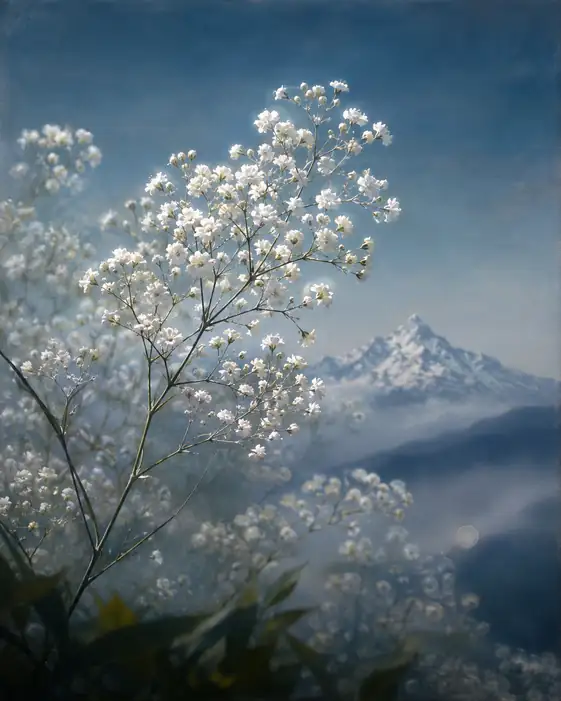 White Baby's Breath Facing the Snowy Peak
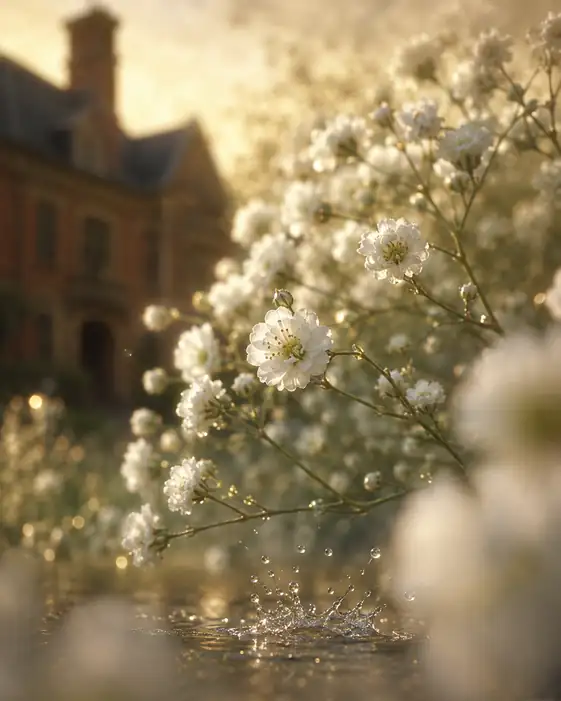 Sunlit Garden and the Water Crown
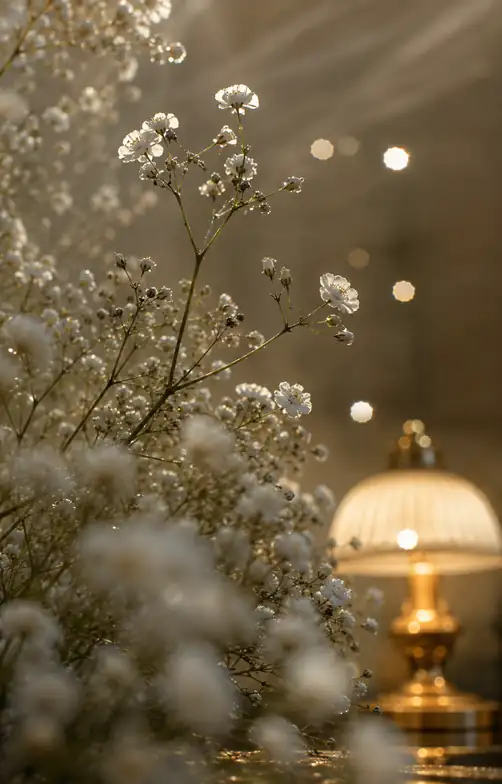 Amber Lamp and the Whispering Blooms
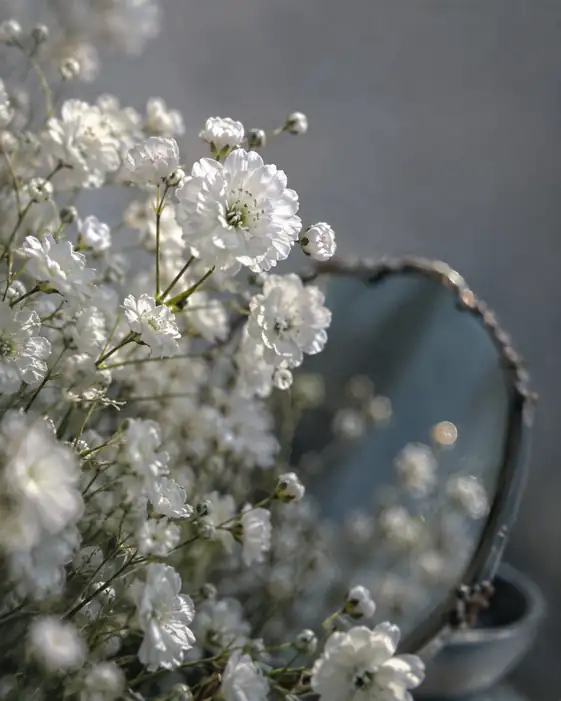 White Baby's Breath and the Mirror's Echo
 Starlit Baby's Breath and the Antique Mirror
 Evening Toast and the Purple Lupine
 Floating Petal and the Twilight Bicycle
 Purple Lupine and the Azure Butterfly