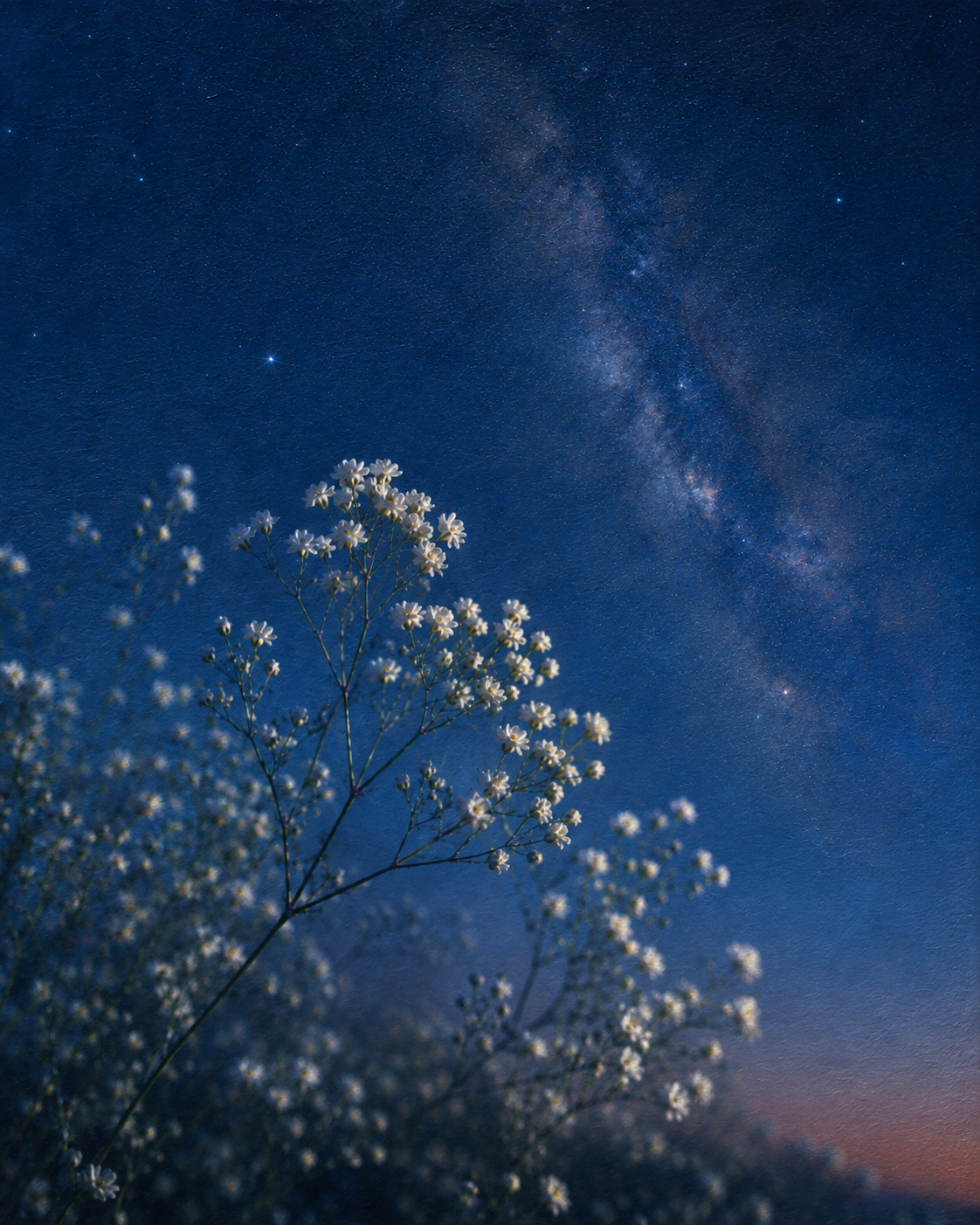
White Baby's Breath and the Milky Way
Critique
Introduction This painting places baby's breath beneath the Milky Way. The kinship between blossoms and stars collapses differences of scale, turning a humble plant into the night sky's terrestrial echo. Description Dark stems rise diagonally from lower left, carrying white flowers and buds. The sharpest spray occupies the center; surrounding blooms dissolve into points. Above, blue sky holds stars and the textured Milky Way. A faint rose glow remains at the lower-right horizon. Analysis The composition divides into a branching floral lower half and an expansive celestial upper half, but repeated white points unite them. The central stem forms a diagonal that appears to continue into the galactic band, leading the eye across the full height. Selective focus gives only some flowers crisp petals, establishing a transition from tangible bloom to pure light. Deep blues dominate, with the warm horizon providing a restrained complementary note. The broad open sky balances the complex network of stems below. Interpretation and Evaluation The analogy between flower and star is direct but fruitful. Each blossom is brief, near, and individually visible; each star appears minute yet may belong to an immense and ancient body. Their visual equality reminds viewers that perceived scale depends on distance. The flowers also seem to reach toward their celestial counterparts, suggesting kinship between earthly growth and cosmic matter. The remaining dusk at the horizon marks transition, so the scene holds both the end of day and the fuller revelation of night. Conclusion With limited color and lucid structure, the painting makes cosmic wonder intimate. It neither diminishes sky nor inflates flowers; repeated light lets each realm clarify the other. The result is contemplative, spacious, and generous.
Same Subcategory
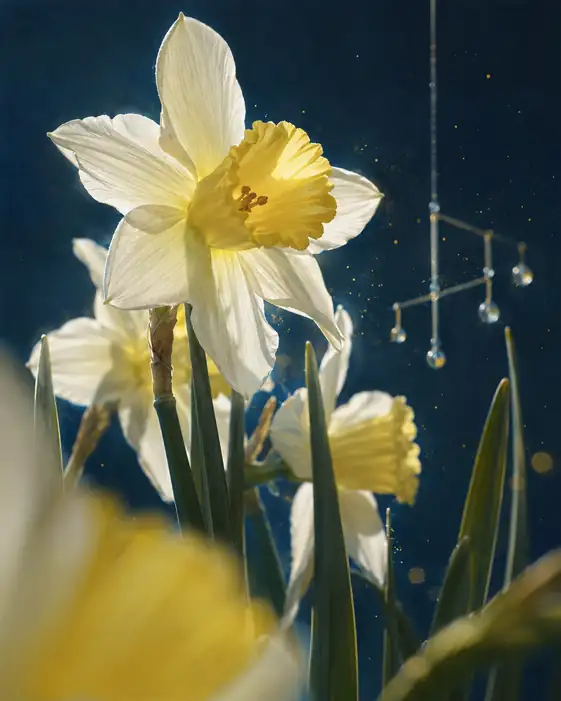 Daffodil Melody in Deep Azure
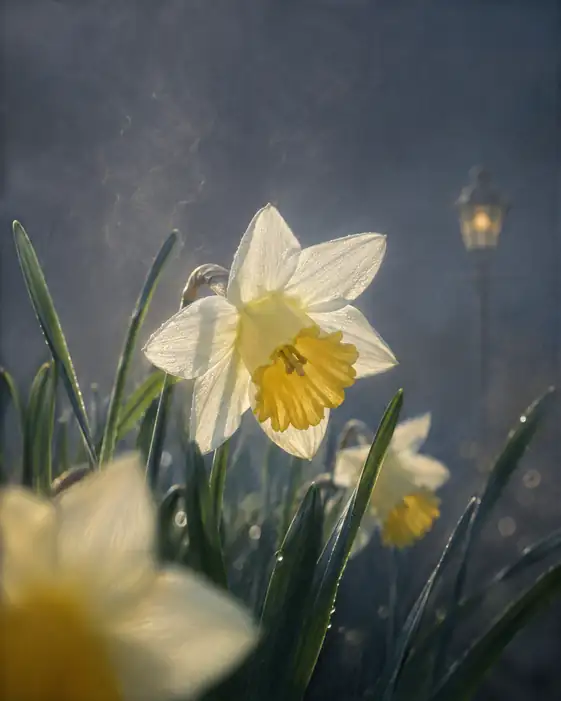 Misty Daffodils and the Distant Lantern
Similar Artworks
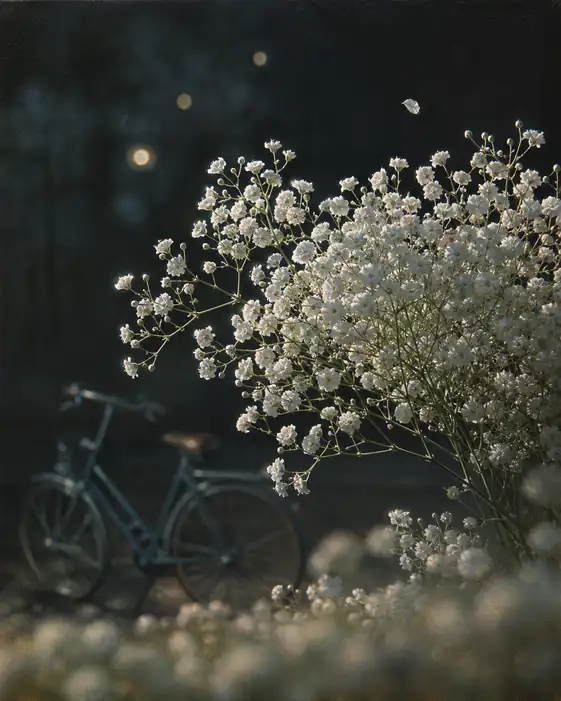 Baby's Breath in Night Mist and the Bicycle
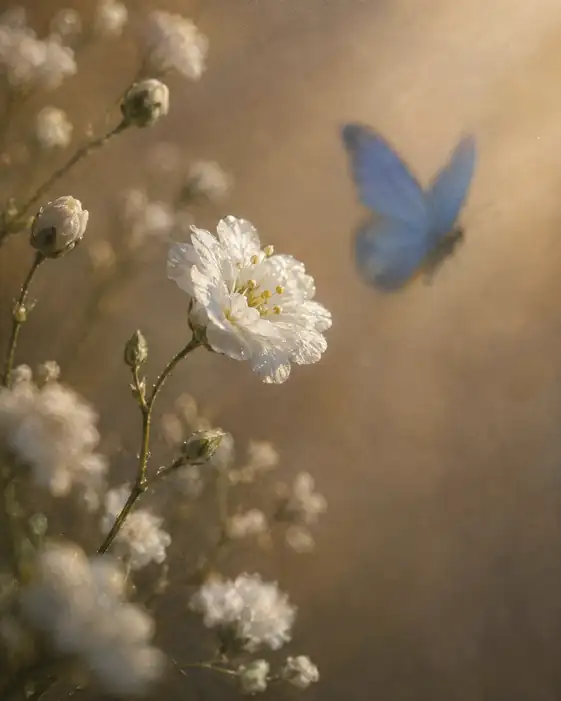 Sunlit Baby's Breath and the Blue Butterfly
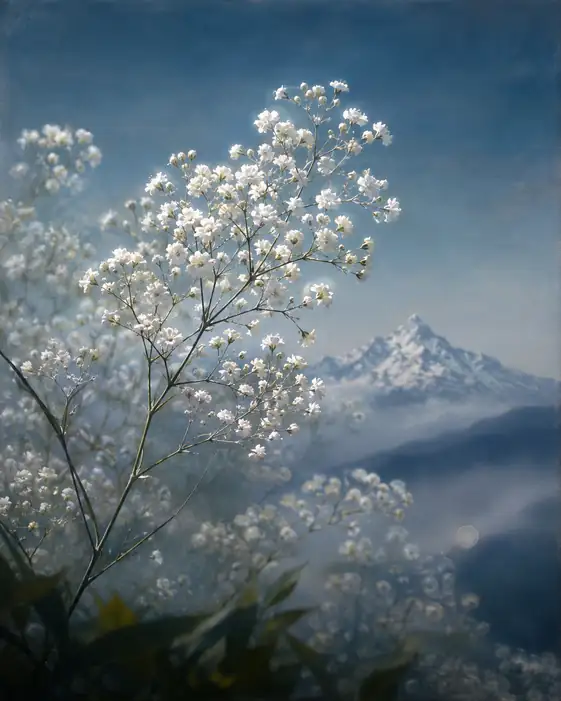 White Baby's Breath Facing the Snowy Peak
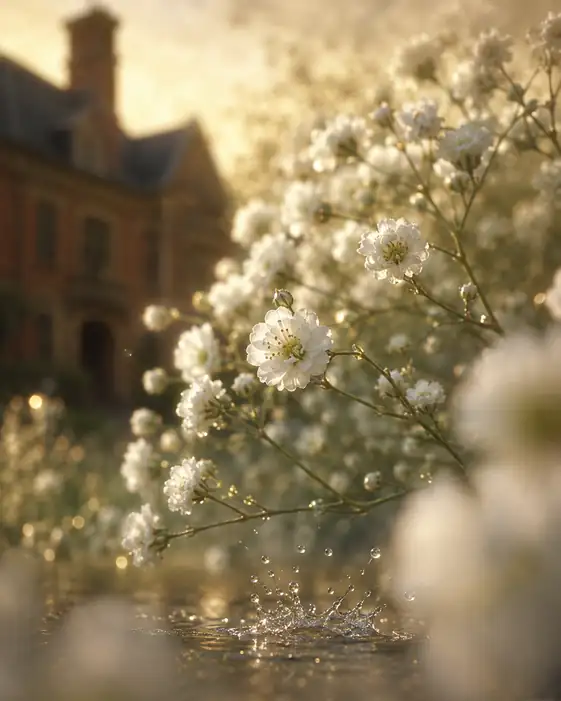 Sunlit Garden and the Water Crown
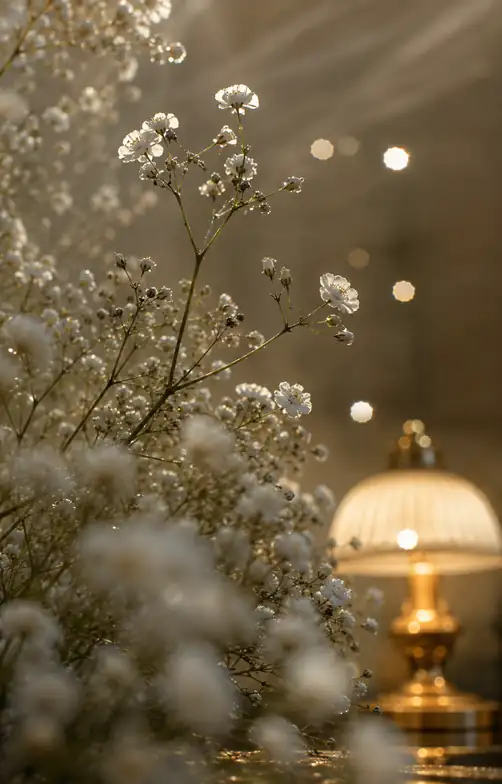 Amber Lamp and the Whispering Blooms
 White Baby's Breath and the Mirror's Echo
 Starlit Baby's Breath and the Antique Mirror
 Evening Toast and the Purple Lupine
 Floating Petal and the Twilight Bicycle
 Purple Lupine and the Azure Butterfly