
Morning Dewdrop and the Glass Sphere
Critique
Introduction This painting places a poppy between direct perception and reflection. Warm backlight makes it immediate, while the glass vessel below gathers a more elusive floral world. Description A red-orange poppy rises left of center on a hairy stem. Its translucent petals turn sideways, and one droplet hangs at the right edge. The background dissolves into pale gold. At lower right, a round glass vessel refracts red flowers; blurred blooms occupy the distance. Analysis The composition balances a tall organic axis against the vessel's compact sphere. Both forms are delicate, but they describe space differently: the flower opens outward, while the glass encloses and bends what it receives. Backlight reveals the petals' folds and gradations from scarlet to orange. The restrained depth of field isolates the principal bloom without emptying the background, whose soft repetitions establish a broader field of life. Highlights on the droplet and glass rim create a precise visual rhyme. Interpretation and Evaluation The paired flower images invite a meditation on experience and preservation. The upper poppy exists openly in light and air; the lower blossoms appear held, doubled, and transformed by glass. The solitary droplet intensifies this contrast, embodying a moment that is both complete and about to change. Rather than treating fragility as sadness, the work makes impermanence luminous. Its symbolism is especially effective because transparency governs every important element: petal, water, vessel, and atmosphere. Conclusion With economical placement and finely coordinated light, the painting makes transience feel abundant rather than diminished. The dialogue between exposed bloom and enclosing glass gives its beauty intellectual structure while preserving the tenderness of a fleeting morning vision.
Same Subcategory
 Purple Lupine Reaching the Clear Stream
Similar Artworks
 Poppies over the Night Sea and Skiff
 Poppy's Reflection and the Sleeping Cat
 Scarlet Poppy beneath the Cumulus Cloud
 Sunlit Poppies on the Morning Ridge
 Bicolor Anemone and the Sweet Celebration
 Scarlet Poppies in the Morning Breeze
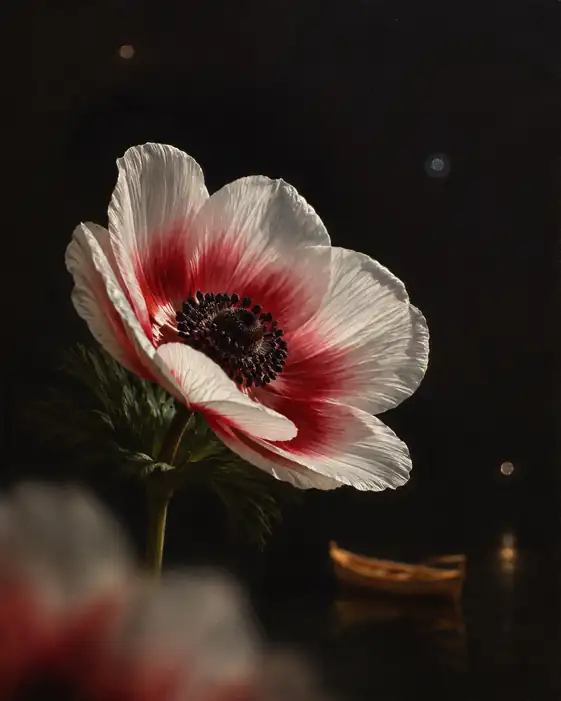 Crimson Anemone and the Lone Skiff
 Scarlet Prayer on the Moonlit Hill
 Poppies in Sunlight beneath the Lantern
 Scarlet Passion and the Crystal Bottle