
Scarlet Prayer on the Moonlit Hill
Critique
Introduction This nocturnal painting raises a red poppy between moon and distant church. Thin petals, airborne specks, and quiet architecture evoke awakening, faith, and fragile light in darkness. Description The poppy stands left of center, its hairy stem supporting scarlet-orange petals seen from below. Backlight exposes folds and veins around a dark center and green capsule. Particles drift through blue night. At upper right, a cream moon glows behind thin cloud. On the lower-right ridge, a white church appears softly. Buds and flowers populate the dark lower field. Analysis Flower, moon, and church form a wide triangle, distributing attention across height and distance. Warm red advances strongly from cool blue, and the moon repeats the capsule’s compact roundness. The vertical stem echoes the steeple, linking organic and architectural aspiration. Sharp petal texture gives way to softened church and sky. Floating particles occupy the interval between foreground and moon, making empty space active and visually joining separate planes. Interpretation and Evaluation The church may suggest refuge or spiritual orientation, while the poppy embodies a vivid, temporary form of earthly presence. The moon offers recurring light beyond both. Yet the painting avoids prescribing belief: the church remains distant, and the flower commands immediate attention through material radiance. Airborne flecks can read as pollen, moisture, or stars, enriching the ambiguity. This layered symbolism remains persuasive because every association grows from visible structure. Conclusion By aligning stem with steeple and flower with moonlight, the work connects bodily life, human aspiration, and celestial recurrence. Its red-blue contrast is dramatic, but soft distance and drifting particles preserve a contemplative stillness around the luminous bloom.
Same Subcategory
Similar Artworks
 Morning Dewdrop and the Glass Sphere
 Poppies over the Night Sea and Skiff
 Poppy's Reflection and the Sleeping Cat
 Scarlet Poppy beneath the Cumulus Cloud
 Sunlit Poppies on the Morning Ridge
 Bicolor Anemone and the Sweet Celebration
 Scarlet Poppies in the Morning Breeze
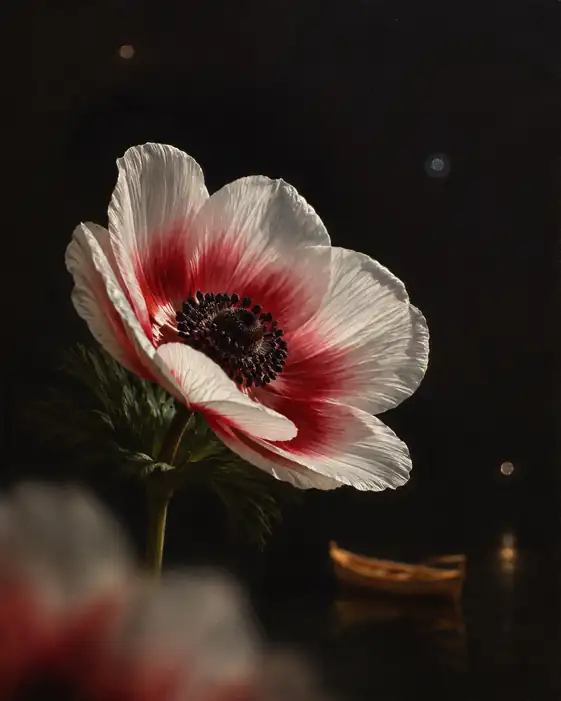 Crimson Anemone and the Lone Skiff
 Poppies in Sunlight beneath the Lantern
 Scarlet Passion and the Crystal Bottle