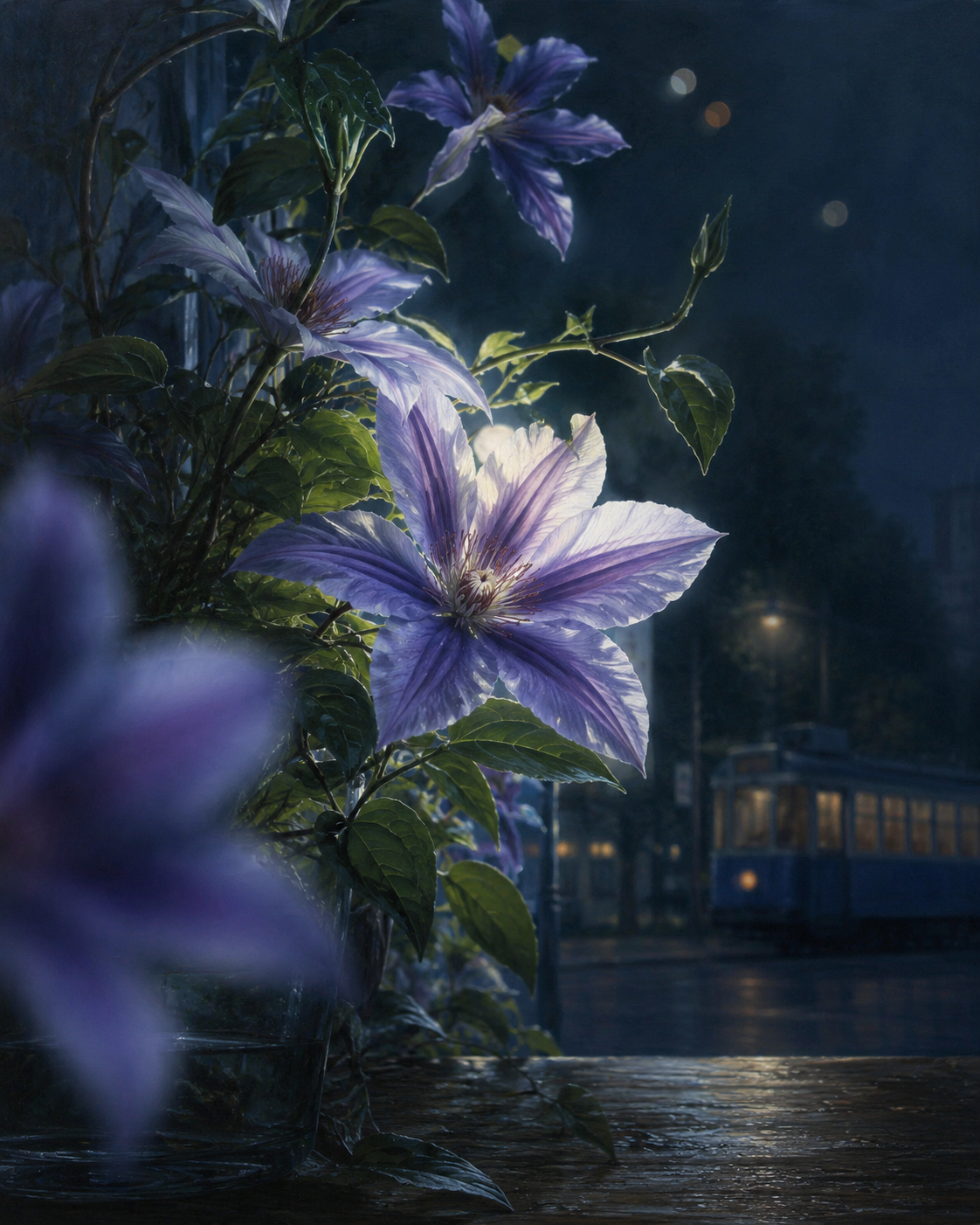
Rainy Rails and the Window Clematis
Critique
Introduction This rainy night places luminous clematis beside a dim street and tram. Garden growth and urban movement overlap at a threshold between private attention and public time. Description A violet-white clematis opens near center, striped petals backlit among wet leaves. Other flowers and buds climb left, while blurred bloom veils the foreground. On the right, a blue tram sits out of focus, warm windows glowing. Street lamps and bokeh hover beyond. Rain-dark pavement reflects light across the bottom. Analysis The sharply rendered central flower contrasts with the softened vehicle, separating immediate garden from distant street. Vine stems form diagonals that reach toward the tram and lights. Cool blue-violet dominates both natural and urban zones, while window gold provides rhythmic warmth. Backlight reveals thin petal veins and leaf edges. Foreground blur, crisp flower, and hazy tram create three spatial stages, and the wet pavement unifies them through reflection. Interpretation and Evaluation The tram implies schedules, shared journeys, and movement beyond the secluded vine. The flowers follow another timetable of opening and decay. Their juxtaposition suggests parallel rhythms rather than conflict between nature and city. No passengers are visible, so the vehicle becomes an invitation or memory instead of a report. The painting’s restrained darkness and selective focus preserve intimacy, while the warm windows prevent the urban background from feeling indifferent. Conclusion By bringing rain-bright petals into dialogue with a softly lit tram, the work discovers tenderness at the edge of public transit. Natural and human time remain distinct but briefly meet in reflected light, making the nocturnal street feel both inhabited and contemplative.
Same Subcategory
Similar Artworks
 Crimson Dahlia Beneath the Moon's Halo
 Crimson Dahlia Overlooking the Misty Peak
 Sunset Tea and the Gilded Rails
 Violet Bloom Beneath the Lunar Halo
 Crimson Banquet in the Evening Glow
 Azure Bloom Cradling the Morning Light
 Mirage on the Still Water
 Dawn Prayer and the Azure Corona
 Crimson Bloom Beneath the Haloed Moon
 Lantern's Glow over Morning Dew