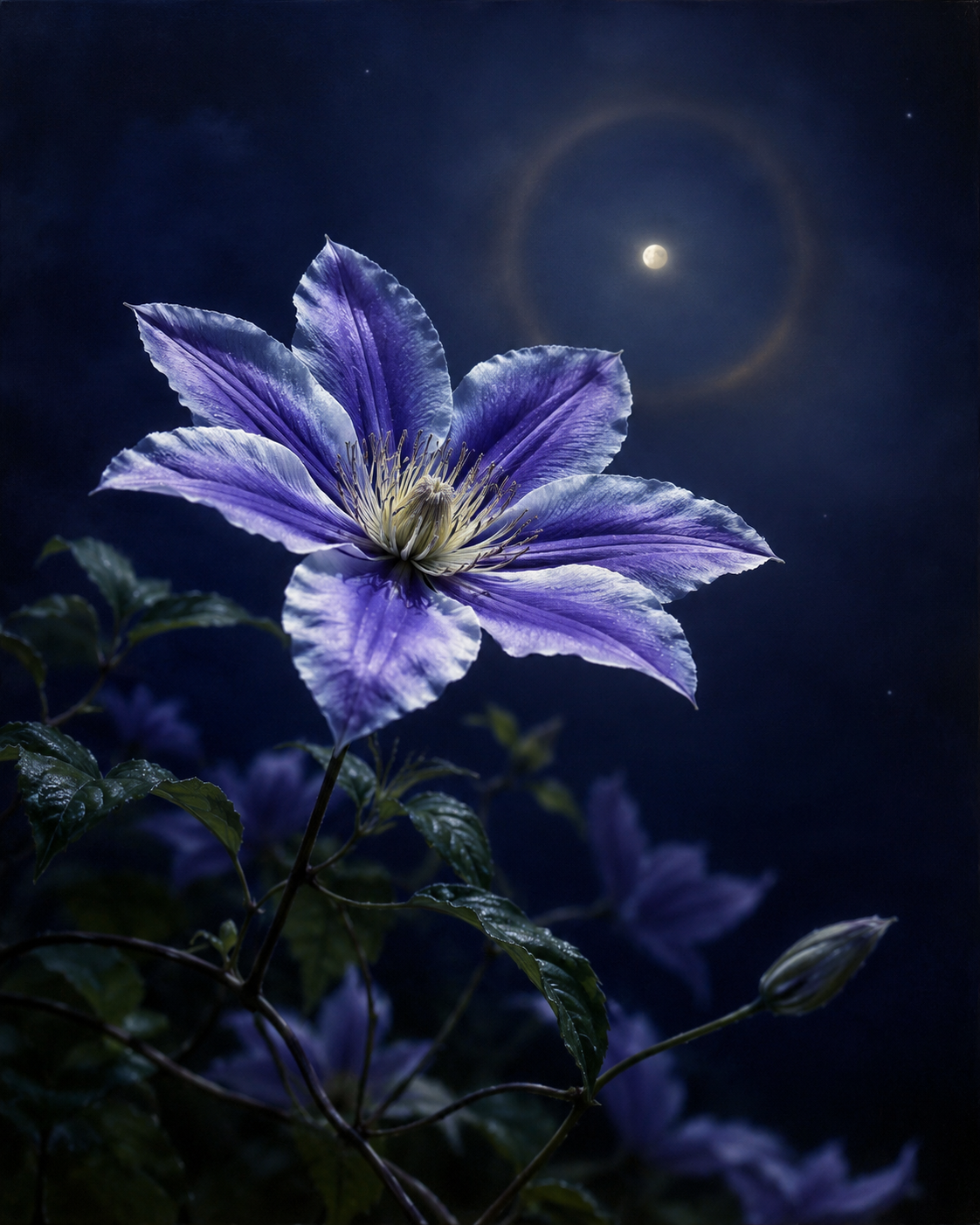
Violet Bloom Beneath the Lunar Halo
Critique
Introduction This painting presents violet clematis beneath a haloed moon. Flower and celestial ring share dark blue night, creating a solemn comparison between earthly opening and distant recurrence. Description The clematis occupies upper-left center, pointed petals striped violet, indigo, and white. Pale filaments and dark anthers radiate around a compact center. Wet leaves and stems fill below with shadowed blossoms and a closed bud. Above, a cream moon glows within a smoky circle. Sparse stars punctuate navy. Analysis The flower’s radial geometry answers the moon’s concentric halo, though their scales differ sharply. Strong edge light models crumpled petal surfaces and separates them from darkness. Violet and blue create tonal unity; the moon and pale filaments add limited warmth. The main stem rises diagonally toward the bloom, while the bud extends in the opposite direction, stabilizing the composition. Broad negative space preserves the halo’s visibility and nocturnal silence. Interpretation and Evaluation The open flower and closed bud mark different moments in a living cycle, while the moon implies a larger pattern of return. Its halo can suggest protection, distance, or an eye witnessing the garden. The painting remains effective because it does not literalize these associations. Petal wrinkles and wet leaves keep the vision material, and the sparse sky avoids decorative excess. The flower appears dignified rather than overwhelmed by cosmic scale. Conclusion By echoing petal radiation in a lunar halo, the work connects temporary growth with recurring celestial time. Its cool darkness, tactile surfaces, and carefully held empty sky create a meditative night in which fragility acquires grandeur without surrendering its physical truth.
Same Subcategory
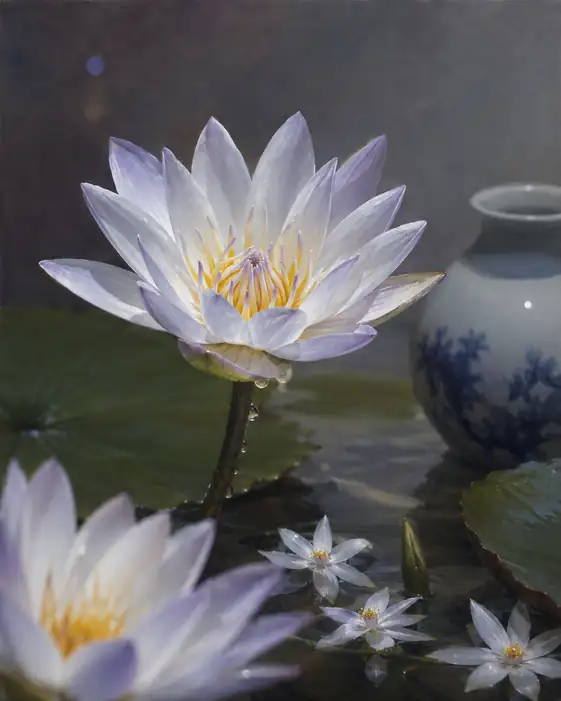 Water Lily and the Cobalt Porcelain
Similar Artworks
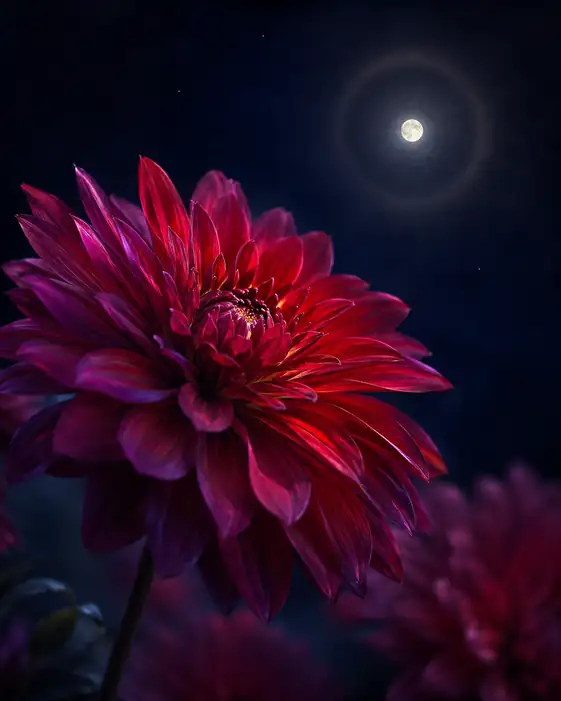 Crimson Dahlia Beneath the Moon's Halo
 Crimson Dahlia Overlooking the Misty Peak
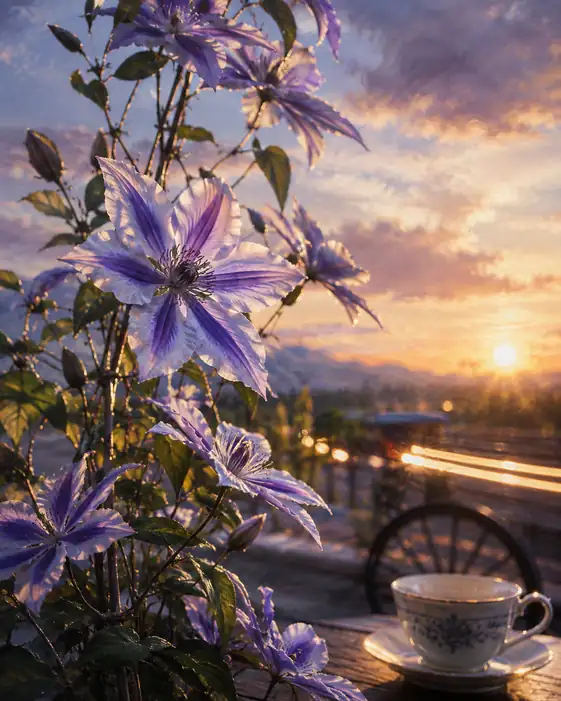 Sunset Tea and the Gilded Rails
 Rainy Rails and the Window Clematis
 Crimson Banquet in the Evening Glow
 Azure Bloom Cradling the Morning Light
 Mirage on the Still Water
 Dawn Prayer and the Azure Corona
 Crimson Bloom Beneath the Haloed Moon
 Lantern's Glow over Morning Dew