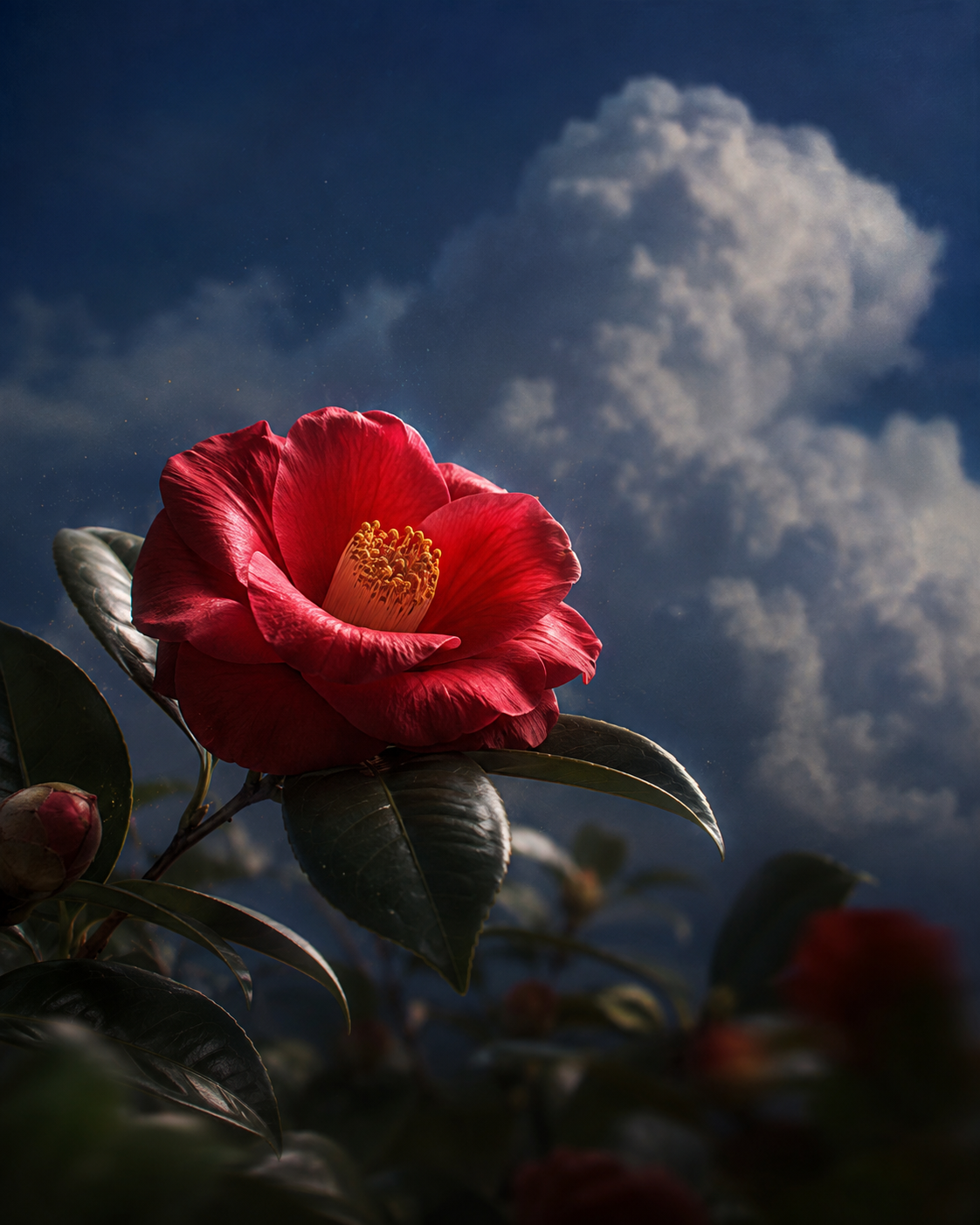
Crimson Camellia Beneath Summer Clouds
Critique
Introduction This low-angle floral landscape sets a fully opened red camellia against a dark blue sky and a towering pale cloud. The close bloom and distant vapor share a sculptural fullness, creating a comparison between compact organic structure and expansive atmospheric form. Description The principal flower occupies the upper left-center, its layered crimson petals opening around a dense gold stamen cluster. Dark glossy leaves spread beneath it, and a closed red bud appears along the lower-left edge. Additional flowers and foliage dissolve into shadow across the bottom. At upper right, a large cream-gray cloud rises in several rounded lobes, with smaller masses extending below. Fine warm particles drift around the flower against the blue field. Analysis The camellia’s circular mass and the cloud’s irregular vertical column form two unequal but visually comparable anchors. Rim light describes petal folds and leaf edges, while the cloud is modeled through broader tonal transitions. Saturated red and gold advance against cool navy and gray. The branch’s diagonals stabilize the flower, and broad negative sky separates it from the cloud. Sharp botanical details yield to soft vapor, producing a clear texture and distance contrast. Interpretation and Evaluation The work invites comparison between a bloom shaped by layered growth and a cloud shaped by transient air. Accurate petals, stamens, leathery leaves, and atmospheric volume demonstrate varied descriptive skill. The asymmetric composition is spacious and controlled. Its restricted color contrast and low viewpoint give the flower monumentality, while the cloud provides an original counterpart that expands the theme from plant form to natural formation. Conclusion A camellia portrait becomes a study of unfolding volume. Scale reversal, edge control, and open sky connect botanical presence with the changing architecture of weather.
Same Subcategory
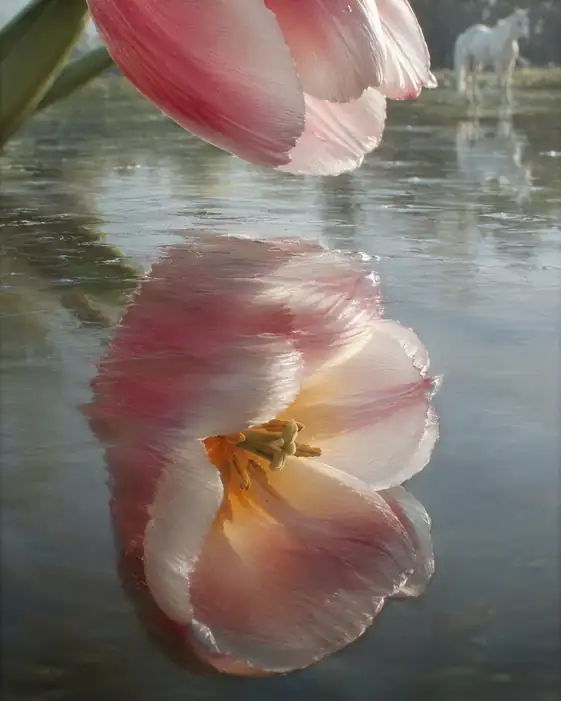 White Steed and Tulip Reflection
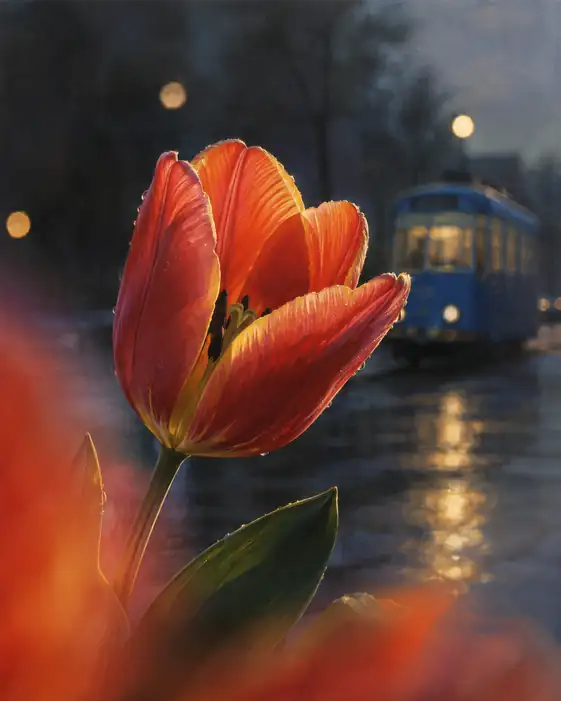 Red Tulip and the Night Tram
Similar Artworks
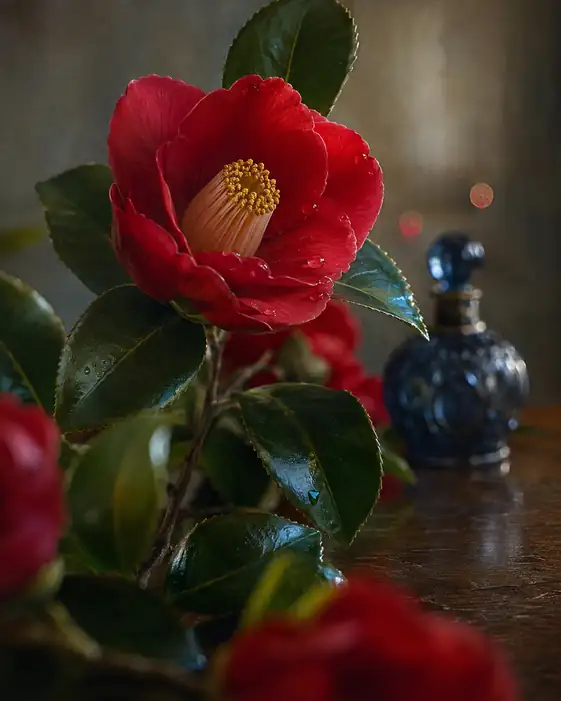 Red Camellia and the Cobalt Bottle
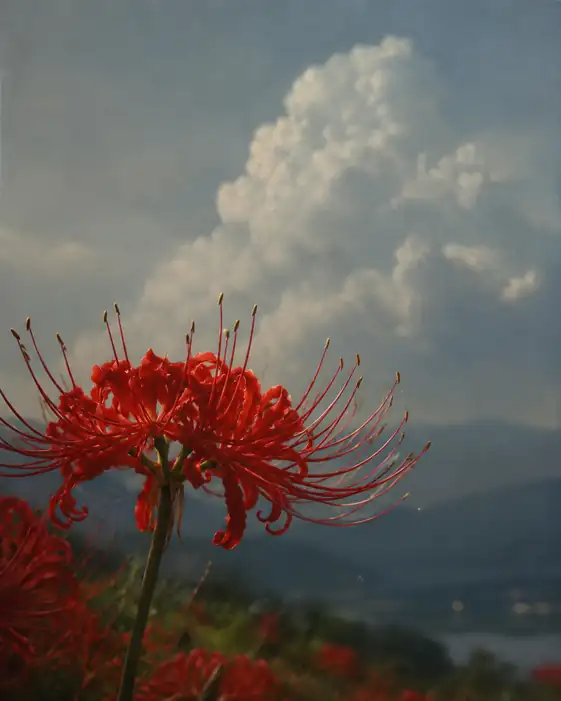 Solitary Flame Beneath the Clouds
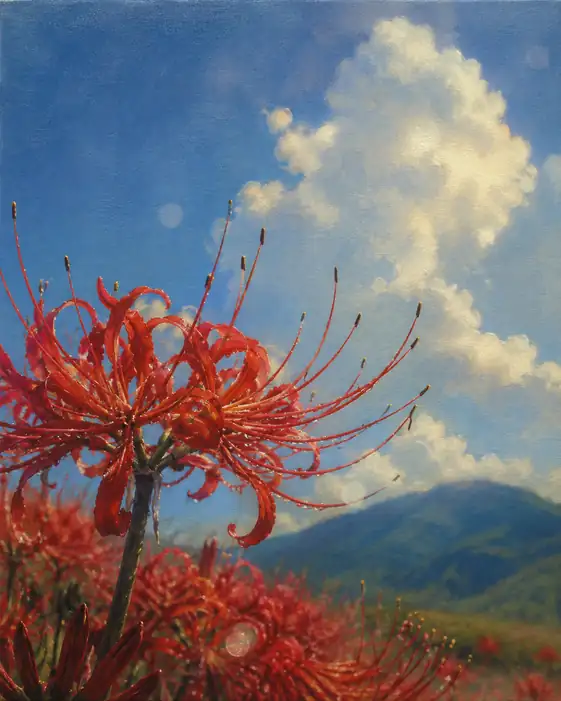 Summer Clouds and Scarlet Bloom
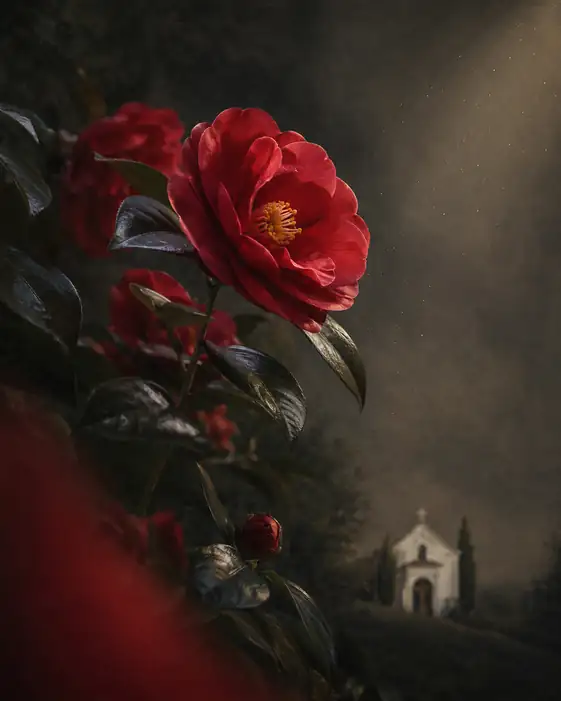 Forest Chapel and the Red Camellia
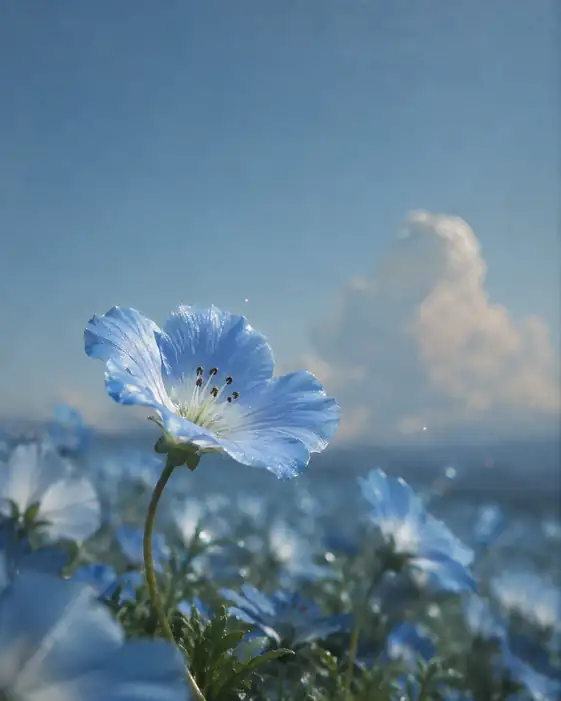 Nemophila and Summer Clouds
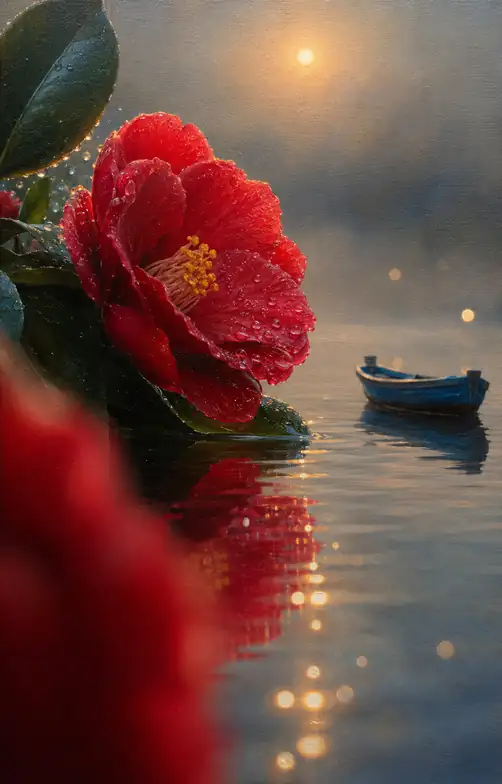 Camellia at Sunset by the Rowboat
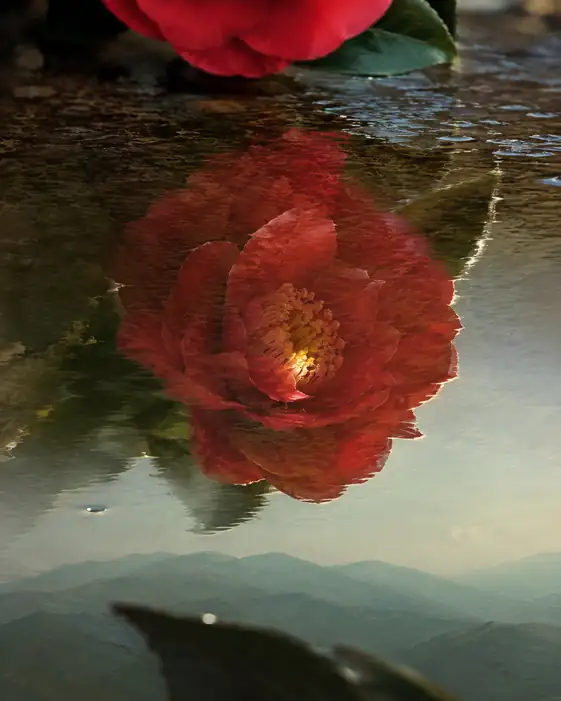 Camellia Mirage on Serene Waters
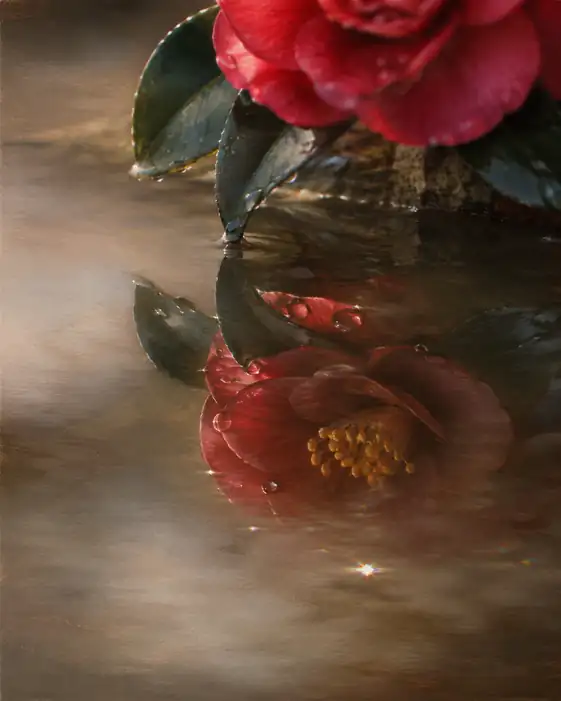 Floating Camellia on Sunlit Stream
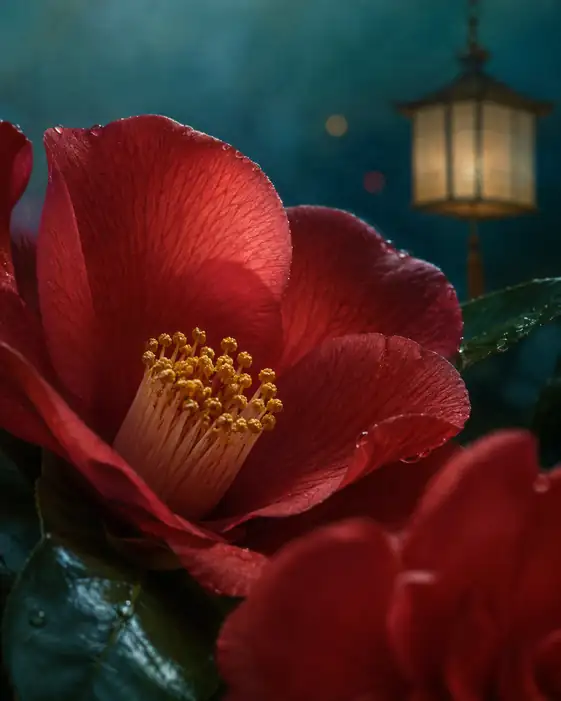 Crimson Camellia Beside the Garden Lantern
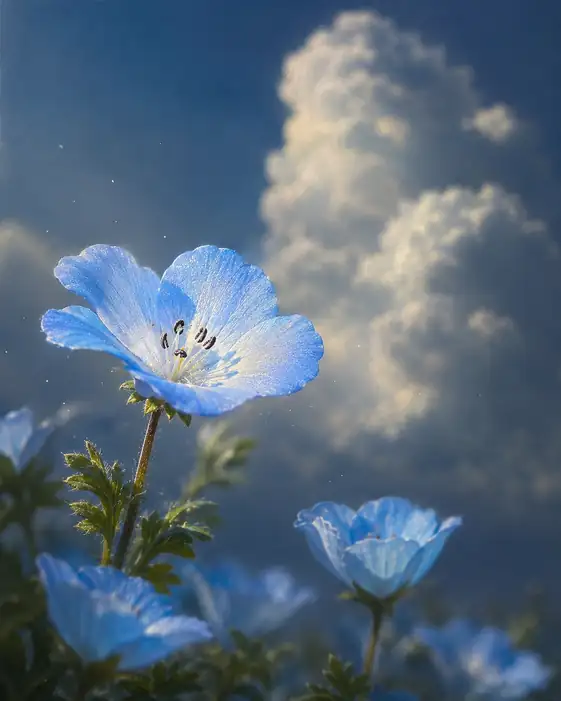 Summer Cloud and Azure Blossom