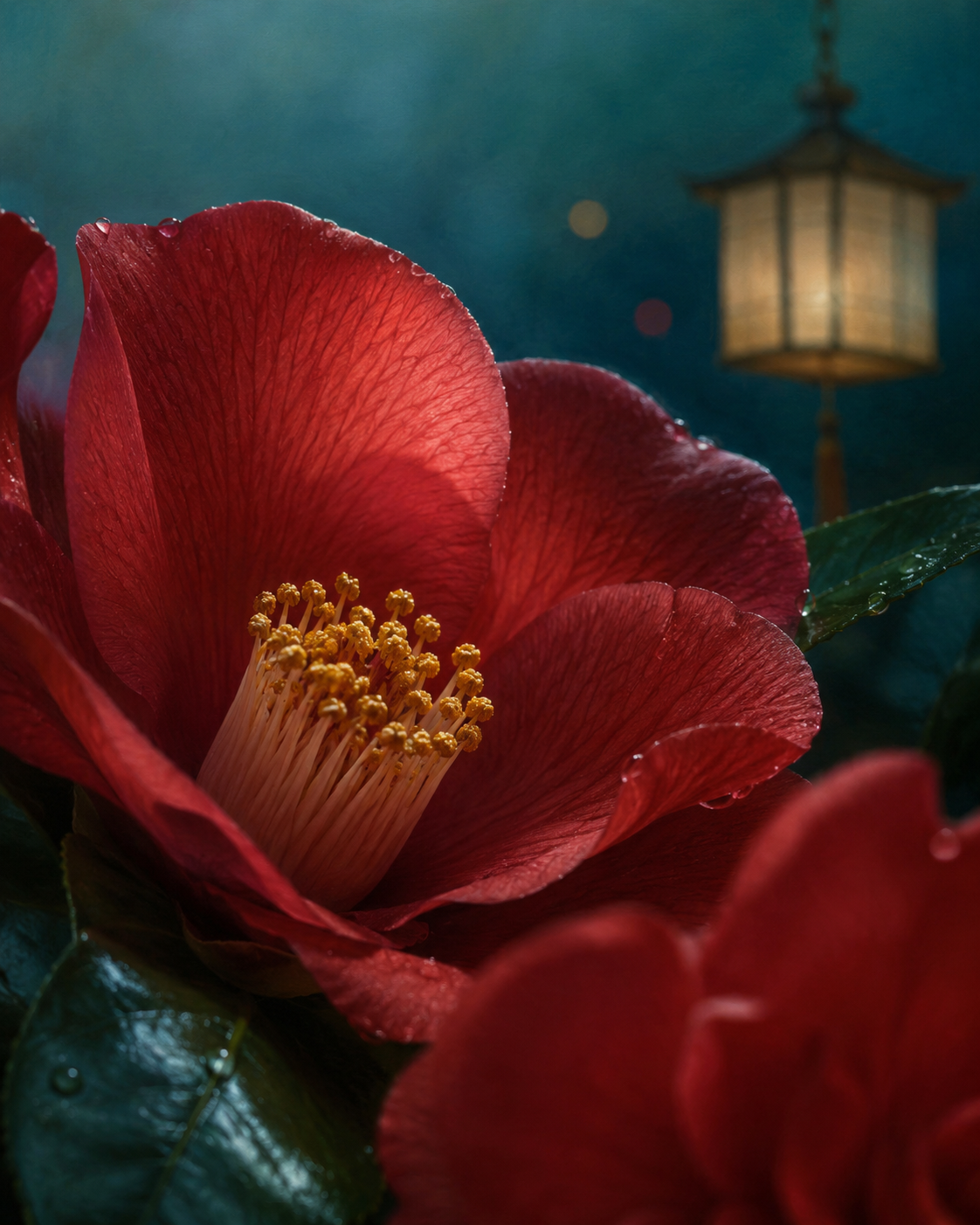
Crimson Camellia Beside the Garden Lantern
Critique
Introduction This nocturnal close view presents a red camellia against a teal background, balanced by a softly glowing square lantern. The concentrated framing makes petal structure and warm illumination comparable, while droplets preserve the cool atmosphere around both forms. Description The main blossom opens from the lower left across most of the image. Broad crimson petals curl around a dense upright bundle of pale filaments with ocher tips. Fine veins are visible through backlit red surfaces, and water beads line several upper edges. Dark glossy leaves frame the flower below and at right. A second red bloom is blurred across the lower-right foreground, while the lantern hangs in the upper-right distance with two small colored circles between. Analysis The flower’s sweeping curves and large scale are countered by the lantern’s compact geometry across a blue-green interval. Backlighting reveals a branching network inside the petals, whereas the stamens catch direct gold light. Crimson and teal establish a strong complementary structure, softened by the lamp’s cream glow. Focus moves from sharp central filaments to layered petals, wet leaves, foreground blur, and distant lantern. The repeated droplets and circular lights provide small linking accents. Interpretation and Evaluation The flower and lantern become two distinct kinds of warm enclosure within night: one organic and open, the other architectural and contained. Detailed venation, moisture, and stamens display persuasive technique. The off-center composition remains balanced through unequal but luminous anchors. Restrained color and the close crop give the camellia monumentality, while the lantern introduces a human scale without diverting attention from the plant. Conclusion A flower study becomes a dialogue about light held by structures. Translucency, focus, and geometric contrast connect bloom anatomy with the order of an illuminated environment.
Same Subcategory
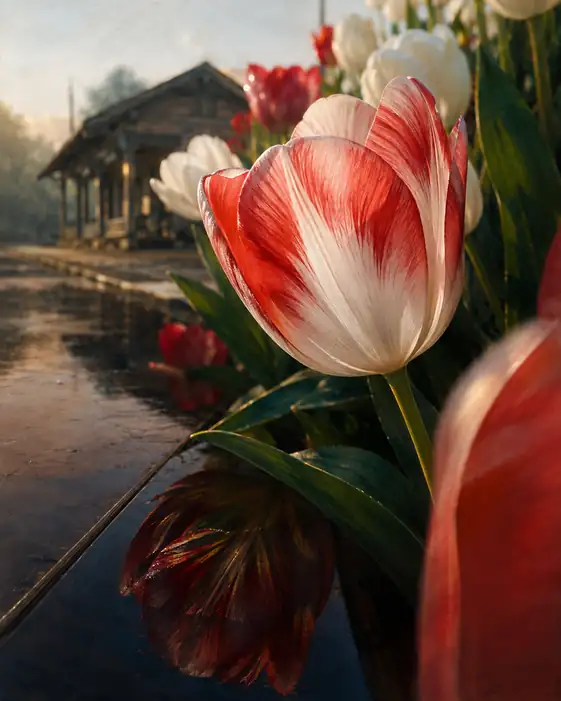 Tulips on Rainy Station Platform
 Tulip Reflection on Wet Cobblestones
Similar Artworks
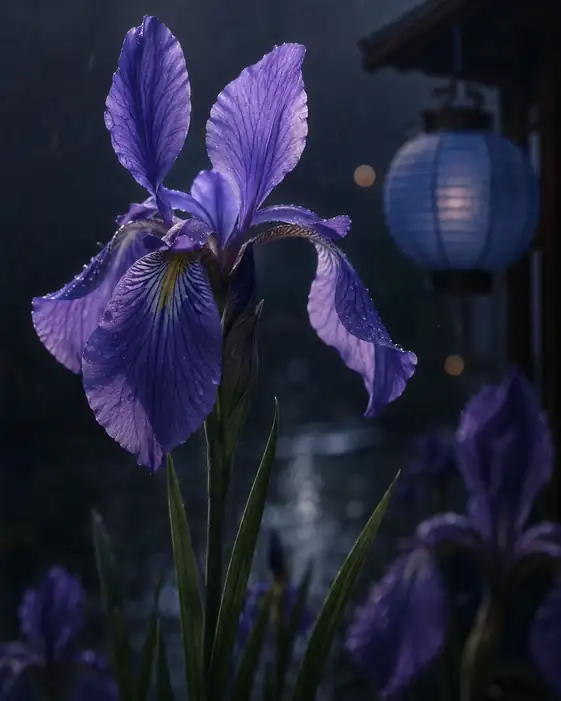 Midnight Iris Beside the Blue Lantern
 Dew-Kissed Lycoris Beneath the Lantern
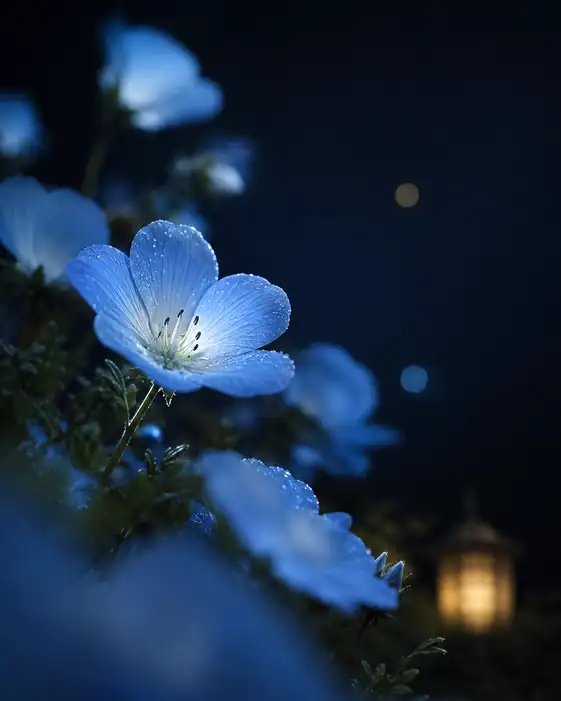 Midnight Nemophila and Garden Lantern
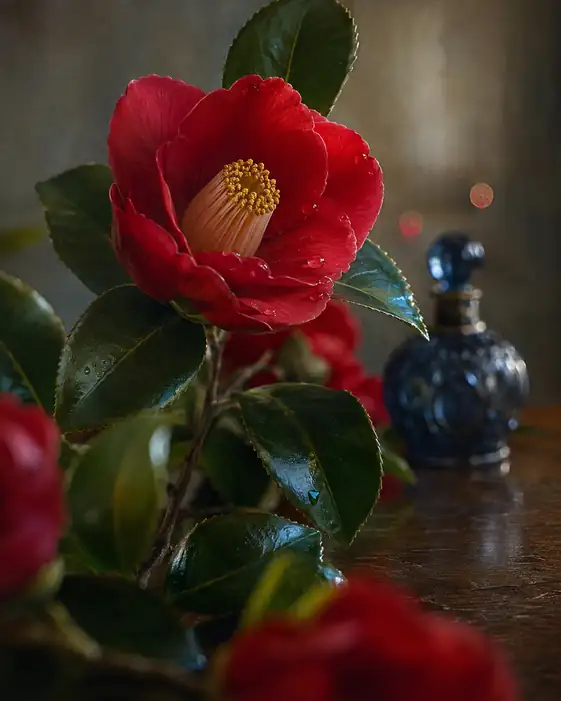 Red Camellia and the Cobalt Bottle
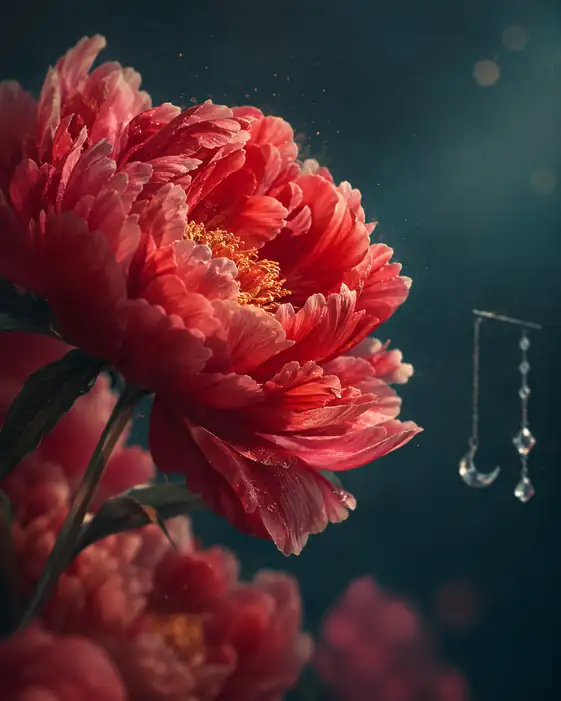 Peony and Crescent Moon Pendant
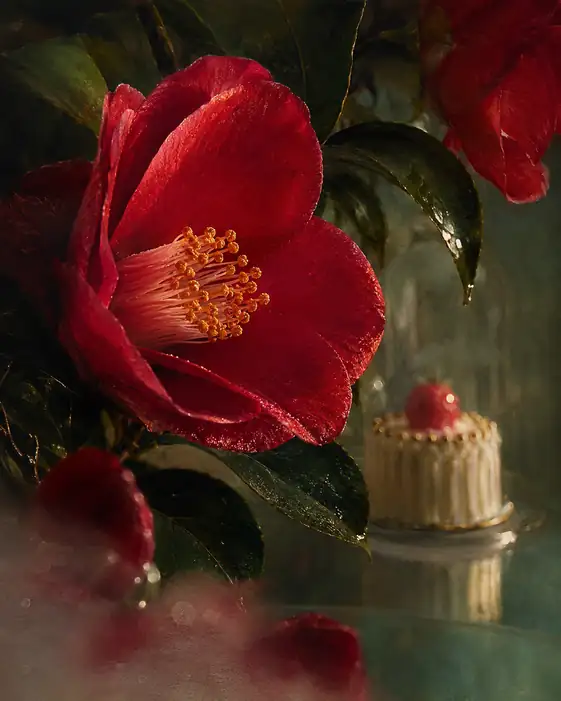 Crimson Camellia and Strawberry Cake
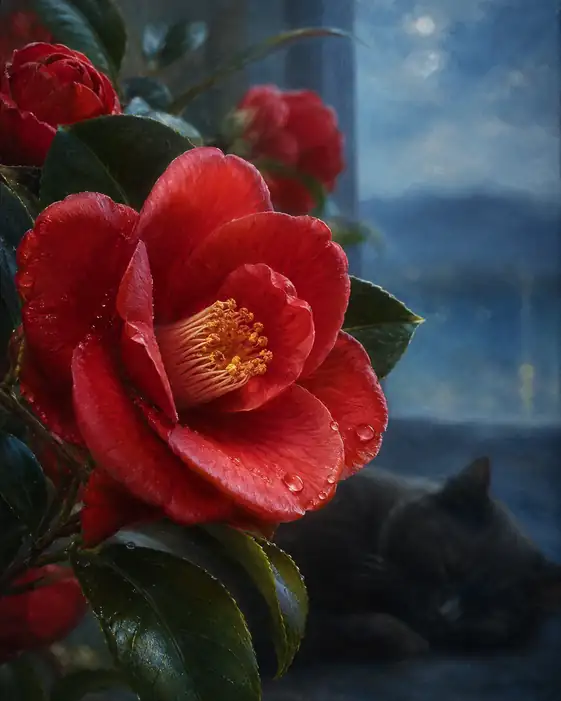 Sleeping Cat Beside Window Camellia
 Moonlit Peony in Velvet Night
 Crimson Peony in Midnight Mist
 Crimson Camellia Beneath Summer Clouds