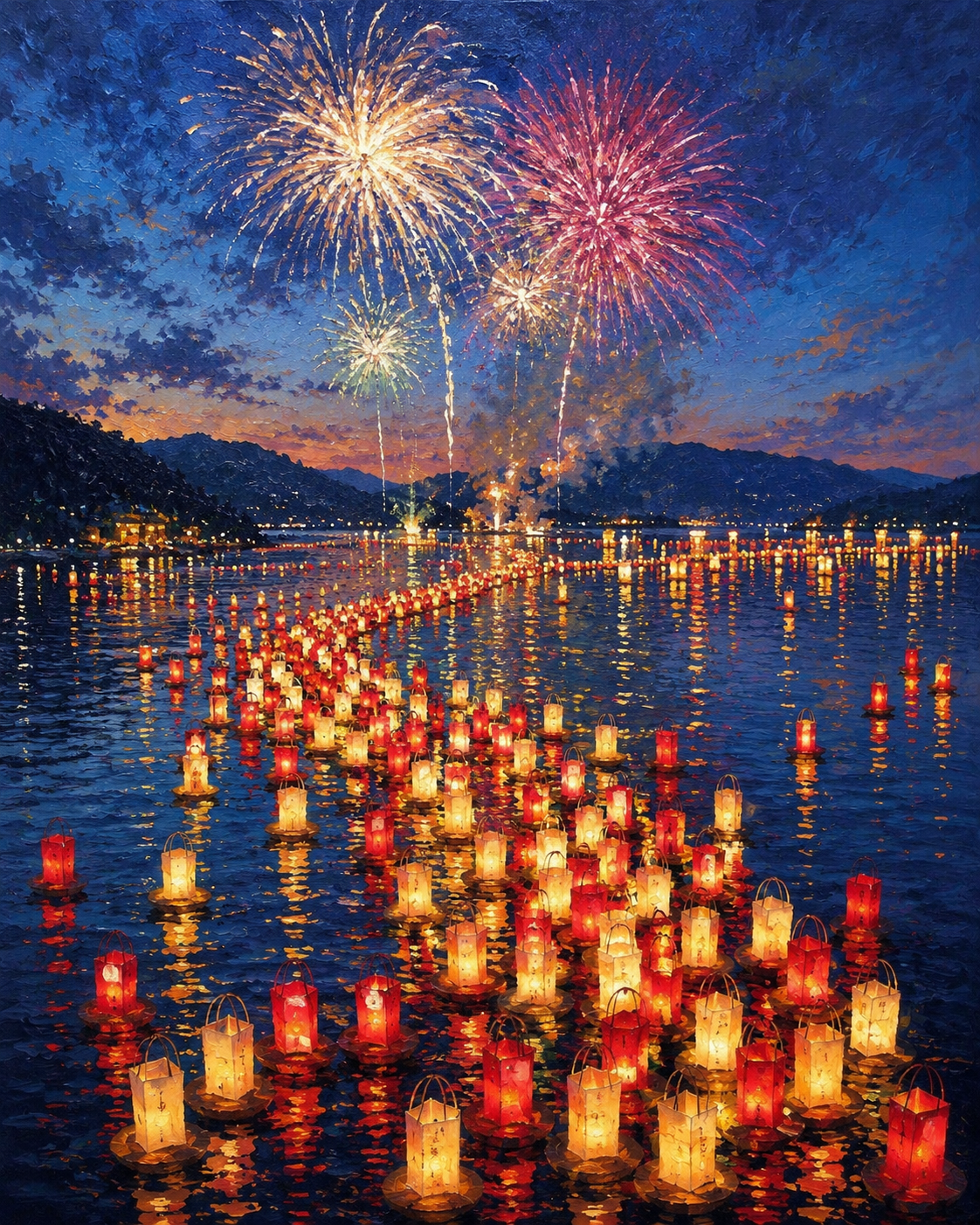
River of Lanterns and Summer Fireworks
Critique
Introduction This painting turns floating lanterns into a luminous route across a mountain lake. Fireworks crown the scene, but the central serpentine procession gives it narrative momentum and unusual spatial clarity. The viewer is invited to follow many modest human lights toward distant, explosive radiance. Description Red and cream lanterns fill the foreground and narrow into a curving stream toward the central shore. Additional lights scatter across the blue water. Dark mountains rise beneath a twilight sky whose horizon retains orange. Four major fireworks—gold, red, white, and green—open above, with thin launch trails connecting them visually to the distant lakeside. Analysis The lantern procession forms an S-shaped recession, beginning broadly below and tightening toward a vanishing area near the central fireworks. This curve offsets the mountains' horizontal weight and the bursts' radial symmetry. Blue dominates sky and lake, while complementary orange-red creates a continuous chain through water and air. Repeated vertical lanterns provide rhythm; their decreasing scale establishes depth. Reflections fracture that orderly sequence and keep the lake mobile. Interpretation and Evaluation The route of lanterns can suggest collective memory, wishes, or lives moving toward a shared horizon. Fireworks offer public spectacle, while individual lamps retain intimacy and duration. The remaining sunset color places the celebration at a threshold between day and full night. Although the foreground contains many similar objects, alternating colors, irregular spacing, and the sweeping curve prevent mechanical repetition. Conclusion The work's strength is its orchestration of movement. A viewer enters among tangible lanterns, travels across reflected light, and arrives at distant bursts above the mountains. The composition therefore transforms decorative abundance into a coherent journey from personal flame to communal sky.
Same Subcategory
Similar Artworks
 Scarlet Fireworks and the Flow of Light
 Floating Lanterns and Fireworks Over Lake
 Golden Canopy Over Lake Lanterns
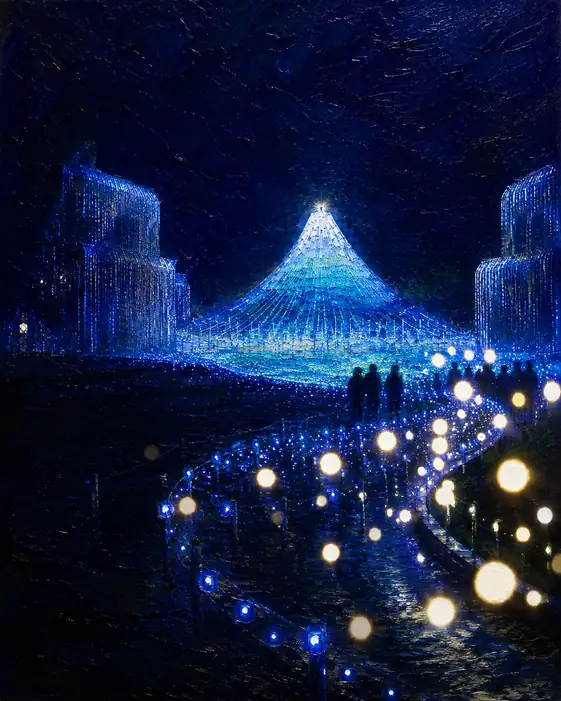 Winding Pathway to the Azure Beacon
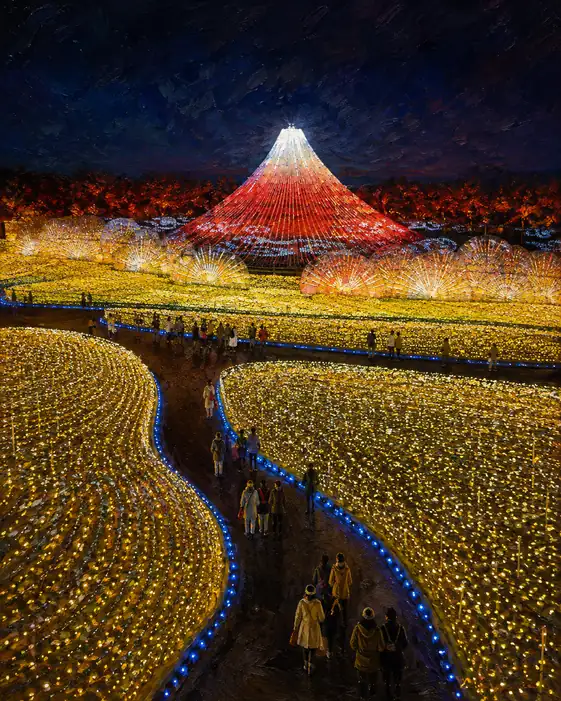 Golden Pathway to the Red Peak
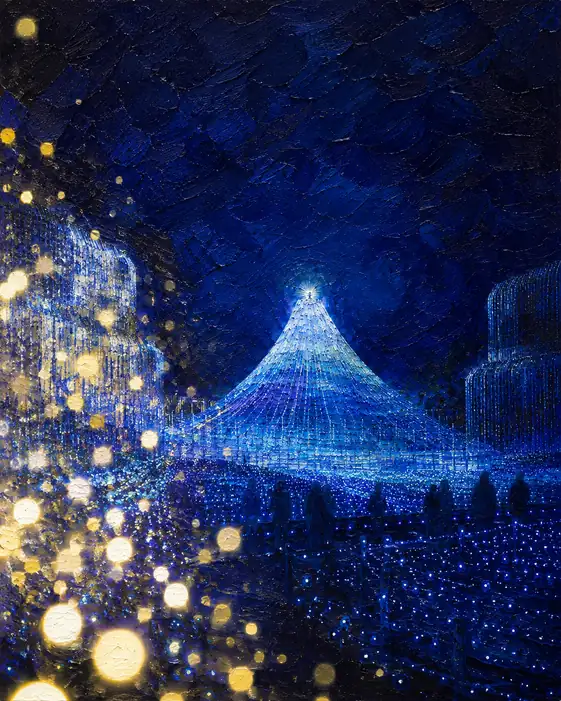 Luminous Mountain and Drifting Orbs
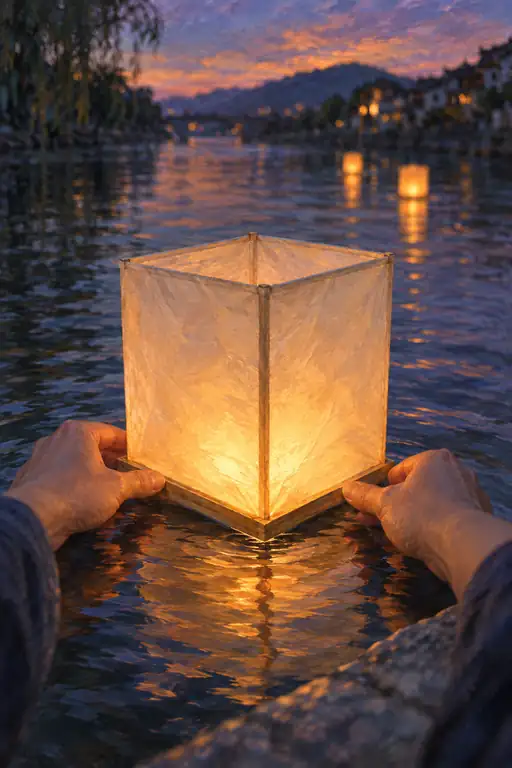 What I Cannot Say, I Give the River
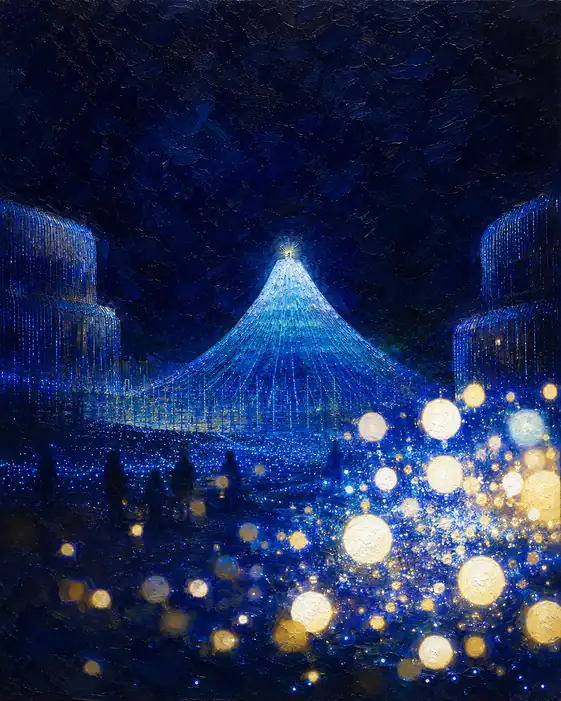 Burst of Light Before the Blue Peak
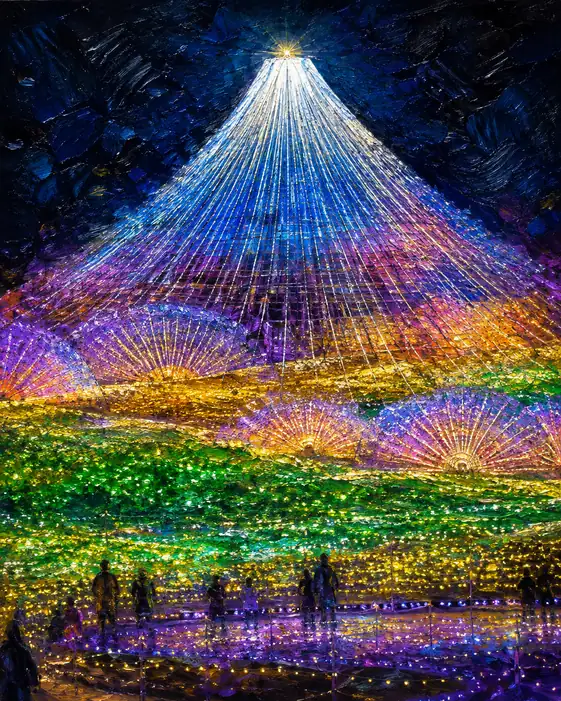 Prismatic Radiance on Winter Night
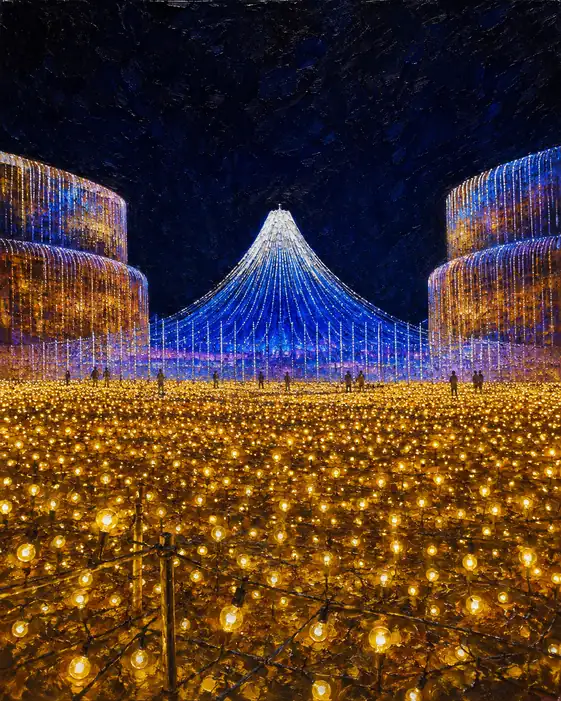 Golden Field Before the Sacred Beacon