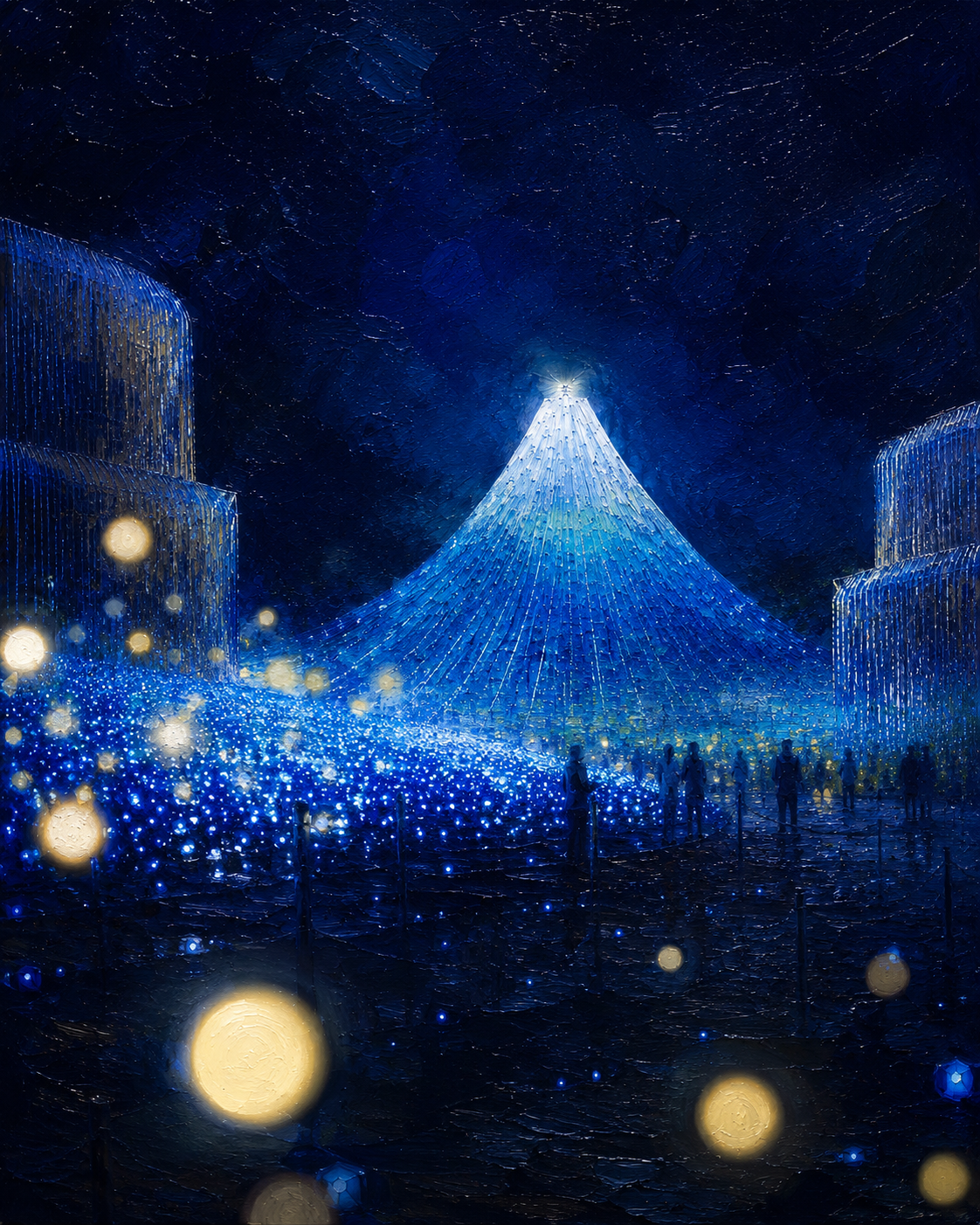
Walking Through the Village Where Lights Bloom
Critique
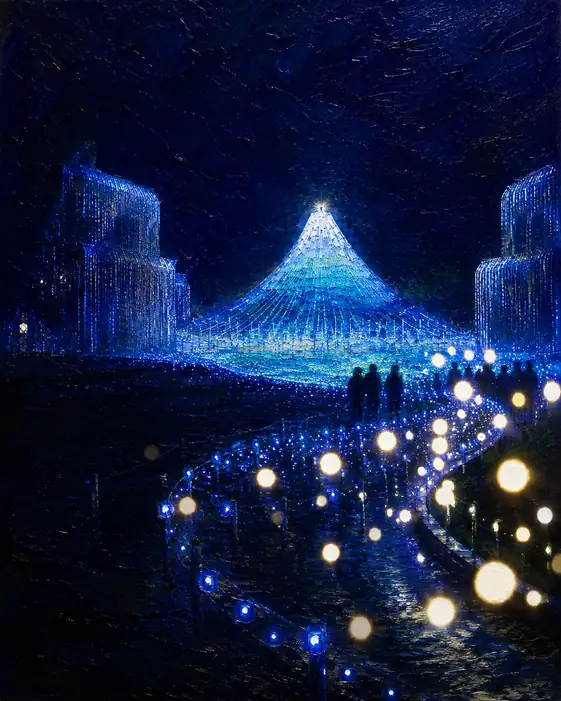
Introduction This painting gives the illuminated mountain unusual breadth. The cone expands across the middle distance, while a sloping river of blue carries the viewer toward it. Sparse warm orbs punctuate spacious nocturnal calm. Description A white star crowns a large turquoise-blue canopy placed slightly right of center. Tall rounded buildings frame both edges, their vertical lights echoing the mountain's strands. A dense blue bank rises from the left foreground, and a dark path curves through the middle toward clustered visitors. Several cream circles appear at left and along the lower edge; most of the sky remains dark. Analysis The mountain's enlarged scale compresses the middle distance and makes its base span nearly the full composition. Its radiating lines oppose the diagonal slope below, creating a broad V-shaped circulation. The path supplies a quiet channel through densely stippled light. Tonal distinctions within blue—from black navy to turquoise and white—carry most of the spatial modeling. Warm circles are few but strategically enlarged, producing foreground depth and chromatic relief. Interpretation and Evaluation The scene presents the installation as an artificial landscape rather than an isolated object. Visitors seem to enter a luminous valley, with architecture acting as cliffs and the canopy as a distant peak. The limited warm accents make human warmth feel intermittent and precious. The central structure is emphatic, perhaps almost too large, yet the asymmetrical path and scattered figures maintain experiential scale and prevent iconic rigidity. Conclusion Through expansion rather than profusion, the painting conveys awe. Blue tonal range, diagonal ground, and restrained gold create coherence and movement. Monumental illumination remains connected to people walking together through darkness.
Same Subcategory
Similar Artworks
 Blue Nocturne and Glowing Specks
 Burst of Light Before the Blue Peak
 Golden Orbs Above the Blue Sea
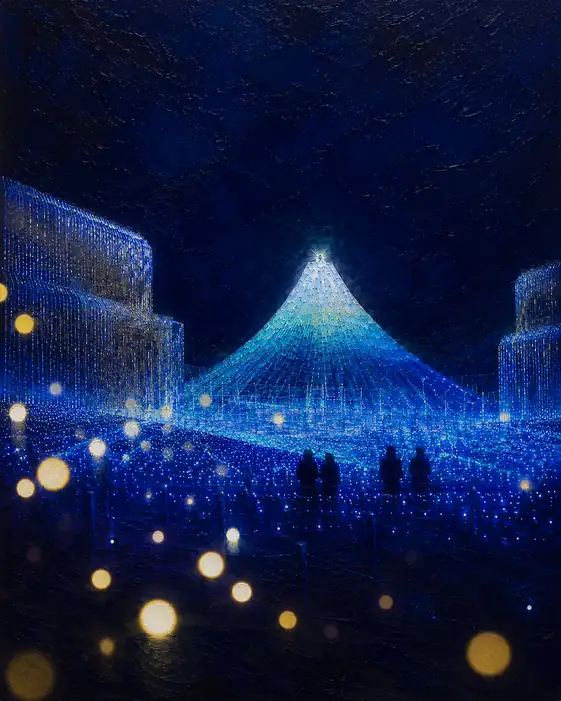 Midnight Blue and Firefly Gleams
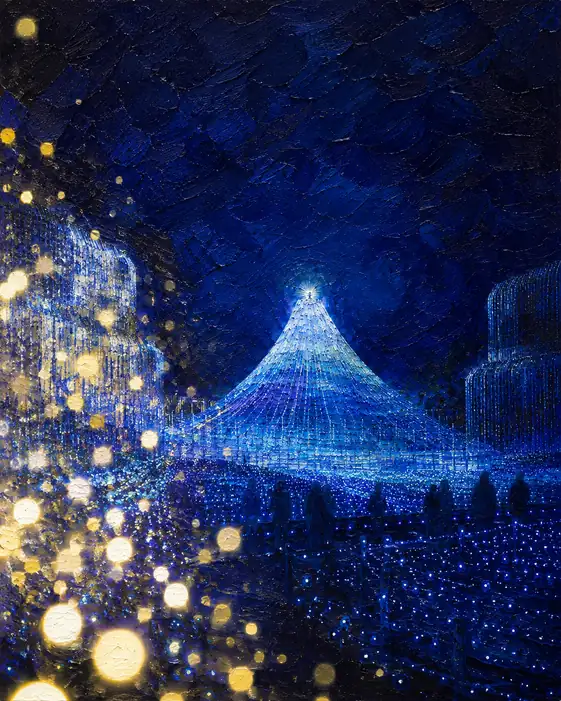 Luminous Mountain and Drifting Orbs
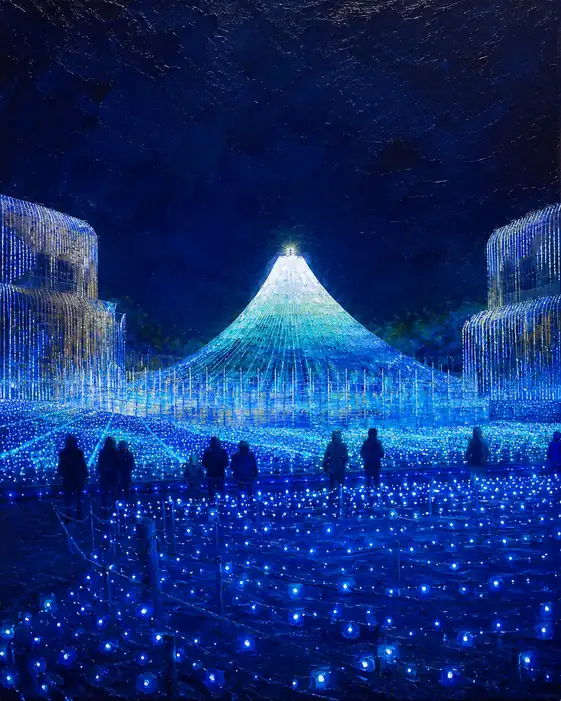 Sapphire Realm and the Mountain of Light
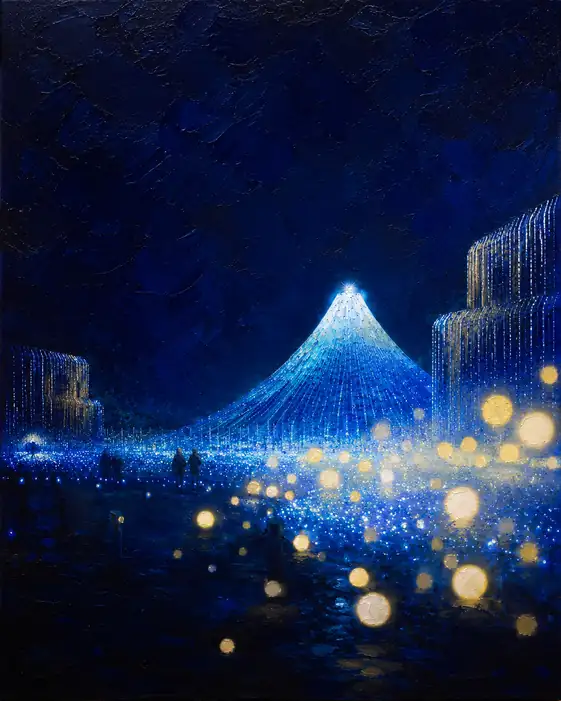 Cascade of Stars Beneath the Peak
 Moonlit Light Path and Sacred Tower
 Prismatic Radiance on Winter Night
 Winding Pathway to the Azure Beacon