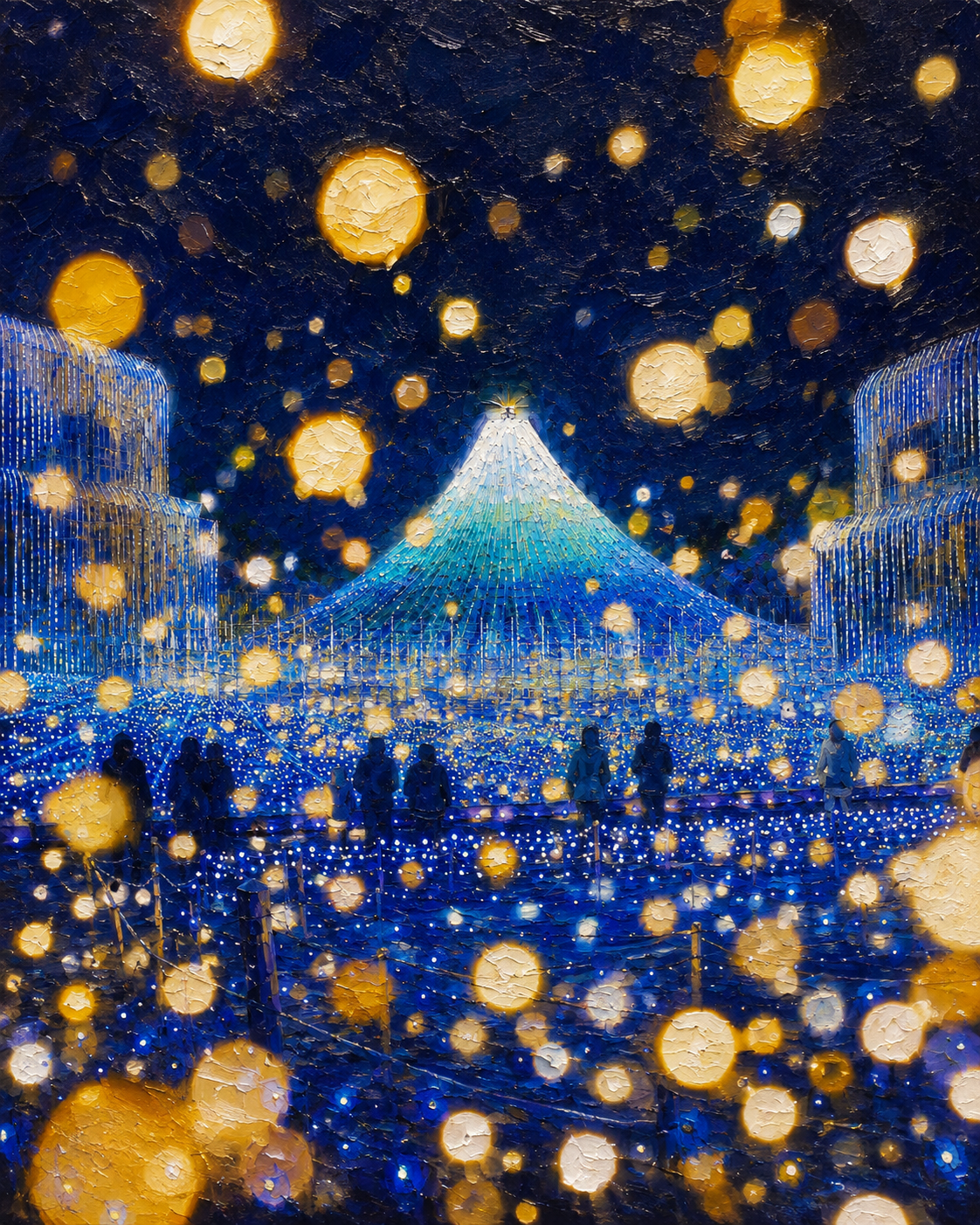
Golden Orbs Above the Blue Sea
Critique
Introduction This painting recasts winter illumination as a blue dream punctuated by hovering gold. A crystalline mountain anchors the scene, but luminous circles loosen its certainty. The combination creates tension between designed spectacle and private fantasy. Description A turquoise-and-white triangular canopy rises at center beneath a deep navy sky. Curving structures on both sides are draped with vertical blue lights, creating a symmetrical enclosure. Dark visitors cross a horizontal walkway before a dense field of blue points. Large amber and cream circles float from the foreground into the sky, partially obscuring people, buildings, and mountain. Analysis Strong bilateral symmetry gives the image ceremonial stability, while differences among the drifting circles keep it visually active. Their scale changes abruptly rather than gradually, compressing distant and near space into one glittering veil. Cool blues dominate nearly every structural plane; complementary gold therefore registers as warmth, proximity, and pulse. Thick, cracked surfaces make the circles resemble painted moons, whereas fine linear marks articulate the canopy and flanking architecture. Interpretation and Evaluation The orbs appear less like literal fixtures than sensations of dazzled vision, perhaps afterimages generated by excessive brightness. They mediate between observer and site, making perception itself the subject. The tiny silhouettes supply human measure and a quiet social rhythm. Repetition is extensive, yet the asymmetrical sizes and occlusions prevent mere pattern. The centralized mountain is conventional, but its cool gradient and partial concealment give it atmospheric depth. Conclusion The work transforms a public installation into a meditation on seeing. Architecture establishes order, figures provide scale, and floating lights dissolve boundaries between space and optical memory. Its worked surface makes blue darkness feel luminous.
Same Subcategory
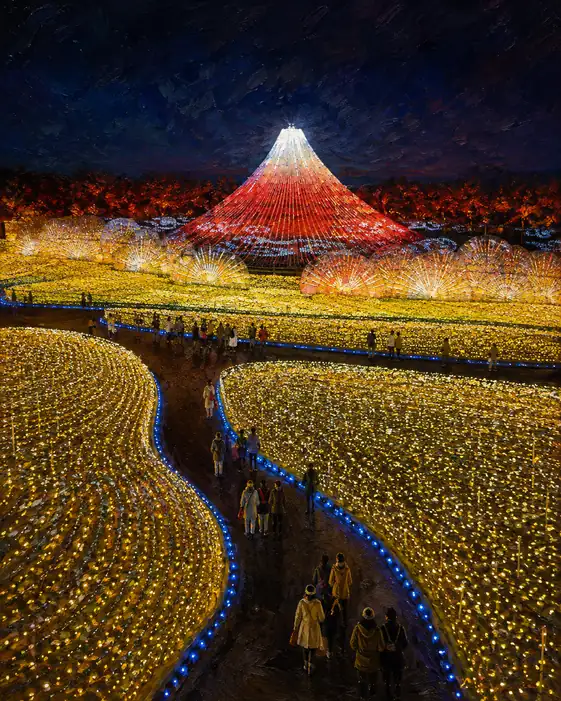 Golden Pathway to the Red Peak
Similar Artworks
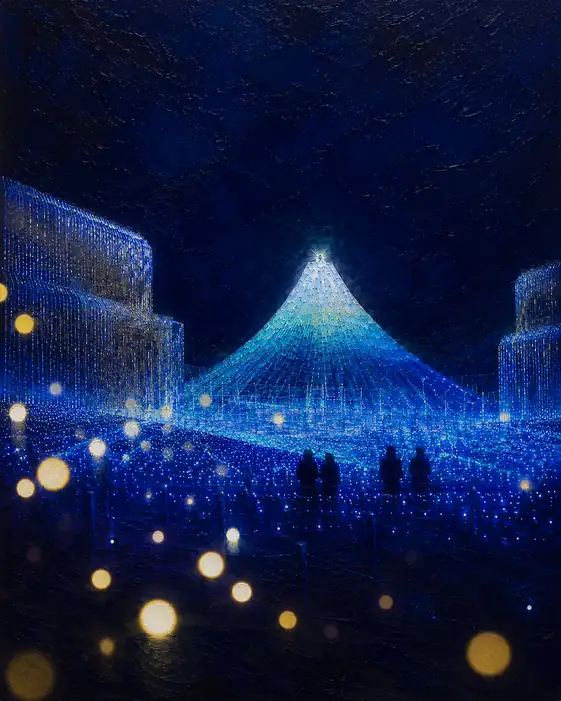 Midnight Blue and Firefly Gleams
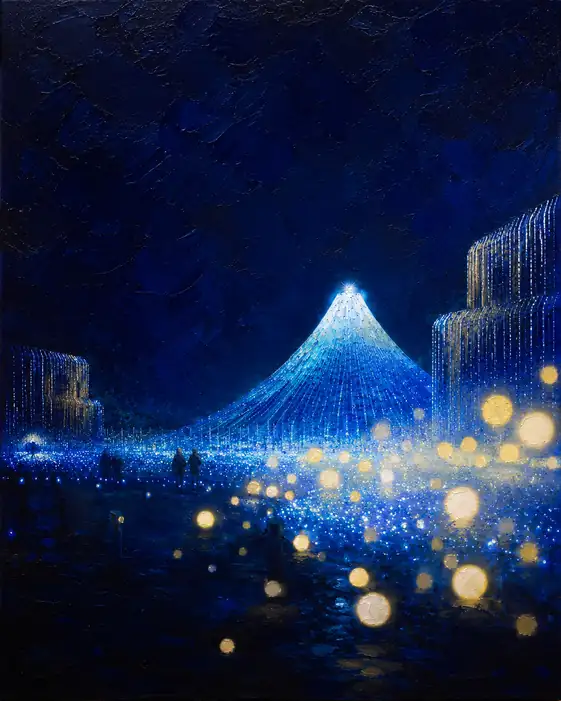 Cascade of Stars Beneath the Peak
 Moonlit Light Path and Sacred Tower
 Burst of Light Before the Blue Peak
 Luminous Mountain and Drifting Orbs
 Walking Through the Village Where Lights Bloom
 Blue Nocturne and Glowing Specks
 Sapphire Realm and the Mountain of Light
 Crimson Mountain and Golden Bokeh
 Winding Pathway to the Azure Beacon