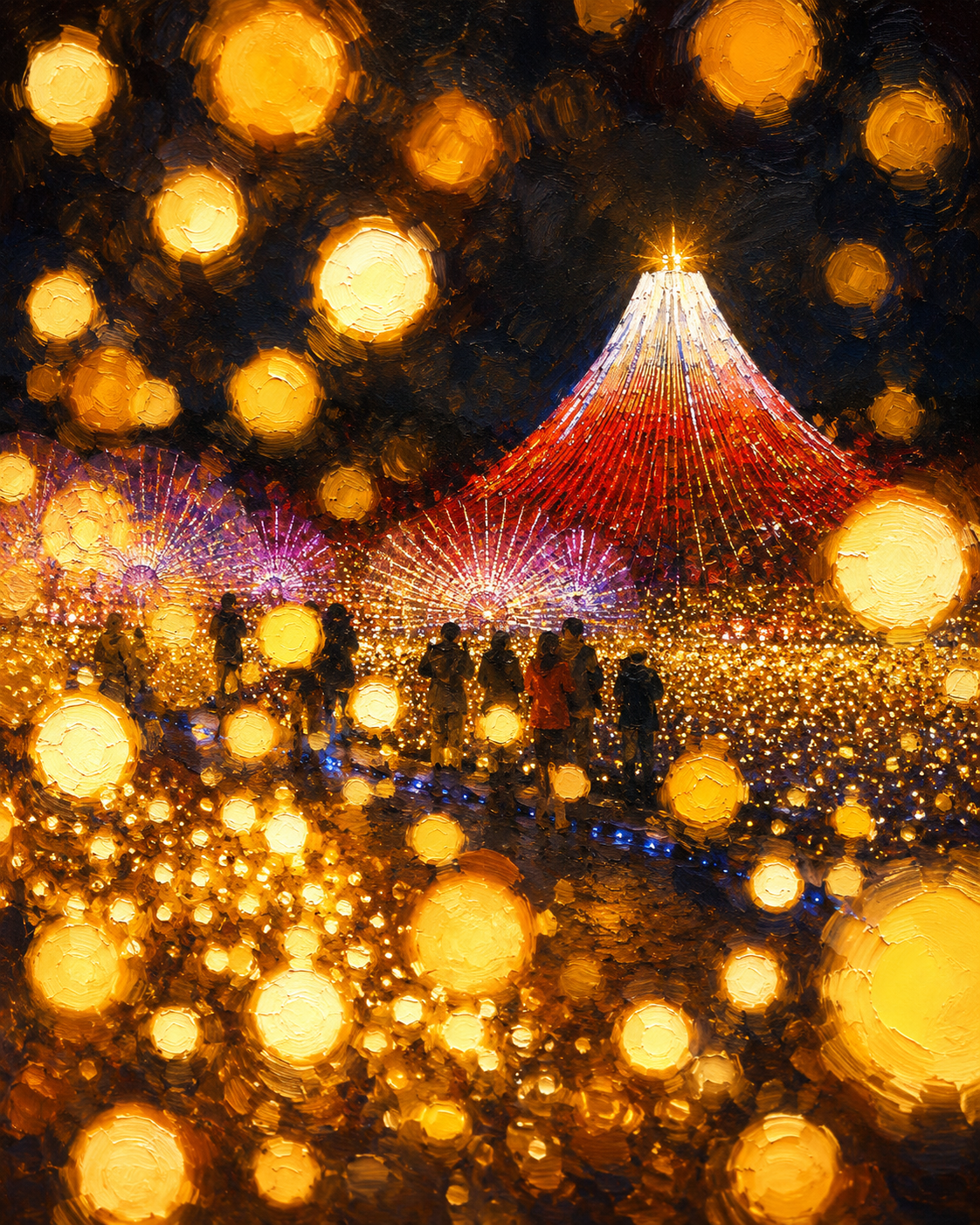
Crimson Mountain and Golden Bokeh
Critique
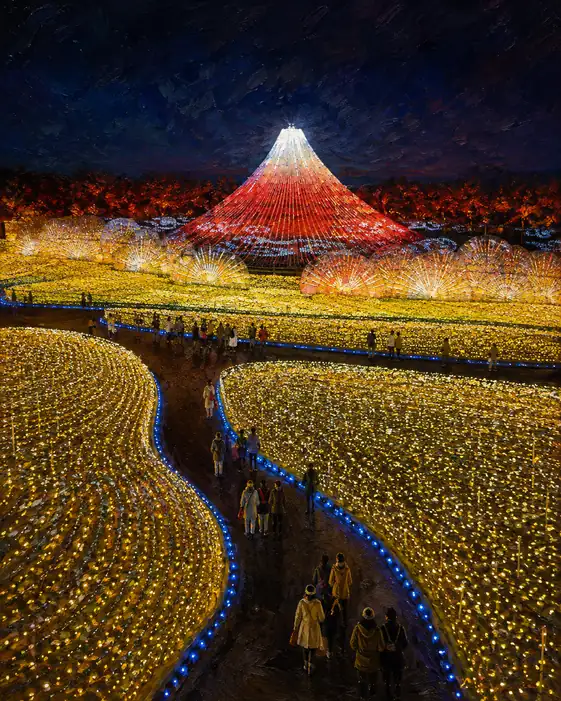
Introduction This nocturnal scene turns a public spectacle into an enveloping field of light. The image amplifies its radiance until viewers seem to stand inside a constellation. Its achievement is uniting festive grandeur with shared wonder. Description A red-and-white mountain of lights rises in the upper right, crowned by a small star. Fan-shaped displays flare along its base, while visitors gather as dark silhouettes across a narrow central path. Large amber orbs float throughout the foreground and sky, surrounded by countless smaller golden points. Dense black and brown passages hold the glowing forms together. Analysis The mountain supplies a clear diagonal ascent, but the scattered circles continually interrupt that directional pull. Their varied sizes create exaggerated depth: huge cropped globes sit close to the picture plane, while tiny sparks recede toward the crowd. Warm orange dominates, set against blue-black shadows and occasional violet or blue accents. Thick, circular brushwork gives each orb a tangible, almost molten surface. Interpretation and Evaluation The floating lights can be read as memories, wishes, or moments of attention made visible. Human figures are small yet essential; their stillness establishes scale and converts visual excess into communal experience. The near-total saturation of gold risks flattening the spatial hierarchy, but the dark path and silhouetted bodies restore enough structure. Particularly effective is the tension between the mountain's ordered strands and the orbs' dreamlike dispersal. Conclusion The painting succeeds through abundance disciplined by a luminous landmark. Tactile handling prevents the spectacle from feeling mechanical, while visitors provide emotional entry. Celebratory and contemplative, it presents illumination as an atmosphere people inhabit together rather than an object observed.
Same Subcategory
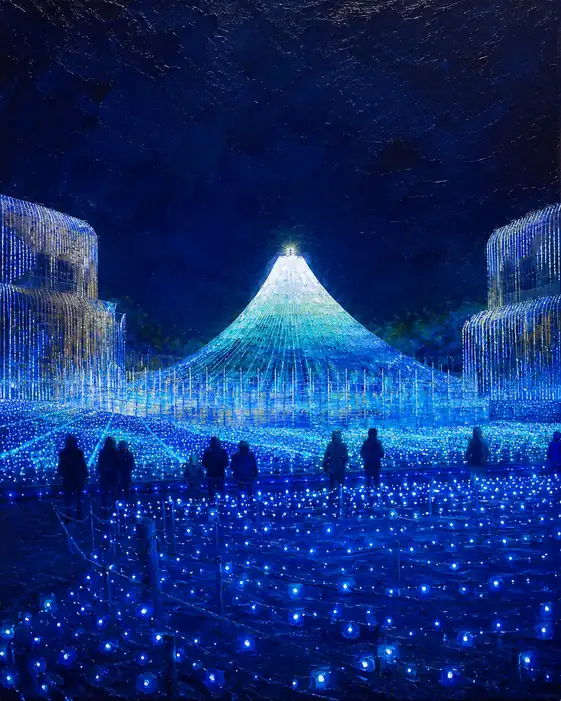 Sapphire Realm and the Mountain of Light
Similar Artworks
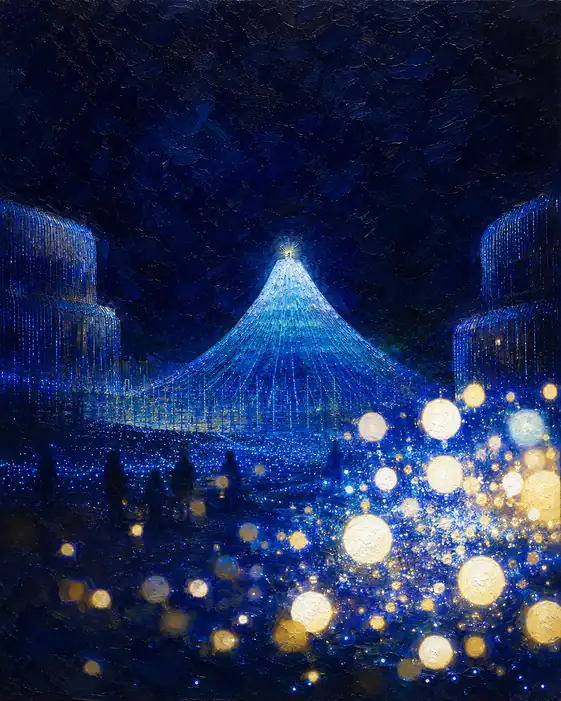 Burst of Light Before the Blue Peak
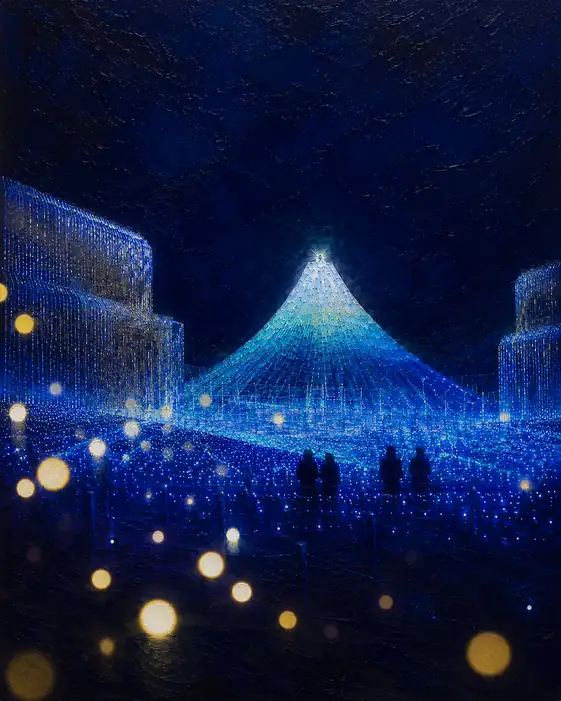 Midnight Blue and Firefly Gleams
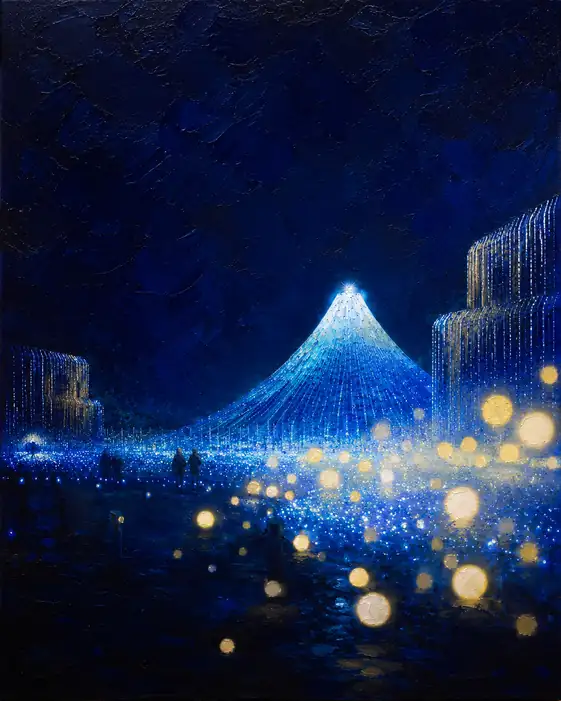 Cascade of Stars Beneath the Peak
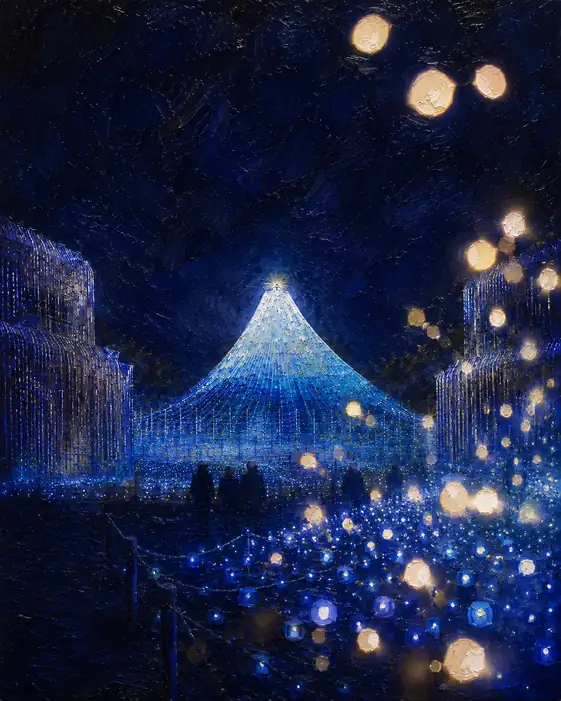 Moonlit Light Path and Sacred Tower
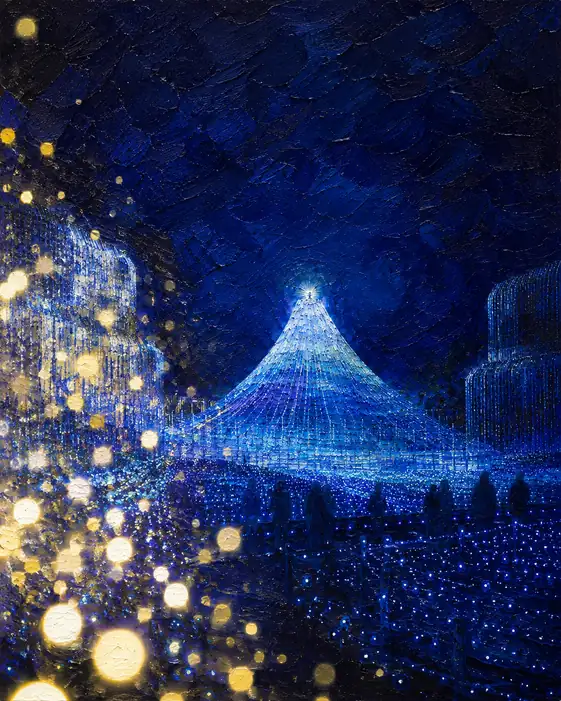 Luminous Mountain and Drifting Orbs
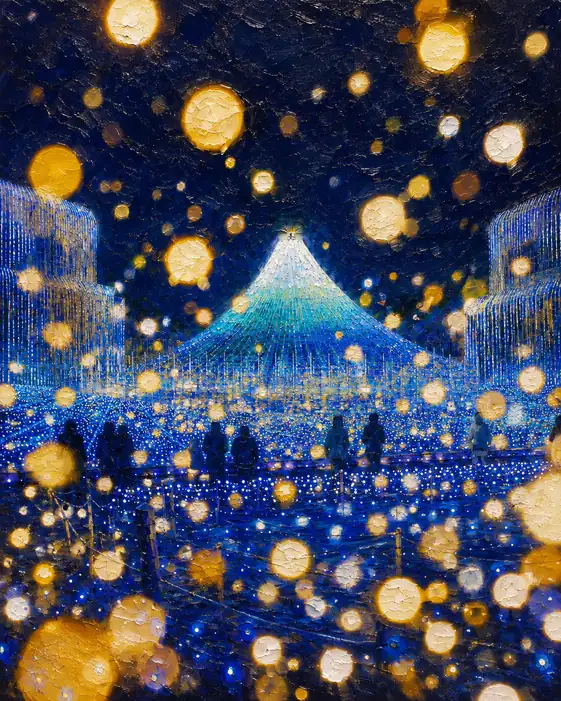 Golden Orbs Above the Blue Sea
 Golden Pathway to the Red Peak
 Prismatic Radiance on Winter Night
 Rainbow Meadow and the Sapphire Peak
 Violet Arches and the Luminous Mountain