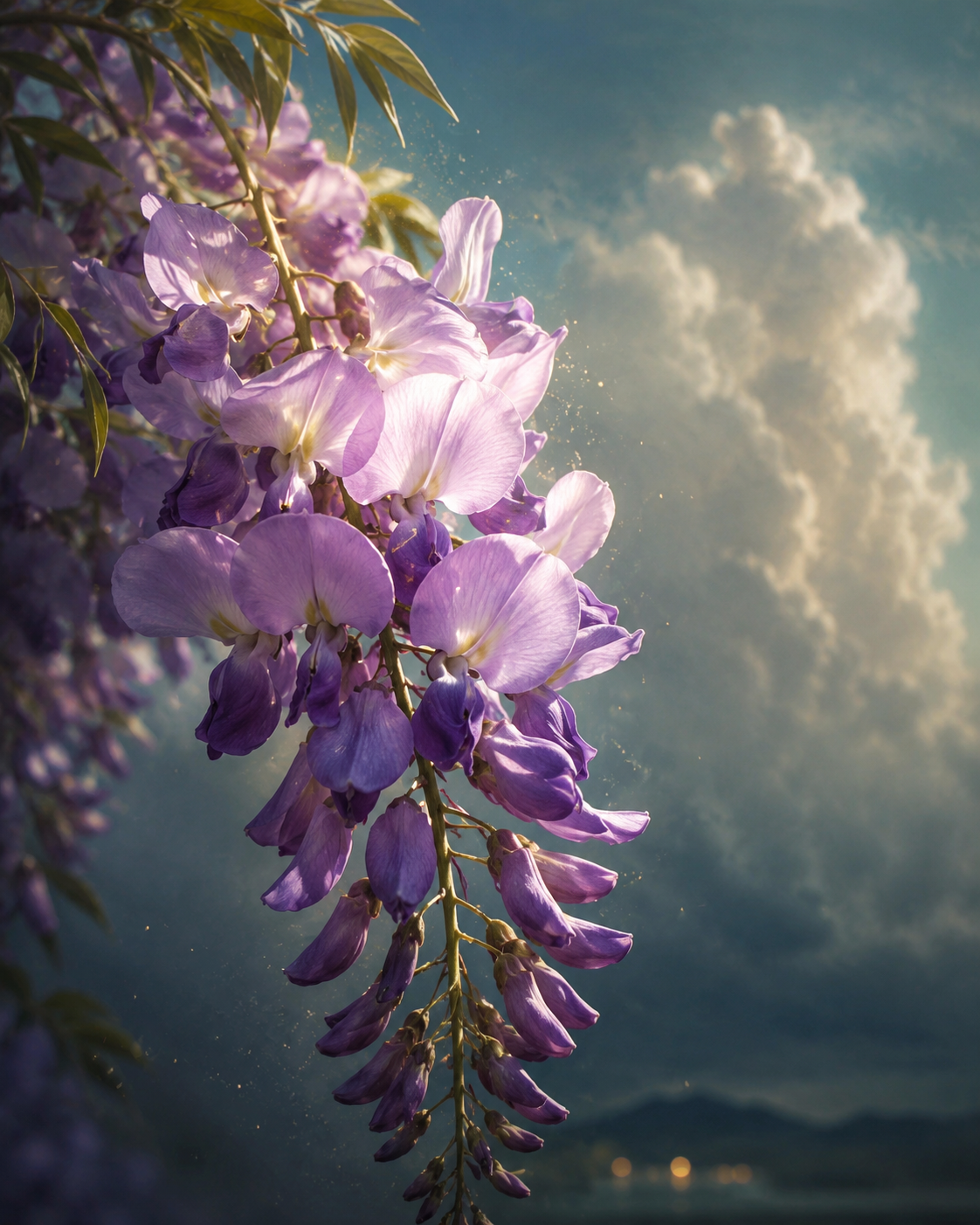
Wisteria Rising to Meet the Summer Cloud
Critique
Introduction This landscape places wisteria before a cream cloud and blue-green sky. The flower fills the left and center, while cloud, mountain, and shore lights open atmospheric distance behind it. Description The main raceme descends from leafy branches at upper left. Broad pale petals face forward around the upper half, then give way to darker curved buds along a thinning green stem. Fine droplets or spray sparkle around the flower in backlight. At right, a tall cumulus cloud rises with bright warm edges and a gray interior. A dark mountain crosses the bottom, where several small amber lights sit near the waterline. Analysis Flower and cloud form two vertical masses of different substance: the raceme is articulated by petals and joints, while the cloud is modeled as a soft continuous volume. Open teal sky separates them. Light passes through the upper petals, exposing violet veins and cream bases; lower buds retain dense purple shadows. The tapering stem directs attention toward the distant lights. Warm cream and amber counter cool lavender and blue, while scattered droplets bridge foreground detail and atmospheric brightness. Interpretation and Evaluation The close flower and rising cloud both register change, but on different scales and in different materials. Their parallel forms make transient growth comparable to moving weather. Drawing is convincing in the alternation of open petals and buds, and cloud modeling preserves volume without hard outlines. The asymmetrical pairing, small points of spray, and restrained mountain base give the scene technical clarity and originality. Conclusion Wisteria dominates first, but viewing makes the cloud equally active. Paired verticals, luminous moisture, and layered distance link one raceme to the circulation of air and water.
Same Subcategory
Similar Artworks
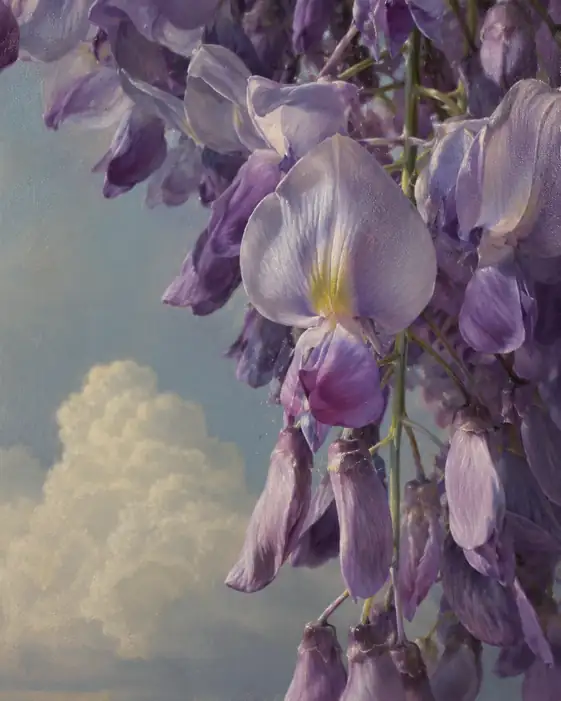 Cloud and Petal in Summer Sunlight
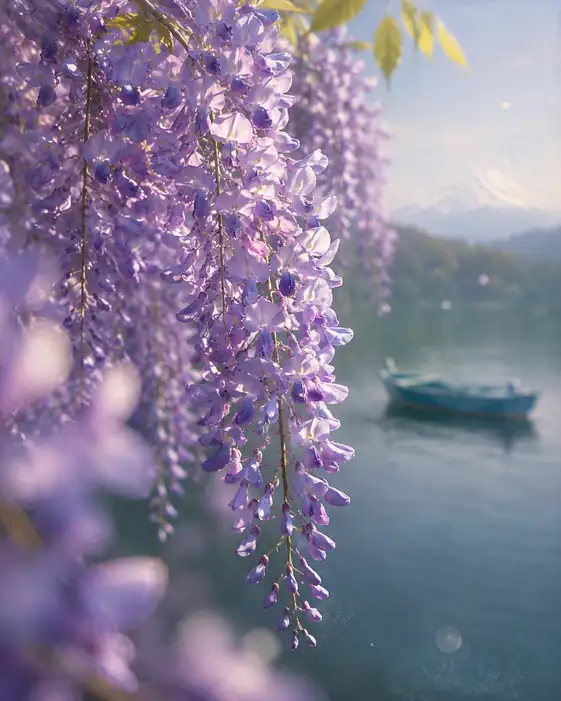 Serene Summit Beyond the Wisteria Bower
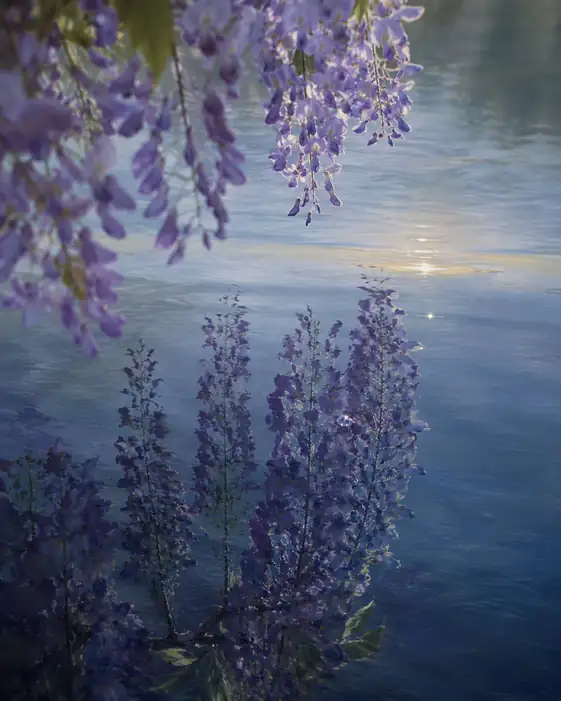 Wisteria Reflected in the Quiet Pool
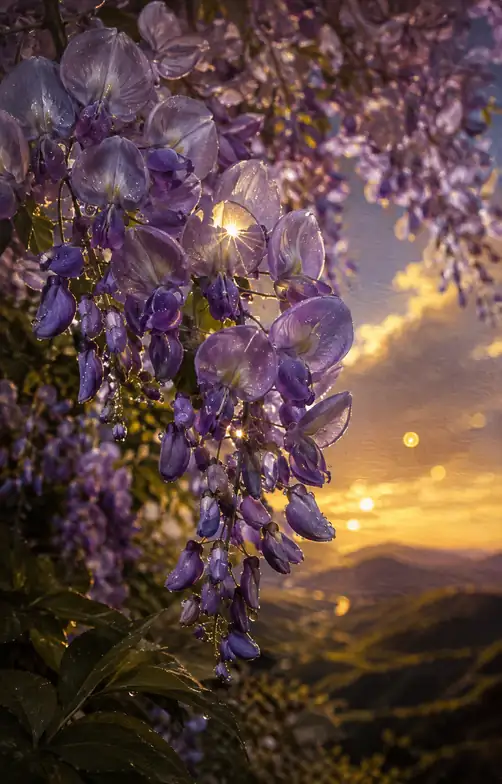 Sunburst Through Wet Wisteria Petals
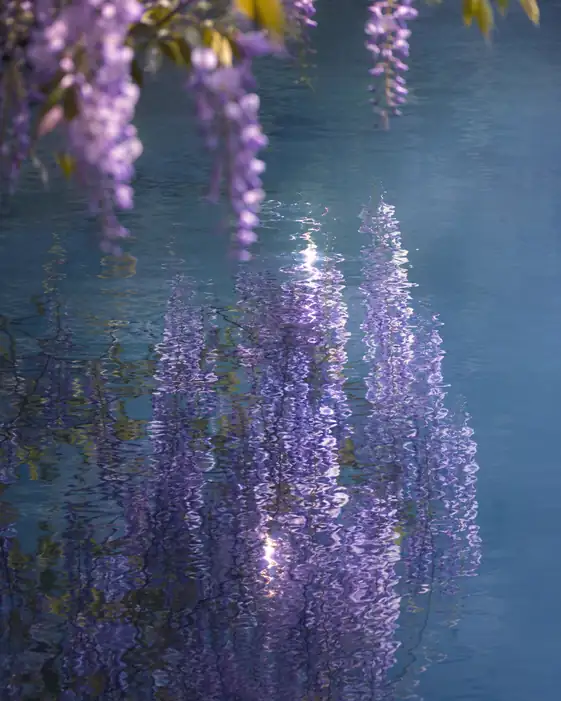 Ripples of Violet Across the Water
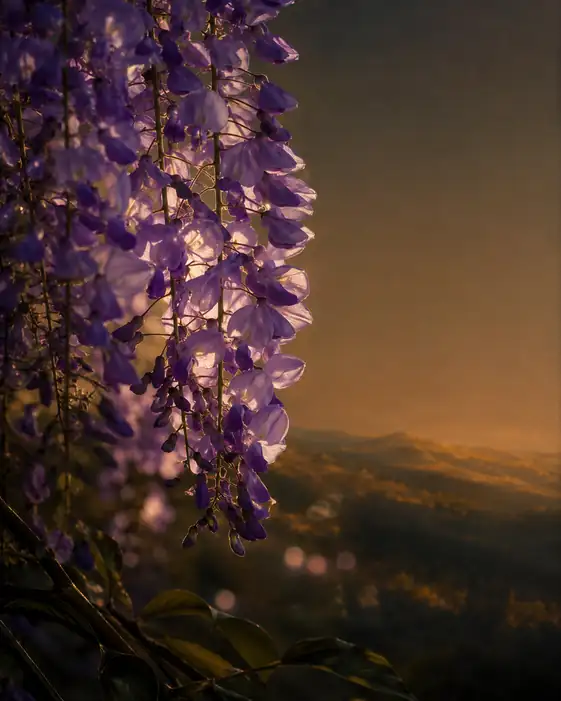 Amber Horizon and Falling Wisteria
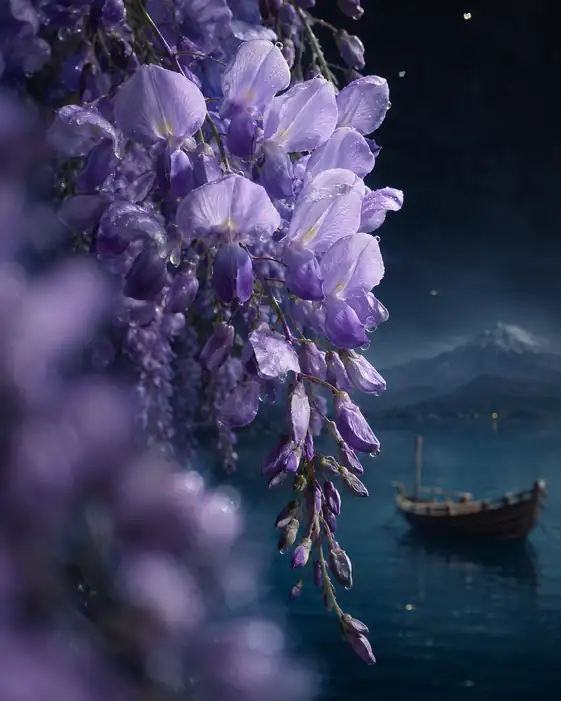 Night Lake Framed in Falling Wisteria
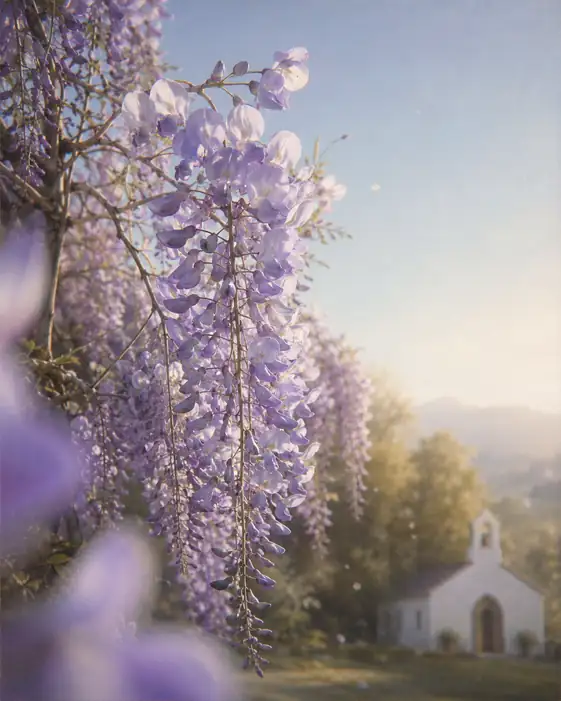 White Chapel Framed in Wisteria
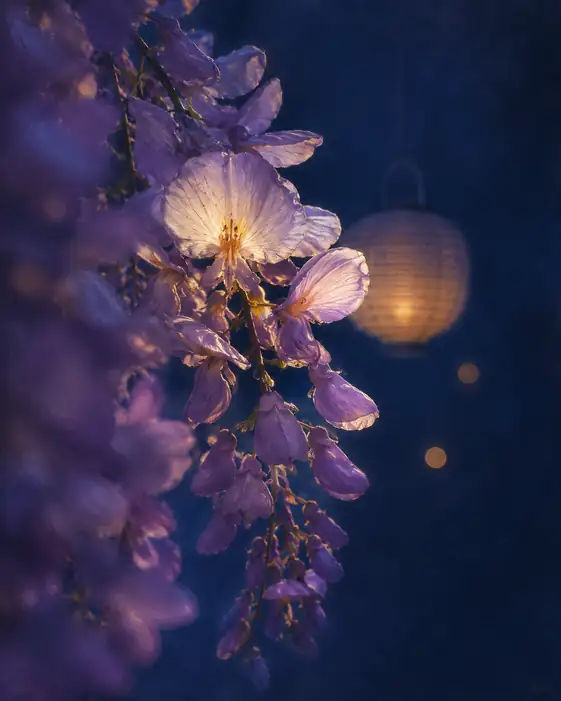 Amber Lantern Beside the Falling Wisteria
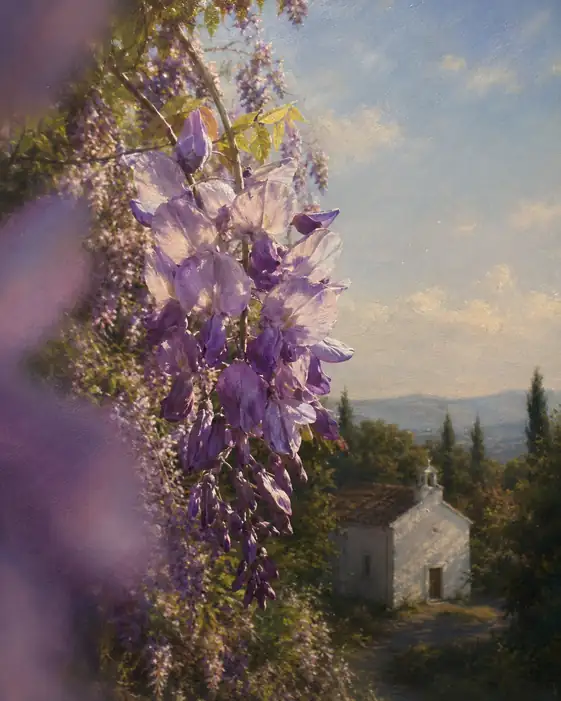 Golden Light Across Wisteria and Stone