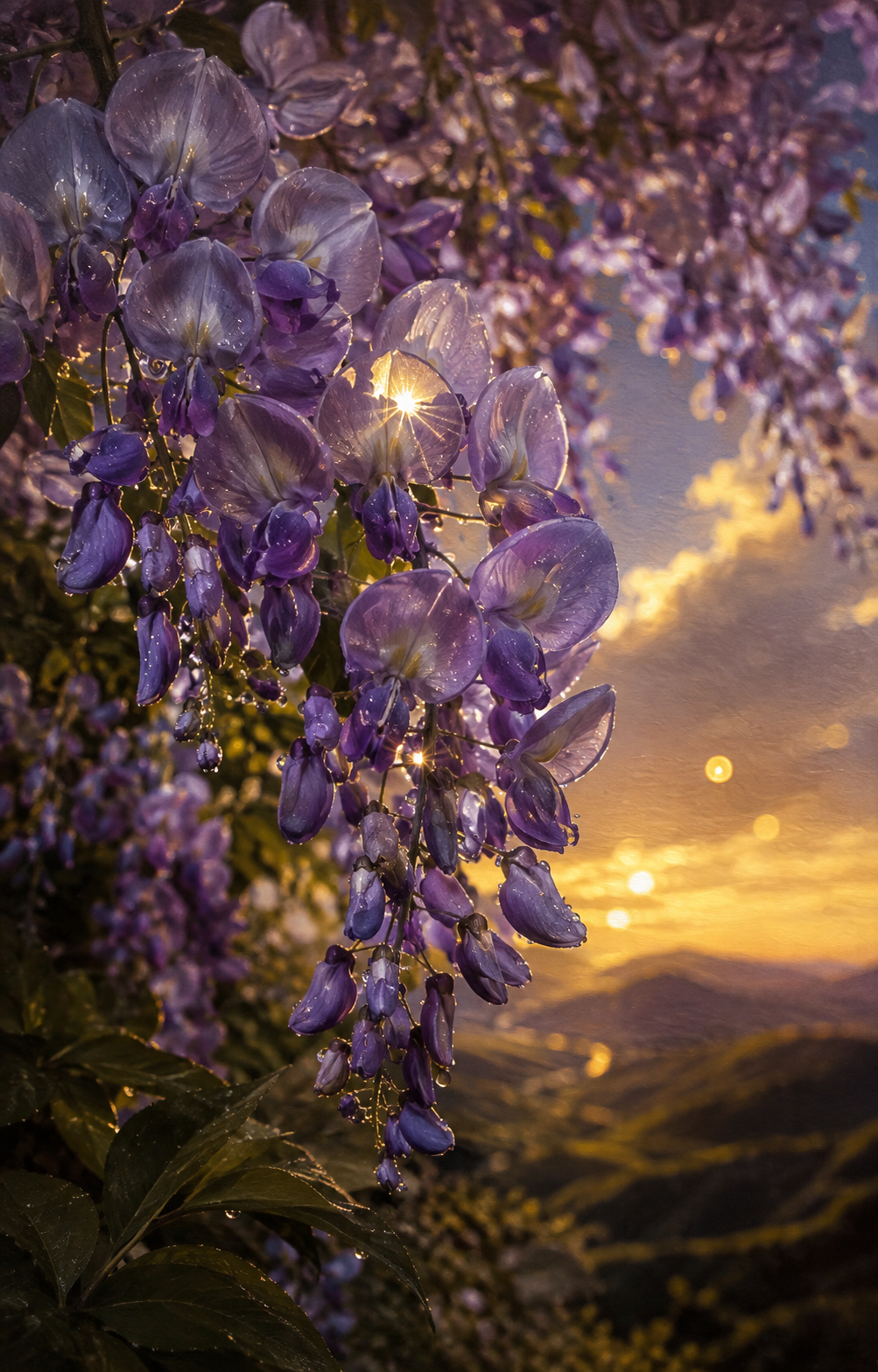
Sunburst Through Wet Wisteria Petals
Critique
Introduction This landscape places wet wisteria against a mountain sunset. A starburst passes through one petal, making moisture, plant surface, and evening light the composition’s defining event. Description Large lavender flowers and dark buds fill the left and center, descending in a heavy raceme above glossy green leaves. Droplets bead along petals, stems, and leaf edges. Near the upper-middle cluster, the sun appears as a small star within a pale petal; a second star-like flash occurs lower down. At right, gold cloud bands cross a warm gray sky above softened dark hills and a valley dotted with circular lights. Analysis The dense floral mass forms a descending diagonal balanced by the open luminous sky. Backlight separates each wet edge with gold and reveals veins inside the broad petals, while lower buds remain saturated violet. Dark leaves anchor the foreground. The sun’s starburst is both light source and focal detail, echoed by droplets and distant bokeh. Violet and yellow-orange create a complementary structure. Sharp foreground texture gives way to atmospheric hills, producing deep spatial layering. Interpretation and Evaluation The flower does not merely stand before sunset; it briefly filters the sun and becomes part of the illumination. Water records a preceding change in weather, while the clearing horizon suggests transition. Petal translucency, droplet placement, and layered foliage are convincingly drawn. Strong color opposition, selective glare, and the diagonal opening toward the valley demonstrate technical control and originality without losing the natural weight of the raceme. Conclusion Star-shaped light commands attention first, but viewing reveals every wet edge redistributing the sunset. Moisture, complementary color, and layered distance make one sun an event shared by flower and landscape.
Same Subcategory
Similar Artworks
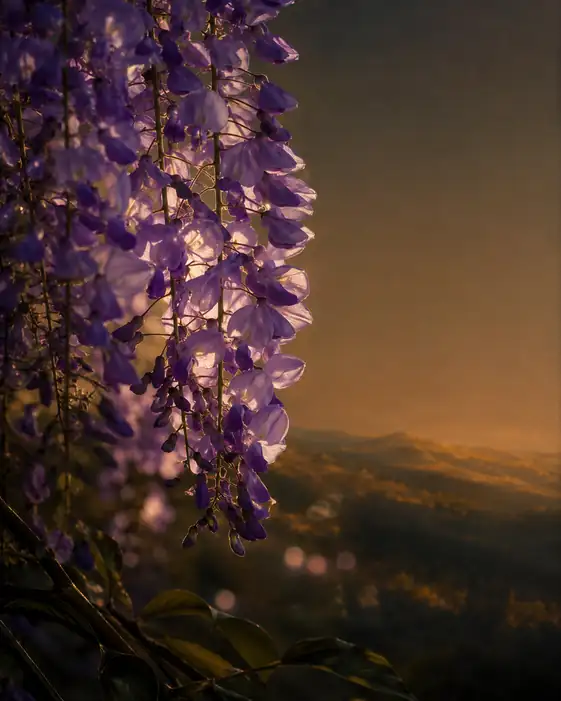 Amber Horizon and Falling Wisteria
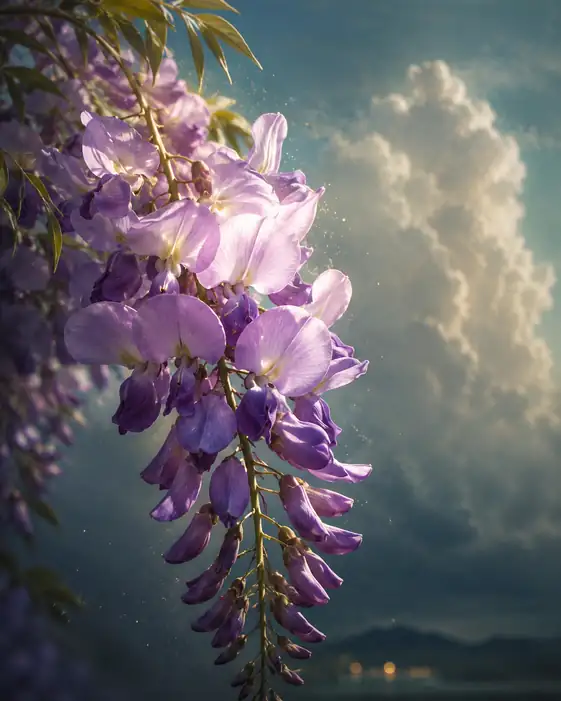 Wisteria Rising to Meet the Summer Cloud
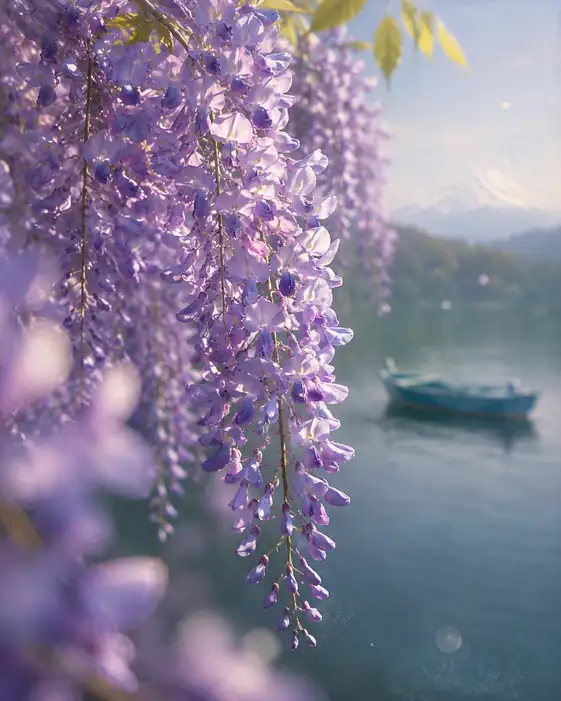 Serene Summit Beyond the Wisteria Bower
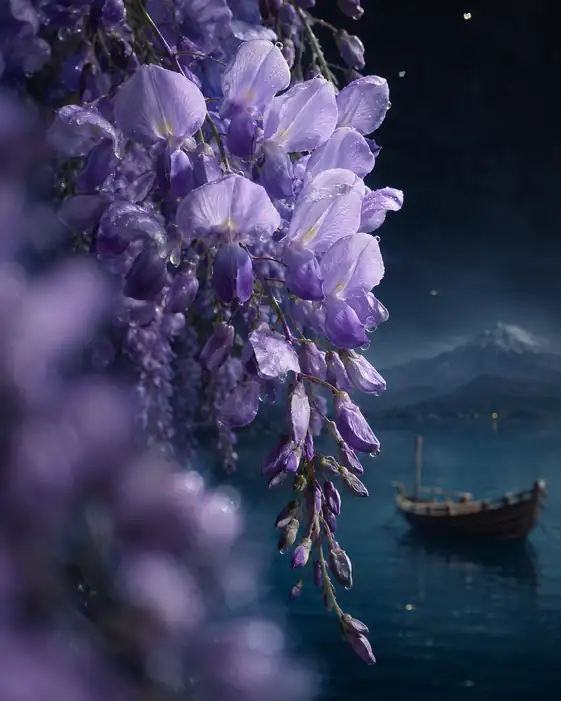 Night Lake Framed in Falling Wisteria
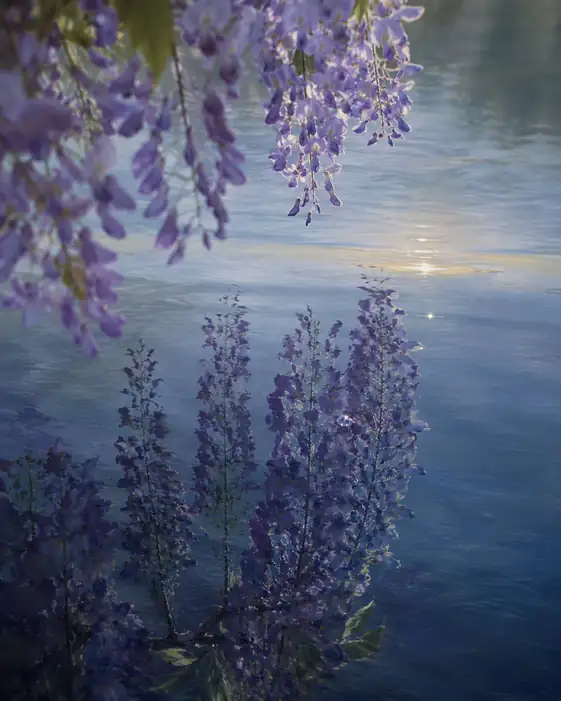 Wisteria Reflected in the Quiet Pool
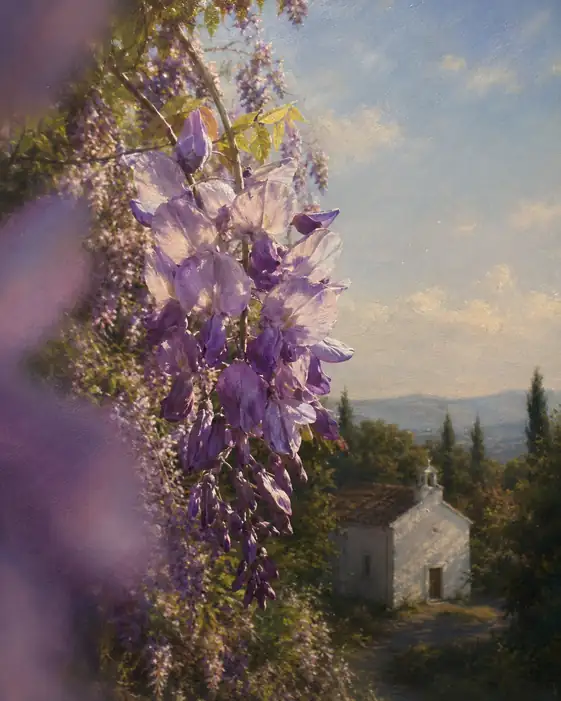 Golden Light Across Wisteria and Stone
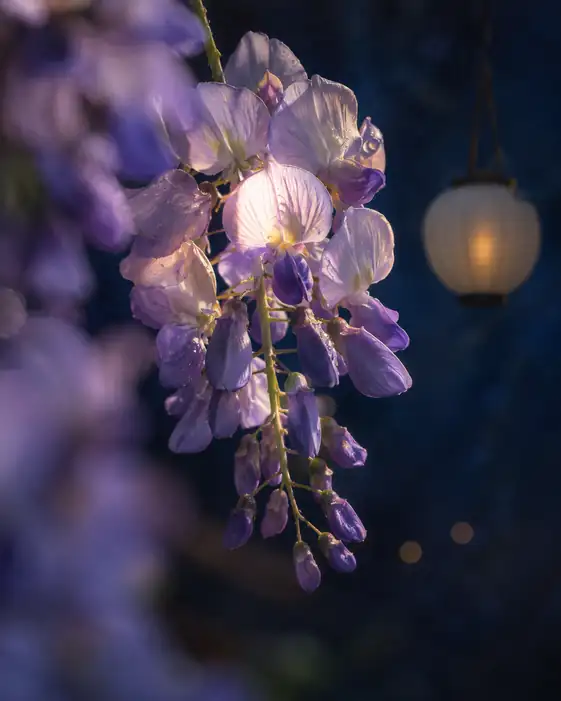 Solitary Wisteria Beneath the Night Lamp
 Amber Lantern Beside the Falling Wisteria
 Morning Tea and Gentle Slumber
 Ripples of Violet Across the Water