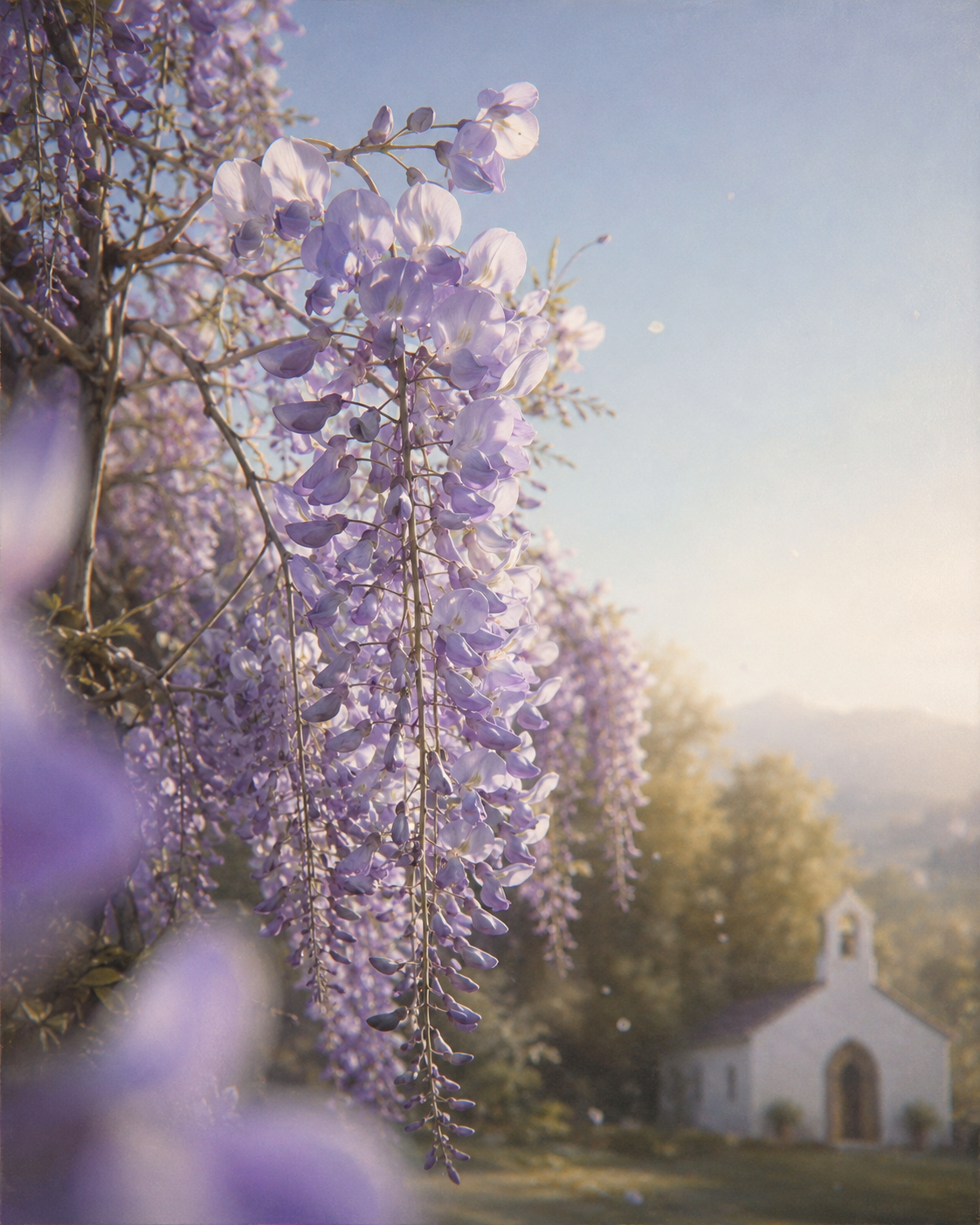
White Chapel Framed in Wisteria
Critique
Introduction This landscape places lavender wisteria in the foreground and a white chapel in sunlit distance. Flowers occupy the left, while blue sky and haze separate intimate growth from a communal landmark. Description Several racemes hang from woody branches at upper left, their open pale petals and darker buds forming long tapering chains. The nearest cluster descends through the center and remains sharply legible. Blurred purple flowers frame the lower left. At lower right, a simple chapel with a small bell opening, pitched roof, and dark arched doorway stands among green-gold trees. Bright sky fills the upper right, and a few loose petals drift across it. Analysis The floral chains establish repeated verticals that contrast with the chapel’s compact triangular roof and rectangular facade. Sharp lavender forms advance against softened trees and building, creating depth through focus and scale. Cool violet and blue dominate the upper field, while golden vegetation warms the horizon. The large sky functions as a luminous pause between flower and architecture. Curving branches lead outward, whereas the longest raceme directs the eye down toward the chapel. Interpretation and Evaluation The chapel is not framed rigidly but discovered beyond the flowering canopy, suggesting a place reached through seasonal experience. Detailed petals, buds, and branching stems demonstrate careful drawing; atmospheric softness keeps the distant structure subordinate yet recognizable. The color transition from lavender to gold is harmonious, and the asymmetrical composition remains balanced through the building’s clear silhouette. Floating petals add measured time and originality. Conclusion Wisteria defines the scene first, but viewing reveals the chapel as the destination of its downward rhythm. Layered focus, luminous space, and restrained color join flowering with a place of gathering.
Same Subcategory
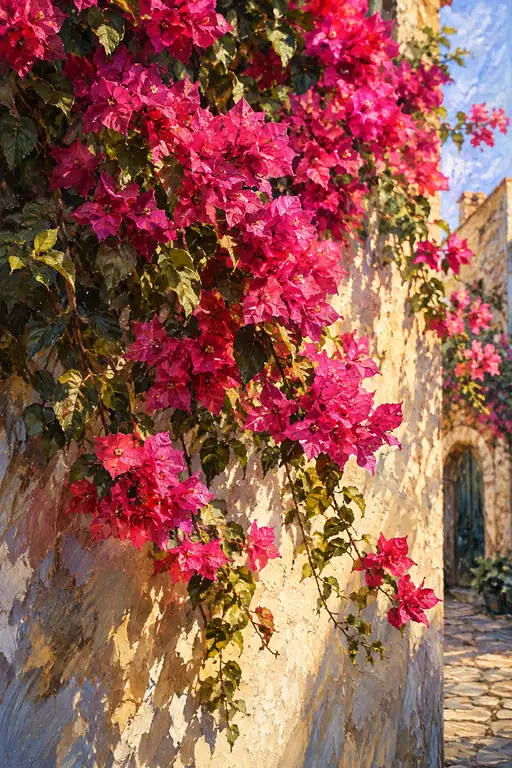 Cascade of Magenta Along the White Alley
Similar Artworks
 Serene Summit Beyond the Wisteria Bower
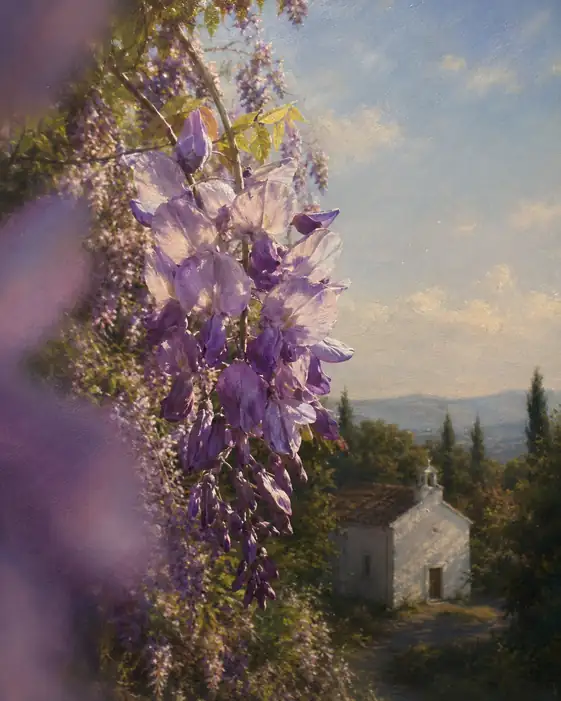 Golden Light Across Wisteria and Stone
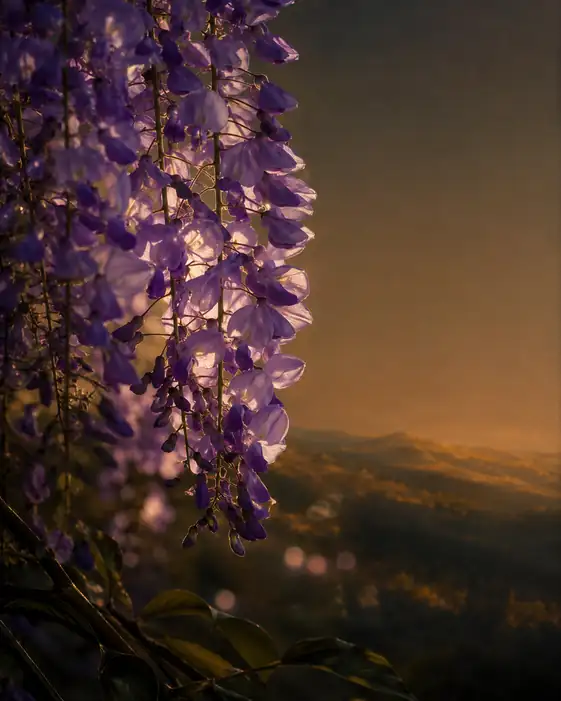 Amber Horizon and Falling Wisteria
 Wisteria Rising to Meet the Summer Cloud
 Wisteria Reflected in the Quiet Pool
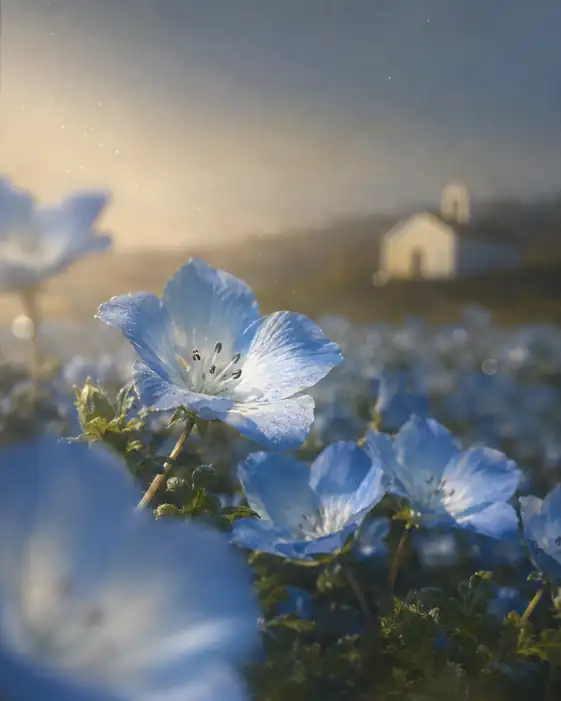 Morning Church in Field of Nemophila
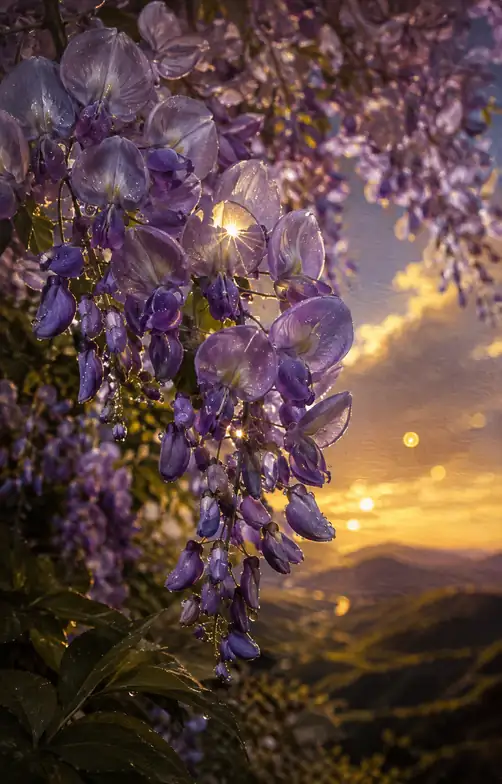 Sunburst Through Wet Wisteria Petals
 Ripples of Violet Across the Water
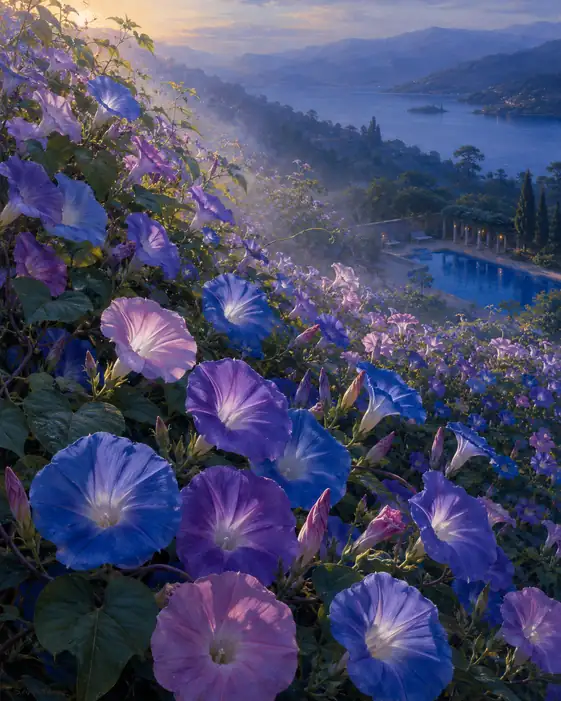 Morning Glories above the Sunlit Coast
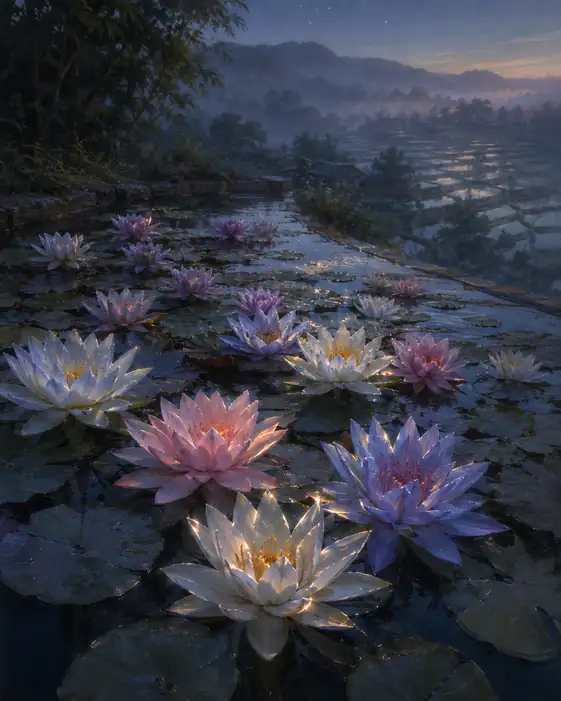 Terraces of Morning Mist and Floating Petals