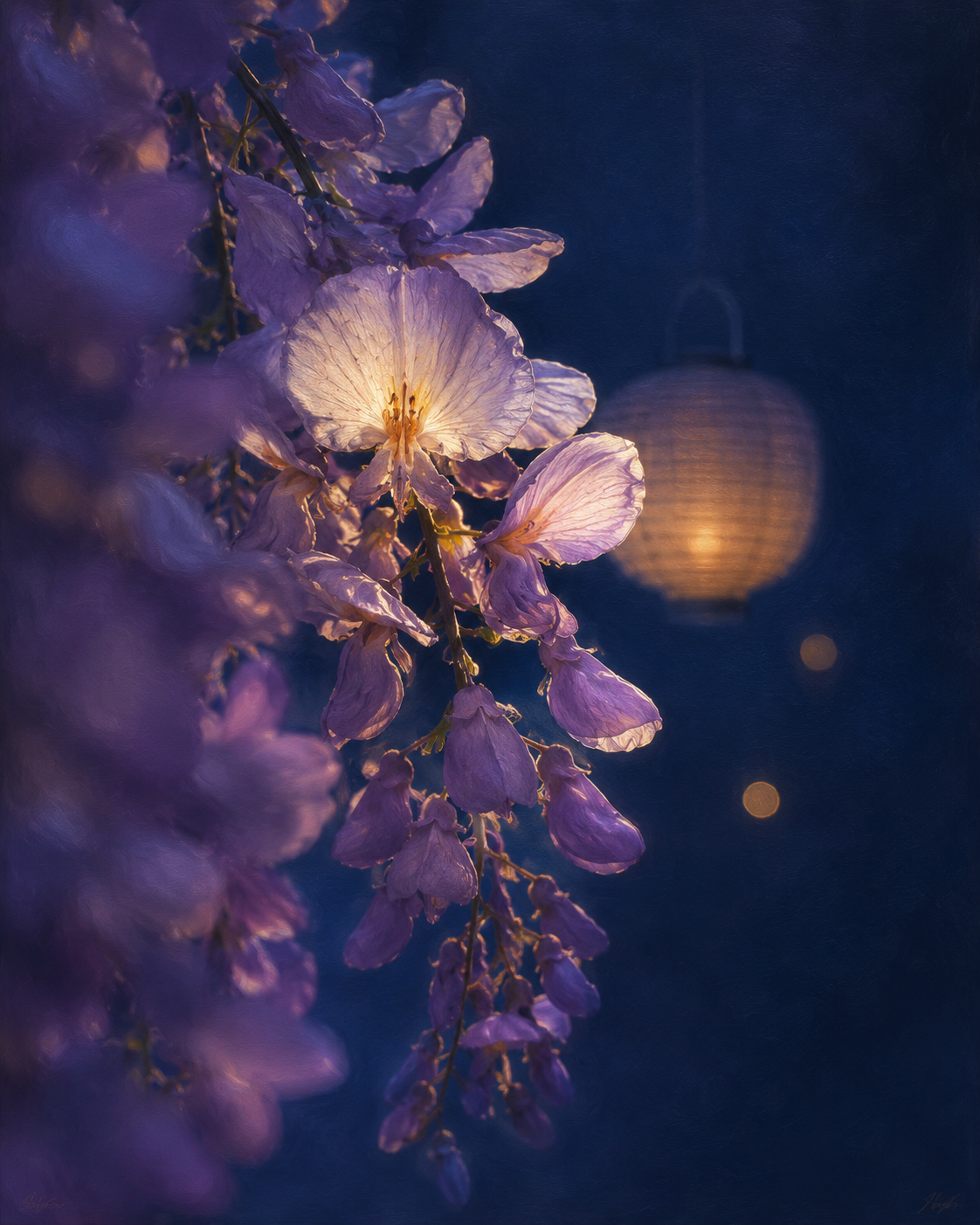
Amber Lantern Beside the Falling Wisteria
Critique
Introduction This painting places hanging wisteria before deep blue night and a glowing paper lantern. The flower remains primary, while the soft amber circle supplies a second center and atmosphere. Description Wisteria descends from the upper left through the middle, with one broad open flower facing forward near the upper center. Its pale membrane glows around golden stamens, while smaller lavender petals and dark buds continue downward. Large blurred flower masses frame the left edge. At right, a round ribbed lantern hangs out of focus and contains a concentrated amber light. Two smaller golden circles punctuate the lower-right darkness. Analysis The floral stem creates a vertical curve balanced by the lantern’s stable circle. Backlight passes through the main petal, revealing branching veins and warm edges; lower buds remain comparatively opaque. Violet and ultramarine establish a cool field, while amber illumination forms a complementary accent. The central flower and lantern nearly align horizontally, but the intervening dark gap preserves depth. Strong focus contrast separates tactile petals from the broad, woven-looking lantern blur. Interpretation and Evaluation The lantern does not simply illuminate the flower; its warmth appears to be absorbed and redistributed through the translucent petals. Precise veins, curled margins, and varied bud positions demonstrate close drawing, while restraint in the background prevents visual competition. The limited palette, bold negative space, and paired circular forms create an original nocturnal composition. Controlled backlighting gives the blossom volume without losing delicacy. Conclusion The flower seems independent first, but viewing reveals an exchange between translucency and constructed light. Cool darkness, warm counterpoint, and descending rhythm make night bind flower and lantern.
Same Subcategory
 A Camellia Holds the Snow Village in Every Drop
Similar Artworks
 Solitary Wisteria Beneath the Night Lamp
 Layered Canopies in the Midnight Blue
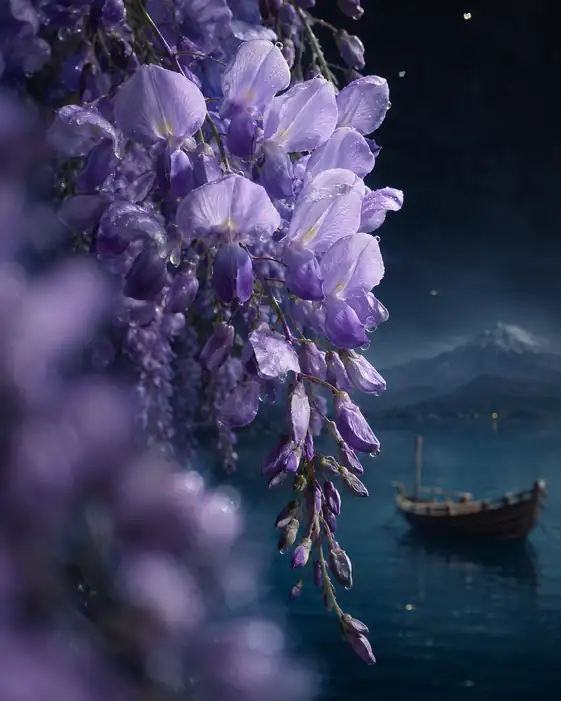 Night Lake Framed in Falling Wisteria
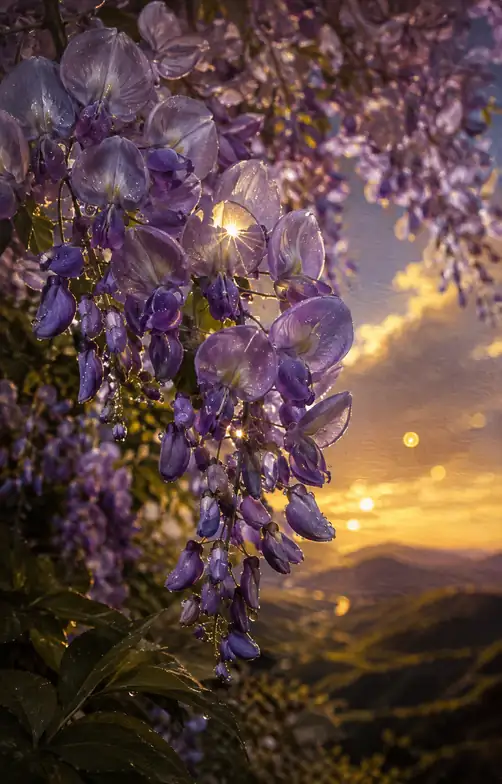 Sunburst Through Wet Wisteria Petals
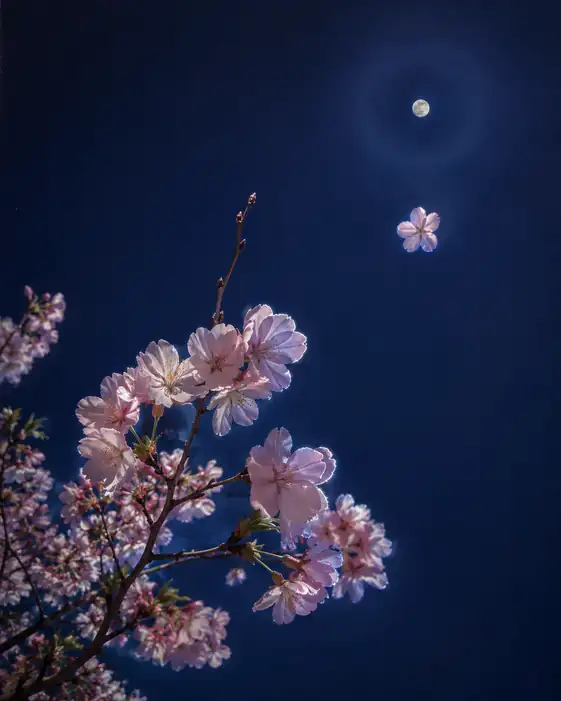 Slender Twigs Reaching for the Moon
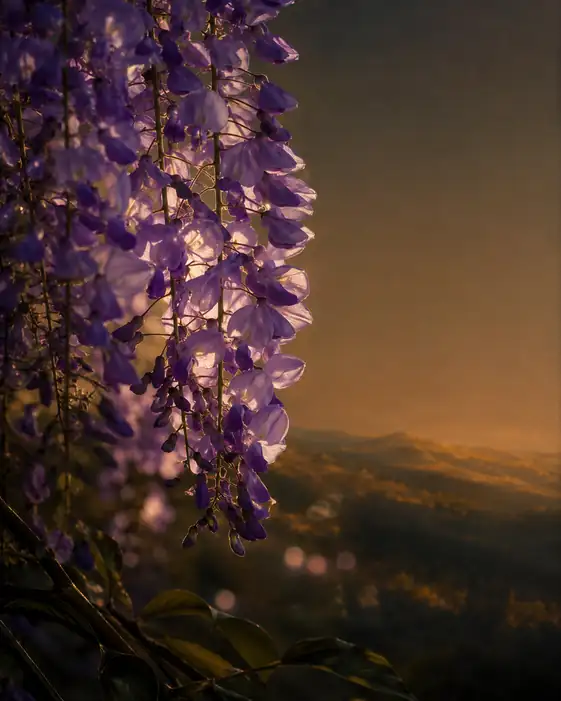 Amber Horizon and Falling Wisteria
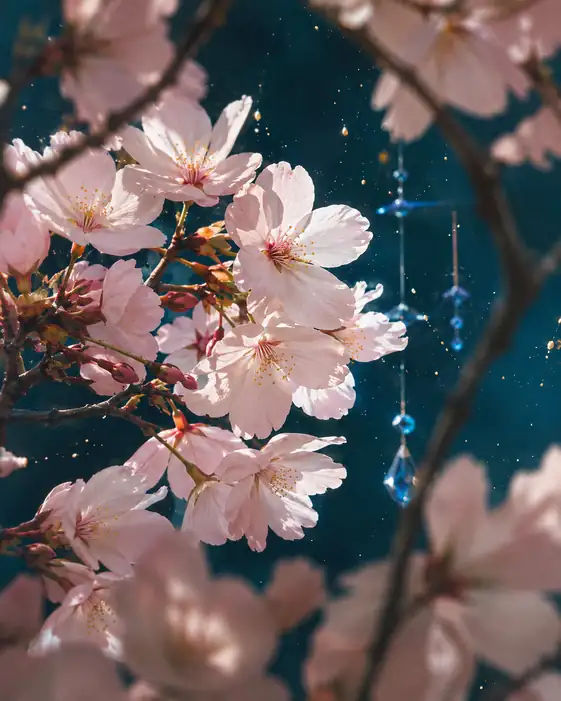 Prismatic Sunlight in the Azure Shadow
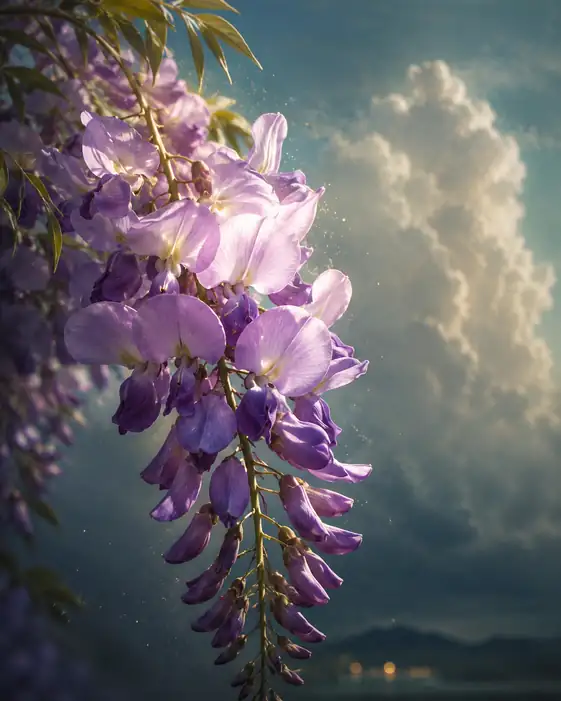 Wisteria Rising to Meet the Summer Cloud
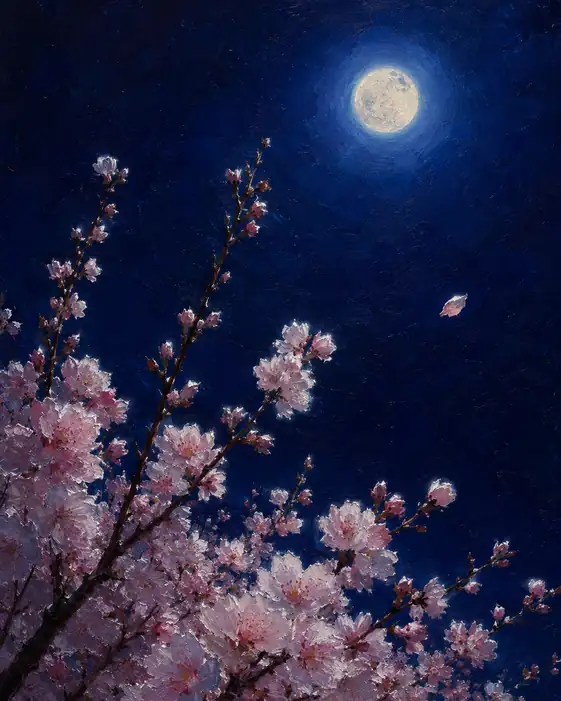 Full Moon in the High Azure Night
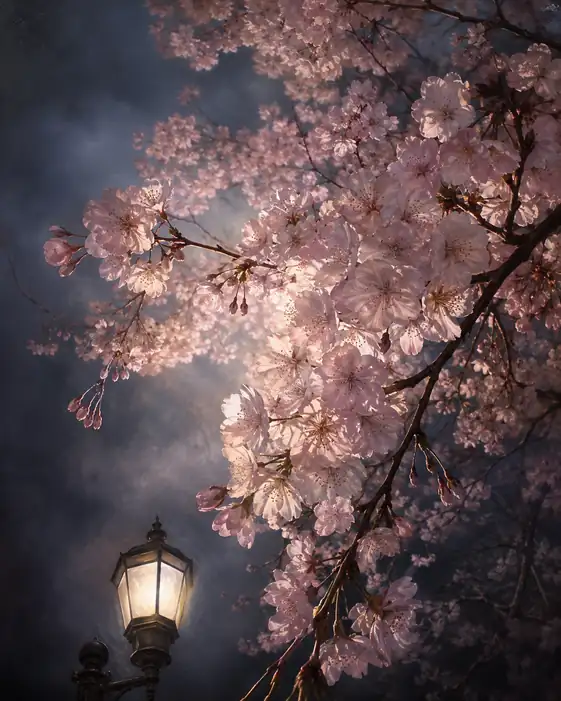 Gaslight Glowing in the Cherry Night